Developing a custom battery pack involves much more than selecting cells and connecting them to a battery management system. The battery also has to fit within the product, accommodate electronics and wiring, meet mechanical requirements, provide access to connectors, and ultimately work within the OEM’s finished assembly.
That is where 3D modeling for 3D printing can become an important part of battery development.
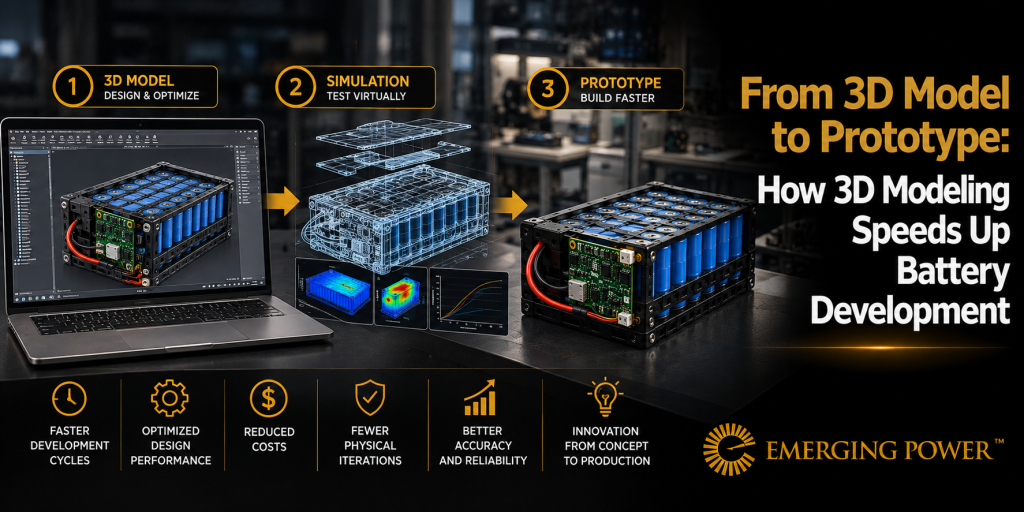
Instead of waiting until production tooling is created to discover a mechanical issue, engineers can develop a digital 3D model, convert that design into a physical prototype, evaluate the result, make changes, and print another version.
This iterative approach can help identify mechanical and integration issues earlier in the development process and complements a structured custom battery pack design workflow.
For OEMs developing custom battery-powered products, moving efficiently from 3D model to physical prototype can reduce unnecessary design iterations later in the project and provide engineers with something they can physically inspect before committing to production.
3D modeling is the process of creating a digital representation of a physical component using computer-aided design (CAD) software.
For battery development, a 3D model may represent:
Once the model is ready, the digital design can be prepared for additive manufacturing, commonly known as 3D printing.
Unlike traditional subtractive manufacturing, where material is removed from a larger piece, additive manufacturing generally builds a component layer by layer according to digital design data.
According to the National Institute of Standards and Technology’s guide to additive manufacturing and 3D printing, additive manufacturing can support rapid prototyping, faster design iteration, customization, and the production of complex geometries.
For engineers, the important advantage is simple: a digital battery design can become a physical component that can be examined, assembled, measured, and revised.
A battery pack must satisfy both electrical and mechanical requirements.
Engineers may identify an appropriate chemistry, voltage, capacity, discharge rate, and protection system, but the resulting battery still has to work within the physical constraints of the OEM’s product.
That introduces questions such as:
A CAD model gives engineers an opportunity to examine these relationships digitally.
A 3D printed battery prototype takes the process a step further by allowing the design team to evaluate the geometry as a physical object.
That transition from screen to physical prototype can expose practical issues that may be difficult to recognize from drawings alone.
Emerging Power’s smart battery design capabilities include mechanical 3D design for enclosures, turnkey designs, manufacturing fixtures, component drawings, and assembly documentation.
Mechanical constraints should not be an afterthought in custom battery development.
The size and arrangement of cells, electronics, wiring, connectors, enclosure features, and mounting hardware can all influence the final battery configuration.
By developing a 3D model early, engineers can evaluate how these components interact before the design reaches production.
Emerging Power’s 3D printing capabilities can support this transition from digital design to physical prototype as part of the wider engineering process.
Bringing mechanical work into the development process earlier can help reduce the risk of discovering major fit or packaging issues after the design has advanced.
Traditional prototype methods can require machining, fabrication, molds, or dedicated tooling.
For appropriate applications, 3D printing can remove some of those early tooling requirements.
Once a printable model has been prepared, a prototype can be produced directly from the digital design. If engineers identify a problem, they can modify the CAD file and create another version.
The development cycle becomes:
Model → Print → Evaluate → Modify → Reprint
rather than committing immediately to production tooling.
NIST identifies rapid prototyping and design iteration as important benefits of additive manufacturing because manufacturers can bypass some of the lead time and expense associated with tooling during development.
One of the most practical uses of 3D printing in battery development is evaluating form and fit.
A prototype enclosure can help engineering teams determine whether the battery’s physical dimensions work with the intended product.
For example, an OEM may need a battery pack to fit inside a compact industrial device while leaving sufficient space for:
A 3D printed enclosure can provide a physical representation of the proposed geometry.
If the enclosure is too large, a connector is poorly positioned, or installation is difficult, engineers have an opportunity to revise the design before moving further into manufacturing.
For projects where enclosure, electronics, chemistry, and certification need to be considered together, Emerging Power’s custom battery pack design checklist provides additional guidance on structuring the development process.
Custom battery applications do not always fit standard rectangular housings.
Medical equipment, military systems, communications devices, instrumentation, industrial products, and portable electronics may impose strict space and packaging requirements.
3D modeling gives engineers greater freedom to investigate:
This is particularly useful when the battery must be designed around an existing product rather than the product being designed around a standard battery.
The result can be a more integrated approach to custom battery pack design.
For applications requiring high energy density and rechargeable power, engineers may also evaluate configurations involving custom lithium-ion battery packs alongside mechanical enclosure requirements.
Production tooling represents a much larger commitment than changing a digital model.
Suppose a prototype reveals that a mounting feature needs to move several millimeters or that a connector opening needs additional clearance.
At the CAD stage, engineers can revise the model and produce another prototype.
If the same problem is discovered only after production tooling has been completed, correcting it may require significantly more rework.
This is one reason rapid prototyping is valuable: its purpose is not simply to make a sample. It creates an opportunity to find and address design issues while the product is still relatively easy to modify.
The broader manufacturing industry uses additive manufacturing for the same reason. The U.S. Department of Energy’s additive manufacturing resources discuss the role of additive manufacturing in advanced production and component development.
Battery projects often involve multiple groups, including:
A shared 3D model gives these groups a common representation of the proposed design.
Instead of relying entirely on written descriptions or two-dimensional drawings, teams can evaluate the geometry and component relationships more directly.
A physical prototype can make communication even easier.
Teams can point to specific features, test how parts interact, and document required changes before the next design iteration.
Although every battery project has different requirements, a 3D-modeling and prototyping workflow may look like this:
The process begins with understanding the product and battery requirements.
These may include:
Mechanical and electrical requirements need to be considered together.
Once the requirements are understood, engineers can begin defining the pack architecture.
This may involve selecting cells, determining cell configuration, planning protection electronics or BMS requirements, and establishing preliminary mechanical dimensions.
Emerging Power’s battery project management process progresses through initial review, preliminary design, design and development, and first articles before production approval.
The battery enclosure and related mechanical components are then modeled digitally.
The model allows engineers to evaluate component positioning and overall geometry before a physical part is created.
The CAD model is converted into a format that can be processed by the selected additive manufacturing system.
The design is digitally divided into layers, and the 3D printer builds the component according to those instructions.
Material and printing-process selection depend on what the prototype is intended to demonstrate.
A prototype designed primarily to verify dimensions may have different requirements from one intended for more extensive mechanical evaluation.
Once printed, engineers can evaluate characteristics such as:
Issues identified during this stage can be documented and returned to the CAD model.
If changes are needed, engineers modify the digital design and create another prototype.
This ability to iterate is one of the most important advantages of combining 3D modeling with rapid prototyping.
Instead of treating the first design as final, engineers can progressively refine the product.
Once the design reaches the required level of maturity, the project can advance toward first articles, testing, customer approval, tooling where required, and eventually production.
This structured approach helps connect prototype development with actual manufacturing rather than treating 3D printing as a standalone activity.
No.
A 3D printed prototype is an engineering tool, not proof that a completed battery system satisfies every performance, safety, environmental, or regulatory requirement.
Depending on the application, additional evaluation may include:
For lithium batteries intended for transportation, relevant products may need to satisfy applicable UN 38.3 safety transportation testing requirements before shipment.
The prototype may help engineers evaluate mechanical design decisions before these later stages, but it should not be treated as a substitute for required design verification or compliance testing.
Emerging Power supports OEM battery development with mechanical, electrical, prototyping, testing, and manufacturing capabilities.
Its mechanical engineering capabilities include 3D design for battery enclosures and related components, while its broader custom battery design services support projects from initial technical review through preliminary design, development, first articles, testing, and production.
For OEMs, this means 3D modeling does not have to operate as an isolated design activity.
It can be incorporated into the larger battery development process alongside:
Learn more about Emerging Power’s 3D printing and prototyping capabilities for custom battery development.
The biggest advantage of 3D modeling for 3D printing in battery development is not simply the ability to print a component.
It is the ability to evaluate and improve a design before making larger manufacturing commitments.
A digital model can be turned into a physical prototype, evaluated, modified, and produced again. That gives engineering teams a practical way to investigate fit, packaging, component placement, assembly, and enclosure design while changes are still relatively easy to make.
For OEMs developing custom battery-powered products, integrating 3D modeling and rapid prototyping into the engineering workflow can create a more efficient path from initial concept to a production-ready battery design.
Need support developing a custom battery pack or prototype?
Emerging Power provides custom battery design, mechanical and electrical engineering, 3D modeling, prototyping, testing support, and manufacturing services for OEM applications.
Request a custom battery design quote to discuss your battery development requirements.
3D modeling for 3D printing is the process of creating a digital three-dimensional CAD model that can be converted into instructions for an additive manufacturing system. The printer then builds the physical component layer by layer.
3D printing can be used during battery development to create prototype enclosures, housings, fixtures, and other mechanical components. These prototypes can help engineers evaluate dimensions, fit, component placement, mounting features, and assembly before moving toward production.
Yes. For suitable components, 3D printing allows engineers to produce prototypes directly from digital models without first creating conventional production tooling. This can make it easier to test and revise early-stage designs.
A prototype enclosure gives engineers a physical representation of the proposed battery design. It can help reveal issues involving fit, connectors, wiring, mounting points, component clearances, and assembly before the final production process is selected.
3D printing can support custom battery pack development by producing prototype mechanical components and helping engineers evaluate custom geometries. The appropriate printing process and material depend on the design requirements and intended purpose of the prototype.
No. A prototype can support design evaluation, but the finished battery may still require electrical, mechanical, thermal, environmental, safety, transportation, and regulatory testing depending on its chemistry, application, and target market.