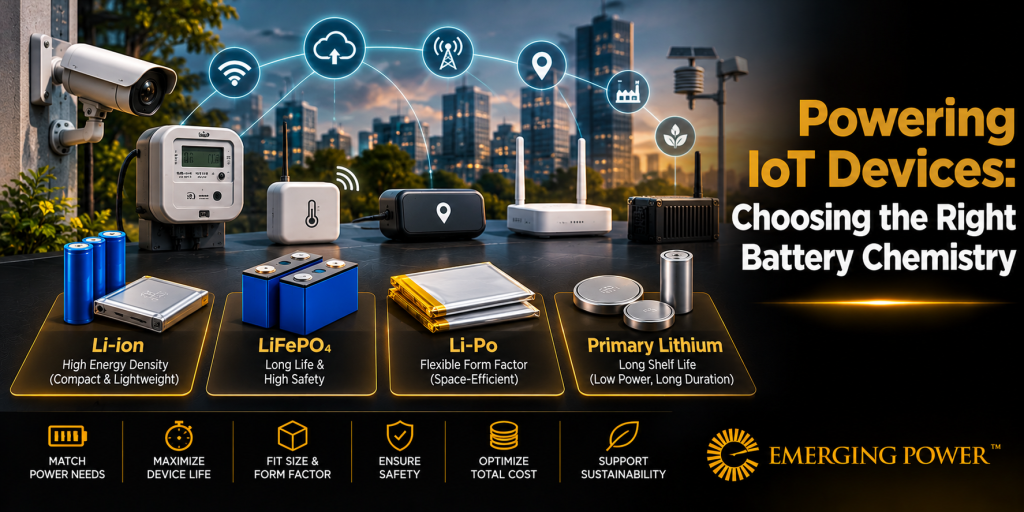
The best battery chemistry for an IoT device depends on how the device actually uses power. A sensor that sleeps for hours and transmits for a few seconds has a very different battery requirement from a rechargeable gateway, handheld reader, or always-connected edge device.
For IoT engineering, chemistry selection should start with the load profile, deployment environment, maintenance plan, wireless protocol, expected service life, and physical constraints. Only then should teams compare lithium primary, lithium-ion, LiFePO4, lithium-polymer, NiMH, or other options.
What Should You Consider When Choosing an IoT Battery?
- Average current during normal operation.
- Peak current during radio transmission, startup, sensing, or actuation.
- Sleep current and wake-up frequency.
- Required service life between battery replacements or charges.
- Operating and storage temperature.
- Available volume and weight.
- Whether the device is rechargeable or maintenance-free.
- Self-discharge and long-term storage behavior.
- Required voltage profile throughout discharge.
- Safety, transportation, regulatory, and field-service requirements.
Why the Load Profile Matters More Than Capacity Alone
An IoT device can have a very low average current but still require short high-current pulses from a cellular, Wi-Fi, LoRa, satellite, or other radio. If the selected cell cannot support those pulses without excessive voltage drop, the device may reset or lose communication even though the battery still has substantial stored energy.
That is why an accurate current-versus-time profile is more useful than a single ‘average current’ figure during battery selection.
Common Battery Chemistries for IoT Devices
Chemistry | Typical Strength | Common IoT Fit |
Lithium primary | Long storage/service life; high energy; non-rechargeable | Remote sensors, meters, trackers, low-maintenance nodes |
Lithium-ion | Rechargeable; strong energy density | Gateways, portable connected devices, frequently used equipment |
Lithium-polymer | Rechargeable; flexible form factors | Compact or shape-constrained connected products |
LiFePO4 | Rechargeable; cycle life and thermal-stability advantages | Industrial IoT, repeated cycling, larger embedded systems |
NiMH | Rechargeable; established chemistry | Selected legacy or specialized designs |
When Lithium Primary Is a Strong IoT Choice
Primary lithium can be attractive when an IoT device must operate for long periods without recharging. Remote environmental sensors, utility devices, asset-monitoring nodes, alarms, and equipment installed in hard-to-access locations are common examples.
Our custom lithium primary battery pack page explains that primary lithium chemistries can provide high specific energy and maintain useful voltage over long periods, although internal impedance and pulse requirements must be evaluated carefully.
For pulse-heavy wireless devices, engineers may need a cell specifically suited for high-rate pulses, additional capacitance, or a hybrid energy architecture. The correct solution depends on pulse magnitude, duration, frequency, temperature, and minimum system voltage.
When Rechargeable Lithium-Ion Makes More Sense
Rechargeable lithium-ion is often a better fit when the IoT device is serviced regularly, has access to charging power, communicates frequently, or requires a higher sustained energy throughput over its lifecycle.
- Portable connected instruments.
- Rechargeable gateways.
- Smart handheld equipment.
- Connected medical or industrial devices.
- Devices with displays, processors, cameras, or frequent wireless communication.
Rechargeable designs also require a charging strategy and protection functions. Depending on the pack, that can include overcharge, over-discharge, current protection, temperature monitoring, state-of-charge measurement, and host communication.
Where LiFePO4 Fits in Industrial IoT
LiFePO4 can be a strong candidate for industrial IoT equipment that values cycle life, repeated charging, power capability, and thermal-stability characteristics more than maximum energy density.
We develop custom LiFePO4 packs for OEM applications where the complete electrical and mechanical design supports LFP’s trade-offs.
Temperature Can Change the Answer
Outdoor and industrial IoT devices can operate in conditions far outside a laboratory. Low temperature can reduce available power and increase voltage drop, while elevated temperature can accelerate degradation in many rechargeable chemistries.
Specify realistic operating, charging, storage, and transportation temperatures before cell selection. A battery that works well at room temperature may not satisfy a remote sensor installed outdoors year-round.
How to Estimate IoT Battery Life
A basic battery-life estimate starts with usable battery capacity divided by average current, but real deployments are more complex. Engineers should account for sleep current, transmit pulses, conversion losses, self-discharge, temperature, battery aging, minimum operating voltage, and safety margin.
For long-life IoT nodes, field life should be validated through representative load testing rather than relying only on nominal capacity printed on a cell datasheet.
Designing the Battery Pack Around the IoT Device
Our IoT battery pack solutions are developed around the end product and include inspection during incoming receiving, manufacturing, and completion.
A custom IoT battery pack can also integrate the connector, wire harness, enclosure, protection circuit, fuel gauge, BMS, labeling, and test requirements needed for production.
For broader engineering support, see our custom battery design services.
Frequently Asked Questions
What battery is best for an IoT sensor?
There is no single best battery for every IoT sensor. Long-life remote sensors often favor lithium primary chemistries, while rechargeable connected devices may favor lithium-ion, Li-polymer, or LiFePO4. The correct choice depends on current profile, temperature, service interval, size, voltage, and safety requirements.
Why do wireless transmissions affect battery selection?
Wireless radios can create short current peaks that are much higher than a device’s average current. The battery must support those pulses without excessive voltage drop.
Are rechargeable batteries always better for IoT?
No. Rechargeable batteries make sense when charging is practical, and lifecycle energy demand justifies it. For remote devices expected to run for years without maintenance, a primary battery may be more appropriate.
What reduces IoT battery life?
High transmit frequency, poor sleep-current control, cold temperatures, excessive self-discharge, high pulse loads, conversion losses, and an undersized battery can all reduce field life.
Choose Chemistry From the Duty Cycle, Not the Label
The right IoT battery supports the device’s real load profile for the required field life and environment. We help OEM teams compare chemistry, cell format, pack architecture, protection, testing, and production requirements before they lock the design.
Discuss your IoT power requirements with us through our contact page.