


Introduction
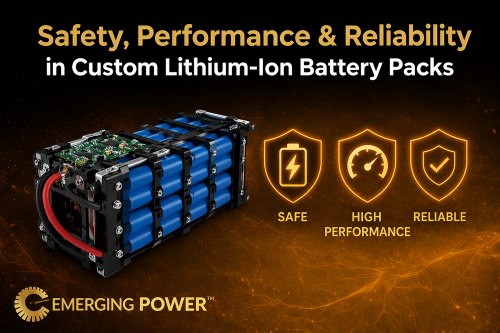
As industries become more dependent on advanced electronics and portable power systems, the demand for safe, high-performance, and reliable energy solutions continues to grow. From medical devices to defense equipment, battery failure is not just inconvenient—it can be critical. This is why custom lithium-ion battery packs are engineered with a strong focus on safety, performance optimization, and long-term reliability. Unlike standard batteries, these solutions are designed to meet precise operational requirements while minimizing risks and maximizing efficiency.Why Safety, Performance & Reliability Matter
In real-world applications, battery systems often operate under extreme conditions—high loads, temperature variations, and continuous usage cycles. A poorly designed battery pack can lead to:- Overheating or thermal runaway
- Reduced lifespan and performance degradation
- System downtime or failure
- Safety hazards including fire or explosion
1. Safety in Custom Lithium-Ion Battery Packs
Safety is the foundation of any lithium-ion battery design.Key Safety Components
Battery Management System (BMS)
The BMS acts as the brain of the battery pack. It continuously monitors:- Voltage levels
- Current flow
- Temperature
- State of charge (SOC)
- Overcharging
- Over-discharging
- Short circuits
Thermal Management Systems
Temperature control is critical. Custom battery packs integrate:- Heat sinks
- Cooling systems (passive or active)
- Thermal sensors
Protection Circuits
Additional safety layers include:- Overcurrent protection
- Short-circuit protection
- Cell balancing mechanisms
Rigorous Testing & Compliance
Custom battery packs undergo:- Environmental testing (temperature, humidity)
- Mechanical testing (shock, vibration)
- Electrical safety validation
2. Performance Optimization in Custom Battery Packs
Performance is about delivering consistent, efficient power under varying conditions.Key Performance Factors
Cell Selection & Chemistry
Different lithium-ion chemistries impact performance:- Lithium Cobalt Oxide (LCO): High energy density
- Lithium Manganese Oxide (LMO): Balanced safety and performance
- Lithium Iron Phosphate (LFP): High stability and long life
Energy Density & Power Output
Custom packs are designed to:- Maximize energy storage in limited space
- Deliver high discharge rates for demanding systems
Efficient Charging Mechanisms
Lithium-ion batteries typically use:- Constant Current / Constant Voltage (CC/CV) charging
- Faster charging
- Reduced stress on cells
- Extended battery life
Design Flexibility
Custom battery packs can be optimized for:- Compact size constraints
- Weight reduction
- Unique form factors
3. Reliability & Longevity
Reliability ensures that a battery performs consistently over time, even in demanding environments.Key Reliability Factors
Cycle Life
Most lithium-ion battery packs offer:- 300–500 charge cycles (or more depending on design)
Environmental Resistance
Custom battery packs are built to operate in:- Extreme temperatures (-20°C to 60°C or wider ranges)
- Harsh industrial environments
Cell Balancing
Uneven charge distribution can reduce battery life. Custom packs include:- Active or passive balancing systems
- Uniform energy distribution across cells
Robust Mechanical Design
Durability is ensured through:- Strong enclosures
- Vibration-resistant construction
- Shock protection
Real-World Applications Where It Matters Most
Medical Devices
- Requires absolute reliability and safety
- No tolerance for failure
Communication Systems
- Continuous uptime is essential
- Stable power delivery required
Industrial Equipment
- High load handling
- Harsh environment resistance
Military & Defense
- Extreme durability and performance
- Mission-critical reliability
Best Practices for Choosing a Custom Battery Pack
To ensure optimal safety, performance, and reliability:- Work with experienced battery design engineers
- Define clear power and environmental requirements
- Choose the right lithium-ion chemistry
- Ensure compliance with safety standards
- Prioritize testing and validation
Future Trends in Custom Lithium-Ion Battery Design
Emerging innovations are improving all three pillars:- Advanced battery chemistries with higher energy density
- Smart BMS with AI-based monitoring
- Safer, more sustainable battery materials
- Faster and more efficient charging technologies