Sourcing a custom battery solution starts with a question many OEM teams get wrong:
Are we buying cells, or are we buying a finished pack?
Whether it is a startup building its first product or an established manufacturer scaling production, confusing these two roles leads to delays, mismatched expectations, and sourcing mistakes. As battery-powered products grow more complex in 2025 and 2026, understanding the supply chain has become essential for anyone specifying power for a new device. The distinction comes down to:
Cell chemistry versus finished, application-ready power systems.
What Li-Ion Cell Manufacturers Actually Do
Lithium cell manufacturers focus on producing the raw battery cell itself. This includes:
- Electrode and electrolyte formulation
- Cell casing, either cylindrical, pouch, or prismatic
- Large-scale cell production and testing
- Chemistry-specific performance tuning
These companies operate at massive scale, producing millions of standardized cells for use across countless products. They generally do not design finished packs, BMS electronics, or application-specific enclosures.
What Battery Pack Manufacturers Actually Do
Battery pack manufacturers take those raw cells and turn them into a finished, application-ready power system. This includes:
- Selecting the right cells for the application
- Designing and integrating a battery management system
- Building the mechanical enclosure and wiring
- Testing for safety, performance, and certification such as UN38.3
- Tailoring the pack to fit size, weight, and connector requirements
This is the layer where a generic cell becomes a functional product component.
Why the Two Roles Are Often Confused
Many OEMs assume a li ion battery manufacturer’s listing refers to one type of company, when the term can apply to either cell producers or pack builders. This confusion often leads to:
- Sourcing cells directly without the engineering support needed to build a safe pack
- Assuming a cell supplier can also handle certification and BMS design
- Delays when a project requires capabilities the supplier does not actually offer
Comparing the Two Roles
| Category | Li-Ion Cell Manufacturer | Battery Pack Manufacturer |
| Primary output | Individual battery cells | Finished, ready-to-use battery packs |
| Typical order volume | Extremely high, often millions of cells | Project-based, matched to product volume |
| BMS design | Not typically offered | Core part of the service |
| Enclosure and mechanical design | Not offered | Included and customized per application |
| Certification support | Limited to cell-level data | Full pack-level testing and certification |
| Best suited for | High-volume consumer electronics | Custom, application-specific products |
Why OEMs Usually Need a Pack Manufacturer, Not Just a Cell Supplier
Unless a company is manufacturing at extremely high volume with an in-house engineering team, working directly with a cell supplier creates more work, not less. A battery pack manufacturer already understands:
- Which cells perform best for a given load profile
- How to design a BMS around the application
- What certifications the final product will need
- How to package the pack to fit tight enclosures
When It Makes Sense to Source Cells Directly
There are cases where sourcing lithium cell manufacturers directly makes sense, such as:
- Extremely high-volume consumer products with dedicated in-house engineering
- Companies that already have an established pack assembly line
- Projects where the OEM controls its own certification process
For most custom, mid-volume, or highly regulated applications, working with a pack manufacturer remains the faster and safer path.
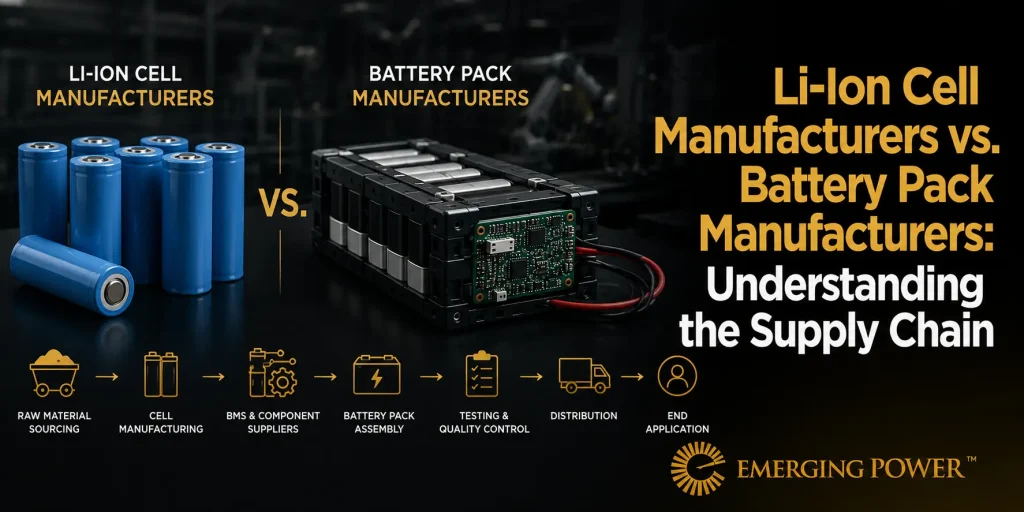
The Full Supply Chain, From Raw Material to Finished Pack
Understanding where cell manufacturers and pack manufacturers fit into the broader supply chain helps clarify why both roles exist and why they rarely overlap. The typical path looks like this:
- Raw material suppliers provide lithium, cobalt, nickel, and other materials used in cell chemistry
- Li ion battery manufacturers process these materials into finished, standardized cells
- Distributors and cell brokers move cells in bulk to companies that need them
- Battery pack manufacturers purchase cells, then design and build the finished power system
- OEMs integrate the finished pack into their end product
Each step requires different equipment, expertise, and scale. A company built to produce millions of identical cells is structured very differently than a company built to design a few thousand application-specific packs.
Common Sourcing Mistakes OEMs Make
Teams that are new to battery sourcing often run into avoidable problems by misunderstanding this supply chain. Frequent mistakes include:
- Contacting a cell manufacturer expecting help with BMS design or certification
- Assuming the cheapest cell price reflects the true cost of a finished pack
- Skipping pack-level testing because the cells themselves were already tested
- Underestimating the engineering time needed to go from raw cells to a certified product
- Choosing a supplier based on cell brand alone, without evaluating pack assembly quality
How Emerging Power Bridges Both Roles
Rather than forcing OEMs to manage cell sourcing and pack assembly separately, an experienced custom battery pack manufacturer manages the entire process as a single, coordinated workflow. This typically includes:
- Sourcing cells from qualified, tested li ion battery manufacturers
- Designing a BMS matched to the specific application
- Engineering the mechanical enclosure around size and durability requirements
- Managing certification testing such as UN38.3 from a single point of contact
- Providing ongoing support for design revisions and production scaling
This approach removes the guesswork of coordinating multiple vendors and gives OEMs a single accountable partner for the finished product.
What This Means for Product Timelines
Working with a pack manufacturer instead of coordinating cell sourcing independently often shortens overall project timelines. Benefits typically include:
- Faster prototyping, since cell selection and BMS design happen in parallel
- Fewer redesign cycles caused by mismatched components
- A clearer certification path, since the manufacturer already understands what testing is required
- Simplified vendor management, with one contract and one point of contact instead of several
A Closer Look at Different Cell Formats
Li ion battery manufacturers typically produce cells in a handful of standardized formats, and understanding these differences helps explain why pack manufacturers play such an important integration role. Common formats include:
- Cylindrical cells, such as the widely used 18650 and 21700 formats, valued for consistent manufacturing quality and mechanical strength
- Pouch cells, which offer a lightweight, flexible form factor but require more careful mechanical support in the final pack
- Prismatic cells, which balance energy density with a more rigid, stackable shape often used in larger packs
Each format changes how a pack manufacturer approaches mechanical design, thermal management, and BMS placement, which is one more reason cell production and pack assembly remain separate specialties.
How Pricing Works Differently at Each Stage
Pricing structures also differ significantly between cell manufacturers and pack manufacturers, which can confuse OEMs comparing quotes across the supply chain. Some key differences include:
- Cell manufacturers price primarily based on raw material costs, cell format, and order volume, often requiring large minimum order quantities
- Pack manufacturers price based on engineering time, component sourcing, testing, and certification, in addition to the underlying cell cost
- A quote from a cell manufacturer will never include BMS design, enclosure tooling, or certification testing costs, since those services are not part of their business model
- Comparing a cell-only quote to a full pack quote without accounting for these differences often leads to inaccurate budget expectations early in a project
Questions to Ask When Evaluating a Supplier
Before committing to either a cell supplier or a pack manufacturer, it helps to ask a few clarifying questions to confirm exactly what is being offered:
- Does this supplier design and test a finished, certified battery pack, or only supply raw cells?
- If cells are supplied, does the company have an in-house team capable of BMS design and mechanical integration?
- What certifications does the finished product carry, and who is responsible for maintaining them?
- Can the supplier support design changes after initial production, or is the relationship limited to a single order?
- How does the supplier handle cell quality control before assembly begins?
Getting clear answers to these questions early prevents costly misunderstandings later in the sourcing process.
Why Certification Responsibility Matters
One of the most overlooked differences between li ion battery manufacturers and pack manufacturers is who takes responsibility for certification. Raw cell suppliers typically provide cell-level test data, but they do not certify a finished, application-specific product. Pack manufacturers, on the other hand, are responsible for:
- Testing the complete assembled pack under UN38.3 and other relevant standards
- Maintaining documentation that ties certification directly to the exact BMS, enclosure, and cell configuration used
- Updating certification when any component of the pack changes
- Supporting OEMs during audits or regulatory reviews tied to the finished product
This distinction becomes especially important for OEMs shipping internationally or selling into regulated industries such as medical or defense, where certification gaps can delay or block a product launch entirely.
Where Custom Battery Pack Design Fits In
A custom lithium-ion battery pack combines cell selection, BMS integration, and enclosure design into a single engineered product, rather than requiring OEMs to manage multiple vendors across the supply chain.
Industries That Rely on Pack Manufacturers
Medical Devices
Certification and safety requirements make finished pack expertise essential.
Drones and UAVs
Weight, thermal, and BMS tuning require dedicated pack engineering.
Industrial IoT
Long field deployments depend on a properly integrated, tested pack.
Defense
ITAR compliance and mission-critical reliability require full pack-level control.
FAQs
Is a cell manufacturer the same as a battery manufacturer?
Not usually. Cell manufacturers produce the raw cell, while pack manufacturers build the finished, application-ready battery system.
Can I buy cells directly and build my own pack?
You can, but it requires in-house expertise in BMS design, mechanical integration, and certification testing.
Do pack manufacturers make their own cells?
Most do not. They source cells from established li ion battery manufacturers and integrate them into custom packs.
Which option is better for a new product?
Most OEMs without in-house battery engineering benefit from working with a pack manufacturer for faster development and safer certification.
Does a pack manufacturer handle UN38.3 testing?
Yes. Pack manufacturers typically manage transportation safety testing and certification as part of the design process.
How do I know which cell type is right for my product?
The right cell depends on your application’s energy density, discharge rate, size, and safety requirements, which a pack manufacturer can help evaluate during the design phase.
Can a pack manufacturer switch cell suppliers if one becomes unavailable?
Experienced pack manufacturers often qualify multiple cell sources for the same application, which helps protect against supply chain disruptions.
Is it more expensive to work with a pack manufacturer than sourcing cells directly?
It can appear more expensive upfront, but it typically reduces total cost by avoiding in-house BMS development, certification delays, and mechanical design work.
Final Thoughts
Understanding the difference between lithium cell manufacturers and battery pack manufacturers helps OEMs avoid sourcing mistakes and set realistic expectations for their project. For most custom or regulated applications, a pack manufacturer offers the engineering depth needed to move from raw cells to a certified, application-ready product.
Ready to Source a Custom Lithium-Ion Battery Pack?
Explore Emerging Power’s custom lithium ion battery pack design services or view our lithium polymer battery packs to see how a full pack solution can simplify your supply chain