


- Reduced product lifespan
- Thermal issues
- Compliance failures
- Increased downtime
- Higher operational costs
Should you choose a custom battery pack or a standard battery pack?
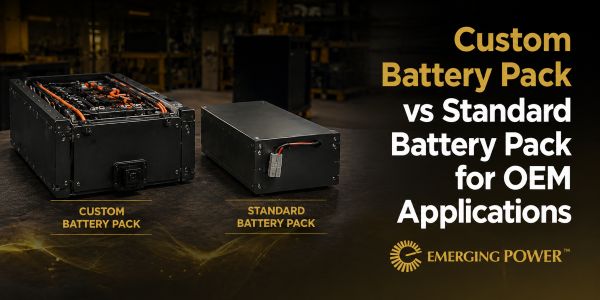
While standard battery packs may appear cost-effective initially, many OEMs are now moving toward custom-engineered battery solutions to improve safety, performance, and scalability. This guide explains the key differences, benefits, limitations, and how to choose the right battery solution for your application.What Is a Standard Battery Pack?
A standard battery pack is a pre-manufactured, off-the-shelf power solution designed for general-purpose applications. These battery packs are mass-produced with fixed:- Voltage ratings
- Cell configurations
- Sizes
- Capacity levels
- Connectors
- Consumer electronics
- Basic industrial devices
- Low-power applications
- Generic portable equipment
What Is a Custom Battery Pack?
A custom battery pack is engineered specifically for an OEM’s application requirements. Custom battery solutions are built around:- Power demands
- Product dimensions
- Environmental conditions
- Runtime expectations
- Safety requirements
- Compliance standards
- Medical devices
- Industrial equipment
- Defense systems
- IoT applications
- Smart metering
- Robotics
- UAVs
Custom Battery Pack vs Standard Battery Pack
| Feature | Standard Battery Pack | Custom Battery Pack |
| Design Flexibility | Limited | Fully application-specific |
| Performance Optimization | Generic | Optimized for OEM needs |
| Safety Features | Basic protection | Advanced BMS & thermal management |
| Product Fit | Fixed dimensions | Custom form factor |
| Lifecycle Performance | Moderate | Enhanced longevity |
| Compliance Support | Limited | Industry-specific certifications |
| Scalability | Restricted | Designed for future growth |
| Initial Cost | Lower | Higher upfront investment |
| Long-Term ROI | Lower | Higher operational efficiency |
Why OEMs Are Moving Toward Custom Battery Packs
The global custom battery pack market continues to grow rapidly due to increasing demand for advanced industrial and portable electronic systems. According to industry market forecasts, the custom battery pack market is expected to surpass $68 billion globally by 2030 due to rising adoption across industrial automation, medical technology, and smart connected devices. OEM manufacturers are prioritizing:- Longer runtime
- Lightweight design
- Faster charging
- Thermal stability
- Compact integration
- Improved safety
The Biggest Problems with Standard Battery Packs
1. Poor Product Fit
Many OEM products have limited internal space. Standard batteries often require design compromises that affect:- Device size
- Weight distribution
- Cooling airflow
- Product aesthetics
2. Limited Thermal Management
Industrial environments generate significant heat. Standard battery packs may lack:- Smart thermal monitoring
- Heat dissipation systems
- Advanced Battery Management Systems (BMS)
- Overheating
- Reduced battery lifespan
- Thermal runaway
3. Reduced Runtime Efficiency
Off-the-shelf battery packs are not optimized for specific load profiles. This often leads to:- Inefficient energy usage
- Faster discharge cycles
- More frequent charging
- Increased downtime
4. Compliance Challenges
OEM products often require compliance with:- UN38.3
- IEC standards
- UL certifications
- Medical safety requirements
- Military specifications
When Should OEMs Choose a Custom Battery Pack?
A custom battery solution is ideal when your application requires:High Reliability
Critical for:- Medical equipment
- Defense systems
- Industrial automation
Compact Product Design
Important for:- Portable electronics
- UAVs
- IoT devices
Extreme Operating Environments
Needed for:- High-temperature applications
- Outdoor systems
- Rugged industrial equipment
Advanced Power Requirements
Useful for:- Fast charging
- High discharge loads
- Long operational runtime
Industries Benefiting Most from Custom Battery Packs
Medical Devices
Portable medical systems require:- Lightweight batteries
- Long runtime
- High reliability
Industrial Equipment
Manufacturing systems demand:- Continuous power delivery
- Thermal stability
- Durable battery architecture
UAV and Drone Systems
Drone applications need:- High energy density
- Lightweight battery packs
- Fast charging capability
IoT and Smart Devices
Connected devices require:- Compact battery integration
- Long standby performance
- Low self-discharge rates
How Emerging Power Supports OEM Battery Development
Emerging Power specializes in custom battery pack design and engineering for OEM applications. Their capabilities include:- Advanced lithium-ion battery pack design
- Smart Battery Management Systems
- Thermal protection integration
- Prototyping and testing
- Regulatory compliance support
- Custom enclosure engineering
FAQs
What is the difference between a custom battery pack and a standard battery pack?
A standard battery pack is pre-designed for general use, while a custom battery pack is engineered specifically for an OEM’s product requirements and operating conditions.Are custom battery packs safer?
Yes. Custom battery packs often include advanced safety systems such as thermal monitoring, smart BMS integration, and application-specific protection features.Why do OEM manufacturers prefer custom battery solutions?
OEMs choose custom battery packs for better performance, improved product fit, longer lifespan, and industry-specific compliance support.Are custom battery packs more expensive?
Initial development costs are higher, but custom battery packs often provide better long-term ROI through improved efficiency, reliability, and reduced downtime.Which industries use custom battery packs the most?
Medical, industrial automation, defense, UAV, robotics, and IoT industries heavily rely on custom battery solutions.Final Thoughts
For OEM manufacturers, battery selection directly impacts product reliability, safety, and long-term operational performance. While standard battery packs may work for basic applications, modern industrial systems increasingly require:- Higher energy density
- Better thermal management
- Compact integration
- Longer lifecycle performance
- Advanced safety systems