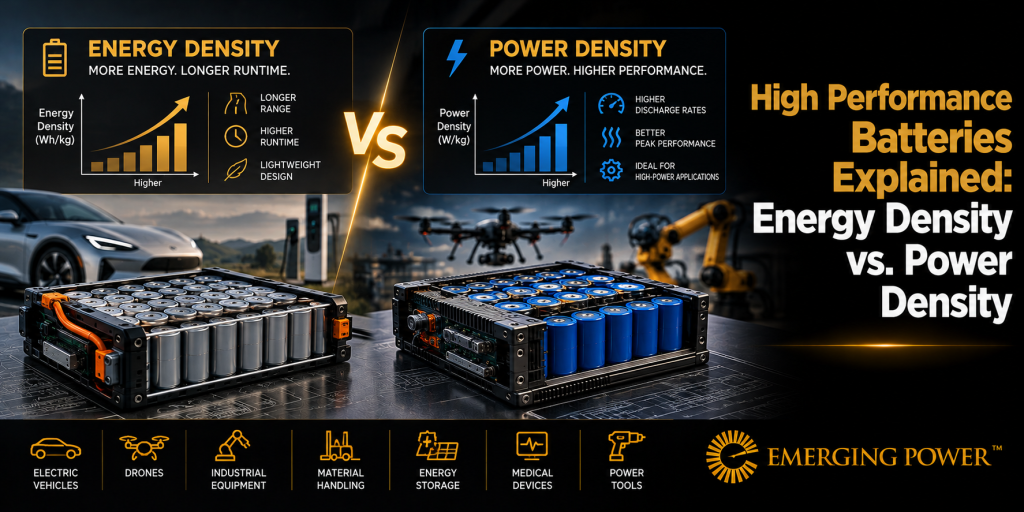
When engineers evaluate high performance batteries, capacity is only one part of the equation.
Two batteries can have similar physical dimensions or stored energy but perform very differently once they are integrated into an application. One may be optimized to operate for a long time between charges, while another may be designed to deliver a large amount of power within seconds.
This difference often comes down to two important battery performance metrics: energy density and power density.
Understanding the difference between them can help OEMs make better decisions about cell chemistry, battery size, discharge requirements, thermal management, and overall battery pack design.
A high performance battery is not simply a battery with the highest capacity or highest energy density.
Performance depends on what the application actually requires.
For one device, high performance may mean maximizing operating time while minimizing battery weight. For another, it may mean supplying a high current during startup or supporting repeated power pulses. Other applications may prioritize cycle life, temperature performance, reliability, packaging flexibility, or a combination of these requirements.
That is why battery selection should begin with the application rather than a single specification.
Through our custom battery design services, we evaluate electrical, mechanical, safety, and application requirements before developing a battery pack around the needs of the product.
Energy density describes how much energy a battery can store relative to its mass or volume.
It is commonly expressed in two ways:
Natural Resources Canada defines energy density as the amount of energy stored relative to battery mass or volume. It also notes that energy density generally decreases as the measurement moves from active materials to cells, modules, and complete packs because components such as enclosures and thermal-management systems add weight and volume without adding stored energy.
For product engineers, this distinction matters.
A cell-level energy-density figure should not automatically be treated as the energy density of the finished battery pack.
Higher energy density can help an OEM achieve objectives such as:
The U.S. Department of Energy explains that increasing volumetric energy density can allow an electric vehicle, for example, to travel farther without increasing battery-pack size or potentially achieve the same range with a smaller pack.
The same basic design principle applies beyond vehicles. Medical equipment, instrumentation, communications systems, tracking devices, portable electronics, and other battery-powered products can all face limitations on available weight or space.
We develop custom lithium-ion battery packs for applications where size, weight, voltage, current requirements, safety, and reliability need to be considered together.
If energy density describes how much energy is available, power density describes how rapidly that energy can be delivered.
Power density may be expressed as:
Natural Resources Canada describes power density as a battery’s rate capability, or the flow of energy into or out of the battery during charging and discharging relative to mass or volume.
Power requirements also need context. Factors such as discharge rate, temperature, state of charge, pulse duration, and whether the specification refers to continuous or pulse power can affect battery performance.
Some applications have relatively stable electrical loads. Others may suddenly require much more current.
High power capability becomes particularly important when equipment must support:
In these cases, simply choosing a battery with high capacity does not guarantee that it can safely provide the required current.
A simple way to understand the distinction is:
Energy density tells you how much energy the battery can carry. Power density tells you how quickly the battery can deliver it.
Metric | Energy Density | Power Density |
Main question | How much energy can the battery store? | How quickly can the battery deliver energy? |
Common units | Wh/kg or Wh/L | W/kg or W/L |
Major design consideration | Runtime, size and weight | Current output and load demand |
Important for | Long-duration operation | High-load or pulse operation |
Higher value generally supports | More energy in less mass or volume | Greater power delivery relative to mass or volume |
Both measurements are important, but neither should be evaluated independently from the application.
Consider two hypothetical products.
Product A is a portable monitoring device expected to operate for long periods between charges. Its current demand is relatively modest.
Its design may prioritize:
high energy density → more stored energy → longer potential runtime
Now consider Product B, which contains a motor that creates a substantial temporary load during startup.
Its battery may need to prioritize:
high power capability → greater current delivery → better support for peak loads
Selecting a high-energy cell without verifying its discharge capability could result in poor performance in Product B. Likewise, optimizing Product A exclusively for high power could sacrifice energy capacity that would have been more valuable for its actual duty cycle.
This is why battery engineering is fundamentally an optimization problem rather than a search for the battery with the largest specification number.
Battery technology can provide combinations of strong energy and power performance, but engineering trade-offs remain.
Cell chemistry, electrode design, internal resistance, physical construction, thermal conditions, discharge rate, battery management, and other factors can influence how a battery performs.
Within lithium-ion chemistry, different formulations can favor different performance characteristics. Lithium cobalt oxide can provide high energy density, while lithium iron phosphate is often selected where discharge capability, cycle life, and thermal stability are important.
This makes chemistry selection an application-specific engineering decision rather than a universal ranking of one chemistry as “best.”
For a deeper technical discussion of this trade-off, see our guide to energy density vs. power density in battery pack design.
A common battery-selection mistake is comparing cells solely through datasheet specifications.
An OEM ultimately uses a battery system, not an isolated cell.
The completed pack may also include:
These components affect the final pack’s mass, volume, electrical performance, safety, and reliability.
That is one reason we evaluate pack-level performance separately from cell-level performance when developing a custom solution.
High performance batteries also need appropriate control and protection.
A battery management system may monitor or manage factors such as cell voltage, current, temperature, charging, discharge limits, state of charge, and cell balancing depending on the battery design.
This becomes particularly important as electrical and thermal demands increase.
Our smart battery design capabilities include protection circuits, fuel gauges, charger-control PCBAs, and battery management systems.
The objective is not simply to select a high-performance cell. We look at the entire battery pack as an integrated system.
Battery performance figures should not be evaluated without considering operating conditions.
Temperature can affect electrochemical reaction rates and battery performance. A battery that meets a power requirement under controlled laboratory conditions may behave differently when used in an application exposed to very low or high temperatures.
OEM requirements should therefore identify the expected operating environment early in the development process.
This can influence cell selection, enclosure design, thermal management, BMS parameters, testing, and potentially the physical size of the finished battery.
Instead of beginning with “What battery has the highest energy density?”, engineering teams should define what the finished product needs the battery to do.
Important questions include:
Once these requirements are defined, engineers can evaluate energy density and power density in the context of the entire system.
Our broader battery engineering and manufacturing capabilities support multiple battery chemistries and applications, including lithium-ion, lithium-polymer, lithium iron phosphate, lithium primary, and nickel-metal hydride solutions.
A high performance battery should not be evaluated using one metric.
Energy density and power density need to be considered alongside:
A battery with exceptional energy density but inadequate discharge capability may be wrong for a high-load device.
A battery with exceptional power capability but insufficient energy storage may require an unnecessarily large pack to achieve the required runtime.
The appropriate battery is the one that achieves the right balance for the actual product.
Battery energy density describes how much energy a battery stores relative to its mass or volume. Gravimetric energy density is typically expressed in Wh/kg, while volumetric energy density is typically expressed in Wh/L.
Power density describes how rapidly a battery can deliver energy relative to its mass or volume. It is commonly expressed in W/kg or W/L.
No. Higher energy density can be valuable when runtime, weight, or available space is important, but battery selection also needs to account for power requirements, temperature, safety, cycle life, charging, physical design, and other application requirements.
Battery capacity describes the amount of electrical charge a battery can provide and is commonly stated in ampere-hours (Ah). Energy considers both capacity and voltage and is expressed in watt-hours (Wh). Energy density relates that stored energy to the battery’s mass or volume.
Not necessarily. Power density describes how quickly energy can be delivered, while energy density is more closely associated with how much energy can be stored for a given mass or volume. Runtime depends on the battery’s usable energy and the application’s load profile.
There is no single best chemistry for every high-performance application. The appropriate chemistry depends on required energy, power, cycle life, operating temperature, size, weight, safety requirements, charging characteristics, cost, and other design constraints.
For OEM product development, the question should not be whether energy density or power density is more important in general.
The better question is:
What combination of energy, power, size, weight, safety, runtime, and lifecycle does this specific product require?
Answering that question early can help engineering teams make better decisions about cell chemistry, pack architecture, electronics, thermal requirements, mechanical design, and testing.
At Emerging Power, we work with OEMs to develop custom battery solutions around specific electrical and mechanical requirements, from initial technical review and battery design through prototyping, testing, and manufacturing.
Request a quote to discuss your application’s energy, power, size, operating environment, and performance requirements.