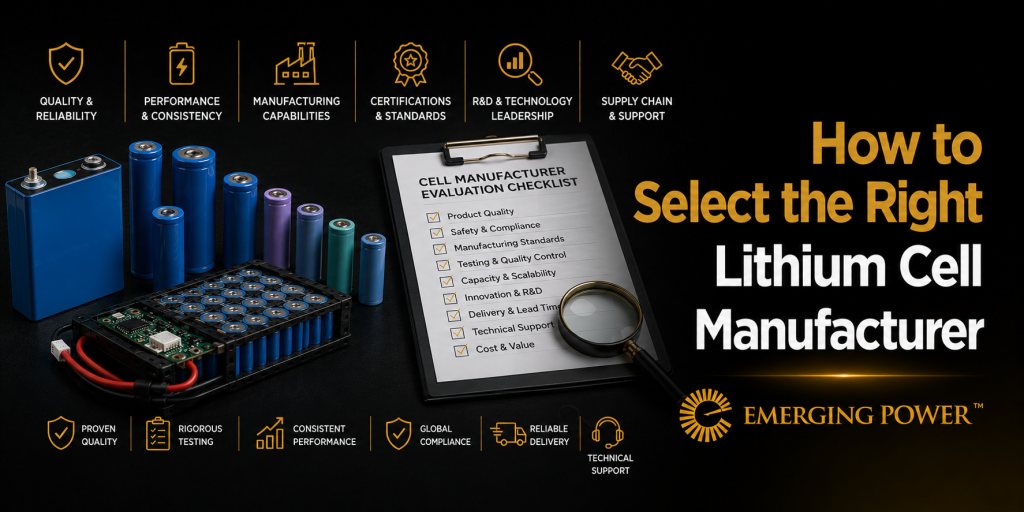
How to Select the Right Lithium Cell Manufacturer for Your Custom Battery Project
Choosing the right Lithium Cell Manufacturer is one of the most important decisions when developing a custom battery solution. The quality of lithium cells directly impacts battery performance, safety, lifecycle, and long-term reliability.
Whether you are building medical equipment, industrial systems, drones, communication devices, or defense applications, selecting the right cell supplier helps ensure your battery pack meets the technical requirements of your application.
The lithium battery market continues to expand as industries move toward electrification and portable power solutions. According to the International Energy Agency (IEA) Global EV Outlook 2025, global lithium-ion battery demand continues to grow across transportation, energy storage, and industrial applications. This growth has increased the need for reliable battery partners that can provide consistent quality and engineering support.
A trusted battery partner does more than supply cells. They help design, test, and manufacture a complete battery solution.
1. Evaluate Cell Quality and Manufacturing Standards
The foundation of any battery pack is the lithium cell. A reliable Lithium Cell Manufacturer should have strict quality control processes and provide detailed information about:
- Cell chemistry options such as Lithium Iron Phosphate (LFP), Lithium Nickel Manganese Cobalt (NMC), and other lithium-ion technologies
- Energy density and cycle life
- Safety certifications and testing documentation
- Manufacturing consistency
- Traceability of battery cells
Different applications require different cell characteristics. For example, a drone battery may prioritize high discharge rates and lightweight design, while a medical device battery may require long cycle life and high reliability.
Working with a manufacturer that understands these differences helps avoid performance issues later.
2. Choose a Partner With Custom Battery Design Experience
Many companies require more than an off-the-shelf battery. Standard batteries often come with limitations in size, shape, power output, and integration.
A professional custom lithium-ion battery designer evaluates your complete system requirements, including:
- Voltage requirements
- Capacity needs
- Operating environment
- Space limitations
- Communication requirements
- Safety requirements
A li ion custom battery is designed around the device rather than forcing the device to adapt around a standard battery.
This approach allows engineers to optimize battery performance while improving reliability and usability.
3. Review Engineering and Testing Capabilities
Selecting a supplier that only assembles battery packs may create challenges during development. A complete battery partner should have engineering capabilities covering:
- Battery architecture design
- Battery Management System (BMS) development
- Thermal management
- Mechanical enclosure design
- Prototype development
- Safety testing
Testing is especially important for applications exposed to demanding conditions.
The U.S. Department of Energy highlights battery safety, durability, and performance testing as critical areas in advancing lithium battery technologies. Proper validation helps ensure battery systems perform safely under real-world operating conditions.
4. Understand Custom Battery Pack Manufacturing Capabilities
A reliable custom lithium battery pack manufacturer should be able to support the entire product lifecycle, from initial concept to production.
Important capabilities include:
Design Support
The manufacturer should help select the right cells, configuration, electronics, and mechanical design.
Prototype Development
Before full production, prototypes allow engineers to validate performance and make improvements.
Production Scalability
The manufacturing process should support both small-volume prototypes and larger production requirements.
Quality Control
Every production battery pack should go through inspection and testing procedures to maintain consistency.
Companies using custom battery packs benefit from solutions specifically designed for their operational requirements rather than generic battery products.
5. Check Industry Experience and Application Knowledge
Battery requirements vary significantly between industries.
A supplier experienced in multiple sectors can better understand application challenges such as:
- Medical equipment requiring dependable power
- Industrial systems requiring long operational cycles
- Drones requiring lightweight high-performance batteries
- Military and communication equipment requiring rugged solutions
A manufacturer with application knowledge can recommend the right chemistry, configuration, and protection features.
6. Consider Supply Chain Reliability
The lithium battery supply chain has become increasingly important as demand grows. According to BloombergNEF’s Battery Price Survey 2024, lithium-ion battery prices have continued to decline over recent years due to improvements in manufacturing scale and supply chain development.
However, companies still need reliable suppliers that can maintain:
- Stable cell sourcing
- Consistent production quality
- Documentation support
- Long-term manufacturing partnerships
A dependable battery manufacturer should provide transparency throughout the development and production process.
7. Ask the Right Questions Before Selecting a Manufacturer
Before choosing a lithium battery partner, consider asking:
- Do you provide custom battery design support?
- Which lithium cell chemistries do you work with?
- Can you develop prototypes?
- What testing standards do you follow?
- Can you support production scaling?
- Do you provide engineering documentation?
These questions help identify whether a supplier can support your project beyond basic battery assembly.
Why Choosing the Right Lithium Battery Partner Matters
The right Lithium Cell Manufacturer provides more than battery cells. They provide engineering expertise, design support, testing capabilities, and manufacturing reliability.
A well-designed battery system improves device performance, reduces development risks, and ensures your product receives dependable power throughout its lifecycle.
For companies developing specialized equipment, partnering with an experienced custom lithium battery pack manufacturer can make the difference between a battery that simply works and one that performs reliably in real-world conditions.
Frequently Asked Questions
What does a Lithium Cell Manufacturer do?
A Lithium Cell Manufacturer produces lithium battery cells used in battery systems. They provide different cell chemistries, capacities, and performance characteristics based on application requirements.
How do I choose a custom lithium-ion battery designer?
Look for a designer with experience in battery architecture, BMS integration, prototype development, testing, and manufacturing support.
What are the benefits of using li ion custom battery solutions?
A li ion custom battery is designed specifically for your device requirements, allowing better fit, optimized performance, improved safety, and efficient power management.
Why are custom battery packs better than standard batteries?
Custom battery packs are engineered around specific voltage, capacity, size, environmental, and performance requirements instead of using a one-size-fits-all approach.
What industries use custom lithium battery packs?
Custom lithium battery solutions are commonly used in medical devices, drones, industrial equipment, communication systems, robotics, and defense applications.
Build a Battery Solution Designed for Your Application
From cell selection to final production, Emerging Power helps companies develop reliable custom lithium battery solutions engineered for their specific requirements.
Talk to our battery engineering team today to discuss your custom battery pack project.