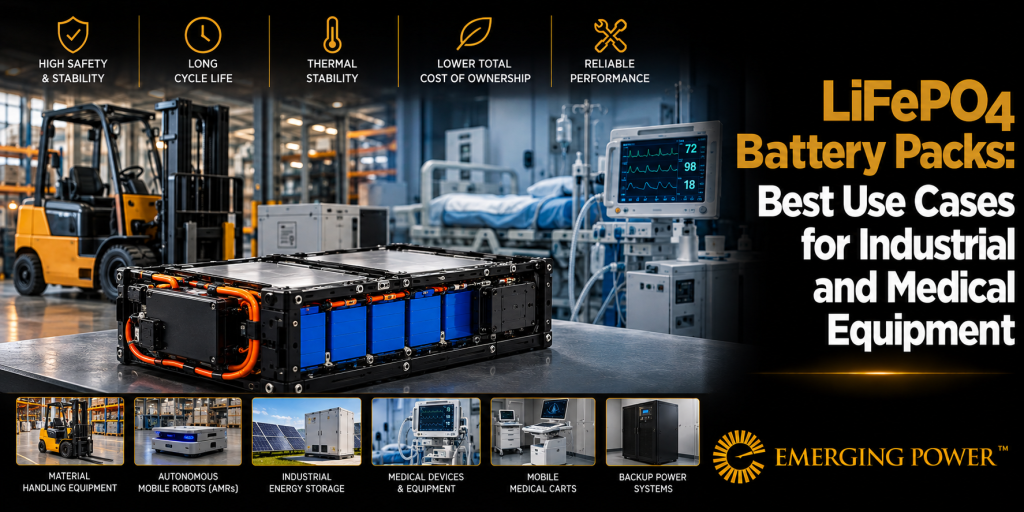
LiFePO4 battery packs, also called lithium iron phosphate or LFP battery packs, are often a strong choice when an OEM needs long cycle life, stable power delivery, and a chemistry that prioritizes thermal stability over maximum energy density. For industrial and medical equipment, that balance can be more important than simply fitting the greatest possible watt-hours into the smallest space.
What Is a LiFePO4 Battery Pack?
A LiFePO4 battery pack is a rechargeable lithium-ion battery system that uses lithium iron phosphate as the cathode material. Compared with several other lithium-ion chemistries, LFP generally trades some energy density for strong cycle-life potential, good power capability, and favorable thermal-stability characteristics.
The U.S. Department of Energy describes LFP as one of the major lithium-ion cathode classes and notes differences among lithium-ion chemistries in energy, lifecycle, and safety characteristics. See the DOE lithium-ion technology assessment.
At Emerging Power, we design and manufacture custom LiFePO4 battery packs around the electrical, mechanical, environmental, and regulatory needs of the end product.
Why OEMs Consider LiFePO4 for Demanding Equipment
- Long cycle-life potential for equipment that is charged and discharged frequently.
- Strong power capability for loads that require dependable current delivery.
- Thermal-stability characteristics that can be attractive in safety-focused designs.
- Relatively flat discharge behavior that can support predictable equipment operation.
- Availability in configurations suitable for custom pack design, monitoring, protection, and enclosure integration.
These characteristics do not make LFP automatically correct for every product. The finished pack still has to be evaluated for voltage, runtime, peak load, charging, operating temperature, dimensions, weight, safety controls, certification, and lifecycle.
Best Industrial Use Cases for LiFePO4 Battery Packs
1. Portable Industrial Instrumentation
Test instruments, inspection systems, portable analyzers, and field-service equipment often need repeatable daily cycling and dependable output. Where the design can accommodate LFP’s lower energy density relative to some other lithium-ion chemistries, its lifecycle and power characteristics can make it attractive.
2. Robotics and Automated Equipment
Robotics, automated guided equipment, mobile industrial platforms, and control systems can create variable loads with repeated charge-discharge cycles. A properly engineered LFP pack can be designed around the required current, duty cycle, communications, and protection needs.
3. Backup and Standby Power
Industrial controllers, communication hardware, and critical monitoring equipment may require rechargeable backup power. The decision should be based on expected standby duration, recharge strategy, required service life, and environmental conditions rather than chemistry name alone.
4. Equipment Exposed to Frequent Cycling
When a battery is expected to cycle repeatedly over the product’s operating life, cycle-life economics can matter more than the lowest initial battery cost. This is one situation in which LFP is often worth evaluating early.
Best Medical Use Cases for LiFePO4 Battery Packs
Medical battery selection requires a system-level view. The appropriate chemistry depends on whether equipment is portable, mobile, stationary, patient-connected, frequently cycled, used as backup power, or expected to operate under defined fault conditions.
Our medical battery pack capabilities include custom design, traceability, serialization, and automated testing for OEM medical applications.
- Portable analyzers and diagnostic instruments where long service life and predictable output are priorities.
- Medical carts and mobile clinical equipment that undergo frequent daily charging.
- Monitoring equipment that needs rechargeable backup power.
- Healthcare devices where the pack can accommodate LFP’s size and energy-density trade-offs.
- Medical systems that require custom electronics, protection, traceability, or end-of-line testing.
For portable rechargeable lithium systems used in medical devices, the FDA currently recognizes IEC 62133-2 as a consensus standard. Applicable standards still depend on the finished medical device and its intended use.
LiFePO4 vs. Other Lithium-Ion Chemistries
Design Factor | LiFePO4 / LFP | Higher-energy Li-ion chemistries |
Energy density | Typically lower | Often higher |
Cycle-life potential | Often a key strength | Varies by chemistry and use |
Power capability | Can be strong | Varies widely |
Thermal stability | Often a key reason to evaluate LFP | Chemistry dependent |
Best fit | Long-life, power, safety-conscious designs | Space- and weight-constrained high-energy designs |
The right comparison is not ‘Which chemistry is best?’ It is ‘Which chemistry best matches the product’s load profile, runtime target, environment, dimensions, safety requirements, and lifecycle?’
What Engineers Should Specify Before Choosing LFP
- Nominal and maximum pack voltage.
- Required usable energy and target runtime.
- Peak and continuous current.
- Charge time and charging method.
- Expected cycle life and calendar life.
- Operating and storage temperature range.
- Available pack dimensions and weight limit.
- Required BMS, fuel-gauge, communications, and protection functions.
- Mechanical shock, vibration, ingress, and enclosure requirements.
- Applicable medical, industrial, safety, and transportation standards.
Do LiFePO4 Packs Still Need a BMS?
Yes, many rechargeable LFP systems require battery management and protection functions. Depending on the pack, these may include overcharge protection, over-discharge protection, overcurrent protection, temperature monitoring, cell balancing, state-of-charge estimation, and communication with the host device.
Our custom battery design process can integrate BMS electronics, charging support, enclosures, automated testing, and regulatory support as required.
Frequently Asked Questions
Are LiFePO4 batteries good for medical equipment?
They can be. LiFePO4 is worth evaluating when cycle life, power capability, thermal stability, and repeated charging are important. The final choice must still be based on the medical device’s specific electrical, mechanical, safety, and regulatory requirements.
Are LiFePO4 batteries safer than lithium-ion batteries?
LiFePO4 is itself a lithium-ion chemistry. It offers better thermal stability than several other cathode chemistries, but pack safety still depends on cell quality, electrical protection, charging, mechanical design, manufacturing controls, and the finished application.
What is the main disadvantage of LiFePO4?
A common trade-off is lower energy density than some other lithium-ion chemistries. That can matter when the product has strict size or weight limits.
Can LiFePO4 batteries be used in industrial equipment?
Yes. Common applications include instrumentation, automation, robotics, backup power, communications, and other equipment that requires frequent cycling or dependable power.
Build the Battery Around the Equipment
For industrial and medical OEMs, choosing LiFePO4 should be a requirements-driven engineering decision. We review the load profile, runtime, temperature, physical constraints, protection needs, lifecycle targets, testing, and compliance requirements before recommending a chemistry and pack architecture.
If you are evaluating LFP for a new or existing product, request a quote and share your electrical and mechanical requirements with our team.