


Introduction
In today’s power-hungry world, lithium-ion and lithium polymer (LiPo) batteries are powering everything from medical devices to drones, industrial systems, and consumer electronics. But what exactly are these two technologies? How do they differ, and how can custom battery pack solutions be optimized for performance, safety, and design? In this guide, we unpack everything you need to know about lithium-ion and lithium-polymer batteries, including key differences, common applications, and when to choose custom solutions from a manufacturer like Emerging Power.What Are Lithium-Ion and Lithium Polymer Batteries?
1. Lithium-Ion Batteries
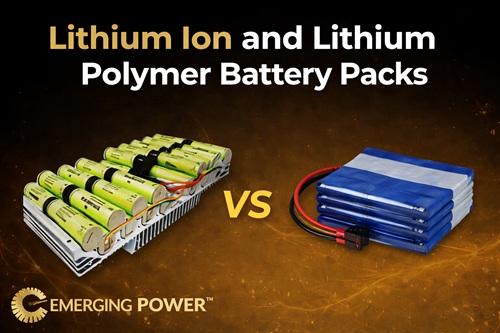
Lithium-ion (Li-ion) batteries are rechargeable cells that store energy by shuttling lithium ions between electrodes. These batteries use a liquid electrolyte and are typically housed in a rigid metal casing, such as cylindrical or prismatic formats. This construction delivers consistent energy, reliability, and cycle life, making Li-ion packs a go-to choice for robust applications. Custom Li-ion Battery Specifications:- Cell voltage: ~3.6–3.7 V nominal
- Capacity: 500 mAh to 3500 mAh
- Typical cycle life: 300–500 cycles
- Operating temperature range: –20°C to 60°C
2. Lithium Polymer (LiPo) Batteries
Lithium polymer batteries are a category within the lithium-ion family that use a solid or gel-based polymer electrolyte instead of a liquid one. Combined with a flexible pouch form factor, they offer advantages in weight, shape flexibility, and compact design. Custom LiPo Battery Specifications:- Nominal cell voltage: ~3.2–3.7 V
- Capacity range: 500 mAh to 3000 mAh
- Energy density: ~250 Wh/L
- Typical cycle life: 500+ cycles
- Operating temperature: –20°C to 60°C
Lithium Ion vs Lithium Polymer — Key Differences
Understanding the technical and practical differences helps engineers and product designers make the right choice.| Feature | Lithium-Ion | Lithium Polymer (LiPo) |
|---|---|---|
| Electrolyte | Liquid | Gel or polymer solid |
| Packaging | Rigid (metal casing) | Flexible pouch |
| Energy Density | High & consistent | Optimized space usage |
| Weight | Slightly heavier | Lightweight |
| Cycle Life | Long (500+ cycles) | Moderate (300–500 cycles) |
| Design Flexibility | Limited | High |
| Best Use Cases | Industrial, EVs, mass production | Wearables, custom devices |
Which Battery is Best for Your Project?
Choose Lithium-Ion If:
- You need high energy density and long life
- You require strong safety and structural integrity
- Applications include industrial equipment, medical devices, or backup systems
Choose Lithium Polymer (LiPo) If:
- Your product demands custom shapes and compact sizes
- Weight and thickness optimization is critical
- You need high discharge bursts in a lightweight form
The Role of Custom Battery Design
- Form factor & weight control: Fit batteries to device specifications
- Battery Management Systems (BMS): Ensure safety and performance
- Thermal & charging optimization: Extend battery life
- Electronics integration: Connectors, PCBs, and testing
- Certifications: UL, UN38.3, IEC compliance
Common Applications of Custom Lithium Battery Packs
- Medical and wearable devices
- IoT sensors and wireless systems
- Drones and UAVs
- Portable consumer electronics
- Industrial and military applications
- Electric mobility and energy storage