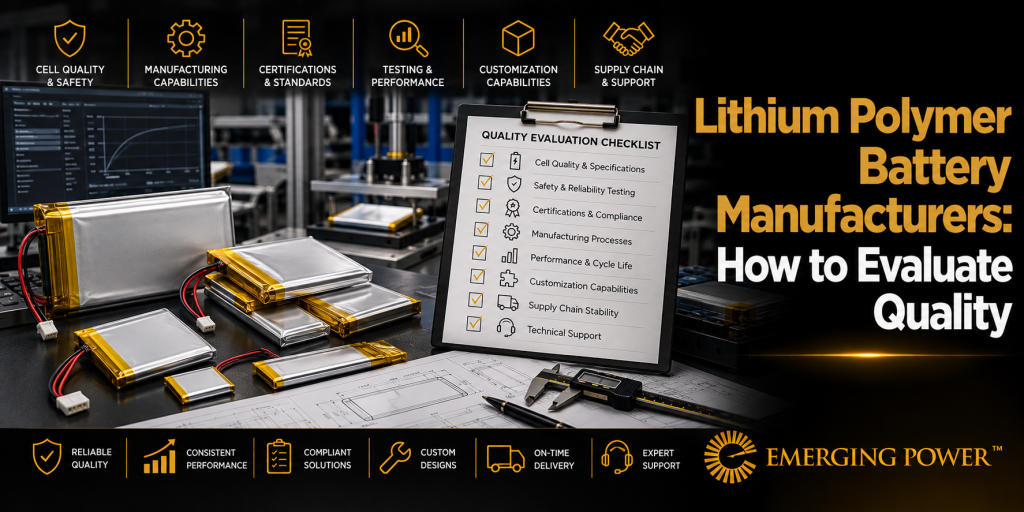
Choosing among lithium polymer battery manufacturers involves much more than comparing capacity, dimensions, lead times, and price.
For OEMs, the quality of a lithium polymer battery can directly affect product performance, reliability, safety, certification, and long-term supply continuity. Two battery packs with similar specifications on paper may perform very differently depending on the cells used, protection electronics, engineering decisions, manufacturing controls, testing procedures, and component traceability behind them.
That makes supplier evaluation an important part of product development.
This guide explains what OEMs should examine when evaluating a lithium polymer battery manufacturer and which questions can help distinguish a capable manufacturing partner from a basic battery supplier.
A lithium polymer battery, often called a LiPo or Li-Polymer battery, is a rechargeable lithium-based battery commonly selected for applications where weight, energy density, or form-factor flexibility is important.
Lithium polymer cells are available in thin and compact configurations that can be useful when a conventional cylindrical cell does not fit the mechanical requirements of a product.
LiPo batteries can be found in applications such as:
However, selecting LiPo chemistry is only the beginning. The cell still needs to be properly selected and integrated into a battery pack that meets the electrical, mechanical, environmental, and safety requirements of the finished product.
OEMs developing a specialized application can learn more about custom battery design and how cell selection, electronics, enclosure design, testing, and compliance fit into the development process.
Battery quality is not determined by one specification.
A battery pack is a system. Cell quality matters, but so do the protection circuit, battery management system, wiring, connectors, mechanical construction, thermal considerations, assembly processes, firmware where applicable, and production testing.
Poor control over any of these areas can create problems such as:
This is why OEM buyers should evaluate the manufacturer’s complete engineering and manufacturing process rather than focusing exclusively on price per pack.
One of the first questions to ask a potential LiPo battery manufacturer is where its cells come from.
The manufacturer should be able to explain its cell sourcing and qualification process. OEMs should understand whether the supplier has established relationships with cell manufacturers and how incoming cells are inspected before they enter production.
Questions worth asking include:
Cell selection should also reflect the actual application. Capacity alone is not enough. Discharge requirements, operating temperature, expected cycle life, charging characteristics, physical dimensions, and other factors may influence which cell is appropriate.
Emerging Power states that it maintains relationships with established cell manufacturers including Panasonic, Samsung, Moli Energy, LG, and Sony and supports multiple battery chemistries, including Li-Polymer.
For a deeper look at the sourcing process, read How to Select the Right Lithium Cell Manufacturer for Your Custom Battery Project.
A battery supplier and an engineering-oriented battery manufacturer do not necessarily provide the same level of support.
For a custom OEM project, the manufacturer may need to evaluate:
The manufacturer should be able to explain why a particular cell, configuration, protection circuit, or BMS design is appropriate for the application.
This is particularly important with lithium polymer batteries because their form-factor flexibility can encourage OEMs to focus heavily on fitting the battery into a restricted space. Electrical performance, thermal behavior, protection, manufacturability, and long-term reliability still need to be considered alongside size.
Emerging Power’s custom battery design services include electrical and mechanical engineering, protection circuits, BMS solutions, charging circuits, automated testing, and regulatory support.
For many rechargeable lithium battery applications, protection electronics are a critical part of the pack.
Depending on the application and configuration, a battery management or protection system may monitor conditions such as voltage, current, and temperature and provide protection against conditions such as overcharge, over-discharge, excessive current, or short circuits.
More sophisticated systems may also require:
Do not assume that every manufacturer has the same electronics capabilities.
Ask whether the manufacturer designs and integrates battery electronics internally, uses an existing platform, or outsources this portion of development.
You can learn more in Emerging Power’s guide to custom battery pack design.
A successful prototype does not prove that a manufacturer can repeatedly build the same battery at production scale.
This is where quality systems become important.
When evaluating lithium polymer battery manufacturers, ask about:
Quality certifications can also provide useful evidence that formal systems are in place.
Emerging Power lists ISO 9001:2015 and AS9100:2016 among its current quality credentials.
These certifications should not replace your own supplier qualification process, but they can be an important part of evaluating a manufacturer’s overall quality-management framework.
One of the most useful questions an OEM can ask is:
What testing will be performed on our battery before it leaves production?
Do not settle for a general answer such as “all batteries are tested.”
Ask what is tested, at what stage, against which acceptance criteria, how results are recorded, and whether testing is performed on prototypes, production units, or both.
Depending on the design and application, validation may examine areas such as:
Testing requirements should be established around the actual battery design and its intended application rather than copied from an unrelated product.
Emerging Power states that its battery development capabilities can include automated testing and custom end-of-line functional test solutions.
Safety and regulatory planning should begin during battery development rather than after the design has been finalized.
The standards and certifications that apply depend on the battery configuration, end product, application, target market, and transportation requirements.
For example, lithium cells and batteries offered for transport may need to satisfy applicable UN 38.3 transportation testing requirements.
Depending on the application, other standards such as IEC or UL battery safety requirements may also need to be considered.
The important point is that there is no single certification checklist that applies identically to every lithium polymer battery project.
OEMs should ask a prospective manufacturer:
Addressing these questions early can help reduce redesign and compliance problems later in development.
Traceability becomes especially important when a battery is used in an OEM product expected to remain in production for years.
If a problem appears in the field, the manufacturer should ideally be able to determine which materials and production records are associated with the affected units.
Ask what information can be traced, including:
Traceability also makes it easier to investigate production problems and control changes throughout the product lifecycle.
A custom lithium polymer battery should not move directly from an initial drawing into full production.
Prototype and first-article stages provide opportunities to confirm that the battery works correctly with the actual product.
Validation can include:
Mechanical fit → electrical performance → charging → thermal behavior → communication → protection functions → system integration
If problems appear during this stage, changes can be made before higher production volumes are committed.
Ask the manufacturer how it handles design reviews, prototypes, first articles, customer approval, and the transition into production.
Producing ten good batteries and producing thousands of consistent batteries are different manufacturing challenges.
OEMs should understand whether a potential partner can support the expected production volume without compromising testing, documentation, or process control.
Ask about:
Emerging Power currently lists manufacturing and assembly capabilities in the United States, Mexico, and Asia, allowing production strategies to be evaluated according to individual project requirements.
Learn more about Emerging Power’s battery manufacturing capabilities.
Unit price is important, but it should not be the only criterion used to compare lithium polymer battery manufacturers.
A lower initial quote can become expensive if the project later experiences:
OEMs should therefore consider the total value of engineering, quality control, testing, regulatory support, documentation, supply-chain management, and long-term production support.
For custom applications, the goal is not simply to purchase a battery. It is to develop a power system that can be manufactured consistently throughout the life of the product.
Before approving a manufacturer, verify that you understand:
A manufacturer that can provide clear, documented answers to these questions gives an OEM considerably more information to evaluate than a supplier offering only specifications and pricing.
Evaluate the manufacturer’s cell sourcing, engineering capabilities, quality-management systems, BMS and protection expertise, testing procedures, traceability, regulatory knowledge, production capacity, and long-term supply-chain support. The evaluation should cover the entire battery development and manufacturing process rather than price alone.
Ask where its cells come from, how cells are qualified, what testing is performed, how production lots are traced, which quality certifications it maintains, how it handles BMS and protection design, what regulatory support is available, and whether it can support both prototypes and production quantities.
Not necessarily in the same form. Battery management and protection requirements depend on the cell configuration, application, charging system, and product requirements. A qualified battery engineer should determine which protection and management functions are appropriate for the specific design.
Lithium cells and batteries offered for transport are subject to applicable transportation requirements, and UN 38.3 testing is an important part of lithium battery transportation compliance. The exact requirements should be evaluated for the specific battery, configuration, shipping method, and destination.
Yes. Lithium polymer cells can be particularly useful for products requiring lightweight or compact battery configurations. However, suitability depends on the application’s voltage, capacity, current, temperature, mechanical, safety, lifecycle, and regulatory requirements.
The best way to evaluate lithium polymer battery manufacturers is to look beyond the battery specification sheet.
Cell quality matters, but so do engineering, protection electronics, testing, manufacturing controls, documentation, traceability, compliance support, and the ability to maintain consistent production over time.
For OEMs, these factors can have a direct impact on product development, certification, field reliability, and long-term supply continuity.
A capable battery manufacturing partner should be able to explain not only what battery it can build, but also how the battery will be designed, tested, documented, manufactured, and supported throughout the product lifecycle.
Developing a custom Li-Polymer battery for an OEM application?
Emerging Power provides custom battery design and manufacturing support, including cell selection, electrical and mechanical design, BMS and protection solutions, testing, regulatory support, and production.
Explore Emerging Power’s custom battery design capabilities or contact the team to discuss your voltage, capacity, form factor, operating environment, testing, and production requirements.