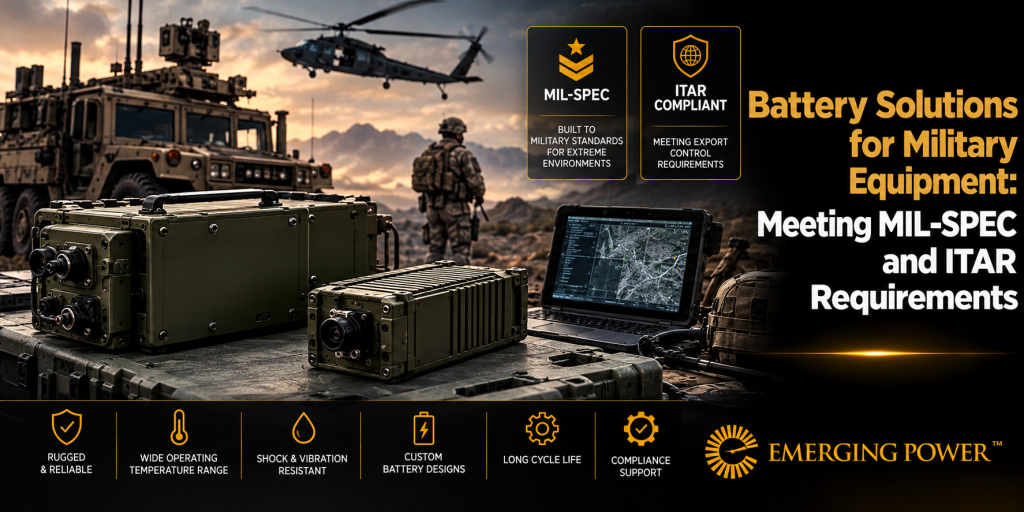
Military battery solutions are not defined by one universal ‘MIL-SPEC battery’ requirement. The correct battery design depends on the platform, procurement specification, environmental profile, electrical load, battery chemistry, interface, logistics plan, and whether defense technical data or articles are controlled under U.S. export regulations.
For OEMs and defense contractors, the safest approach is to identify the exact contractual and technical requirements first, then design, document, test, and manufacture the battery pack against those requirements.
What Does MIL-SPEC Mean for a Battery Pack?
MIL-SPEC is a broad term used for U.S. military specifications, standards, handbooks, and related procurement requirements. A battery project may be governed by a battery-specific performance specification, an interface standard, environmental test requirements, drawing notes, program-specific requirements, or a combination of these.
The Defense Logistics Agency’s ASSIST database lists active battery documents such as MIL-PRF-32383 for sealed rechargeable batteries used in portable military communications electronics.
Another active document, MIL-STD-3078, addresses interoperability for replaceable batteries used in Army equipment.
The key point: do not select a test plan simply because a standard is commonly associated with military equipment. The procuring activity, contract, drawing, statement of work, and system requirements determine what actually applies.
What Is ITAR and When Does It Matter?
The International Traffic in Arms Regulations, or ITAR, are administered by the U.S. Department of State’s Directorate of Defense Trade Controls. ITAR controls specified defense articles, defense services, technical data, exports, temporary imports, and related activities associated with items on the United States Munitions List.
The Department of State explains the framework on its official ITAR and Export Controls portal.
Not every product sold to a military customer is automatically ITAR-controlled. Classification and program requirements matter. OEMs should work with their export-control and legal teams to determine jurisdiction, classification, authorization, data handling, and supplier obligations.
Emerging Power is ITAR registered and supports military and defense battery programs that require controlled handling of applicable technical data.
Core Design Requirements for Military Battery Packs
Requirement | Why It Matters |
Temperature | Field equipment may face severe heat, cold, storage, or rapid temperature changes. |
Shock and vibration | Vehicles, airborne systems, carried equipment, and transport can expose packs to mechanical stress. |
Ingress/environment | Humidity, water, dust, salt, or other environmental exposure may influence enclosure and sealing. |
Power profile | Radios, optics, UAVs, displays, and computing systems can have very different peak and continuous loads. |
Weight and size | Soldier-carried and airborne equipment are highly sensitive to mass and volume. |
Storage/service life | Defense logistics may require long storage periods and predictable readiness. |
Traceability | Controlled programs often require robust documentation and component traceability. |
Interoperability | Some programs require defined interfaces, form factors, connectors, or replaceability. |
Military Battery Chemistry Selection
Military equipment may use rechargeable lithium-ion, LiFePO4, lithium-polymer, lithium primary, NiMH, or other chemistries depending on mission requirements. Chemistry selection should consider energy density, power, operating temperature, storage life, charging logistics, safety, weight, and availability.
Our military battery solutions support applications including communications equipment, rugged computers, training systems, night vision equipment, UAVs, and other defense electronics.
For long-life non-rechargeable applications, our custom lithium primary battery packs can be evaluated where the load profile and program requirements favor primary lithium.
Testing Is Program-Specific
Military battery qualification can include electrical, mechanical, environmental, safety, and transportation testing. Exact tests and acceptance limits should be derived from the applicable contract and technical baseline.
- Incoming component inspection and supplier controls.
- In-process inspection during assembly.
- Electrical functional testing and end-of-line automated testing.
- Mechanical verification for new designs.
- Temperature, shock, vibration, humidity, immersion, or other environmental tests when specified.
- Transportation testing for applicable lithium battery designs.
- Documented first-article or qualification testing when required by the program.
A strong quality plan also defines test equipment, pass/fail limits, calibration, traceability, nonconformance handling, and records retention.
ITAR Registration Is Not the Same as Product Certification
This distinction is important for procurement teams. ITAR registration relates to defense trade activities and regulatory obligations. It is not a product safety certification and does not mean every battery automatically meets every military specification.
Likewise, passing one military or transportation test does not establish compliance with all requirements for a defense platform. Compliance should be mapped requirement by requirement.
A Practical Military Battery Development Workflow
- Confirm program jurisdiction, data-handling requirements, and supplier access controls.
- Identify every applicable drawing, specification, interface standard, environmental requirement, and test method.
- Define voltage, energy, current, runtime, storage, temperature, dimensions, weight, and charging requirements.
- Select cells and chemistry based on the mission profile rather than commercial availability alone.
- Design the electrical protection, BMS, mechanical enclosure, connector, harness, and labeling.
- Build prototypes or first articles and verify fit, function, ruggedness, and integration.
- Execute qualification and acceptance testing to the program-defined requirements.
- Freeze the controlled bill of materials and production process.
- Maintain traceability, inspection records, revision control, and change management through production.
Frequently Asked Questions
What is a MIL-SPEC battery?
The term usually refers to a battery designed, manufactured, or qualified to specified U.S. military requirements. There is no single MIL-SPEC that applies to every battery. The correct requirements depend on the equipment and procurement program.
Does a military battery manufacturer need to be ITAR registered?
It depends on the activities performed and whether the company manufactures or exports defense articles or furnishes defense services subject to ITAR. The State Department administers ITAR, and organizations should obtain appropriate export-control guidance for their specific activities.
Does ITAR registration mean a battery is MIL-SPEC compliant?
No. ITAR registration and MIL-SPEC conformance address different issues. A battery must be evaluated against the technical requirements applicable to the program.
What tests are common for military batteries?
Depending on the program, testing may address electrical performance, temperature, shock, vibration, humidity, ingress, storage, charging, safety, and transportation. The applicable specification should define the actual tests and limits.
Design Military Power Around the Mission
A defense battery is only successful if the complete system performs against its mission and contractual requirements. We support OEMs from requirements review and cell selection through custom battery design, testing, documentation, and production.
Learn more about our custom battery design capabilities or contact us to review a military battery requirement.