Choosing a Li-ion battery supplier is not simply a purchasing decision. For an OEM, the supplier you select can influence product safety, performance, regulatory compliance, production continuity, and long-term support.
A competitive quote is important, but price alone does not tell you where the cells come from, how each battery pack is tested, what happens if a component becomes unavailable, or whether the supplier can support your product as it moves from prototype to production.
Before signing a supply or manufacturing agreement, OEM teams should evaluate the supplier from both an engineering and supply-chain perspective.
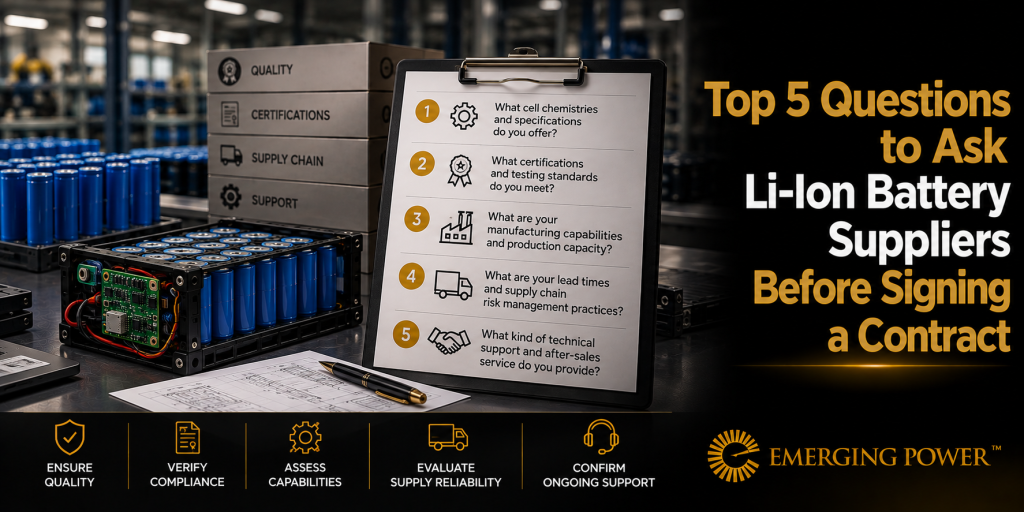
Here are five important questions to ask Li-ion battery suppliers before making a long-term commitment.
Before choosing a lithium-ion battery supplier, ask about:
The strongest supplier should be able to provide clear, documented answers rather than relying on general assurances.
Start with one of the most fundamental questions: Who manufactures the cells inside the battery pack?
Not all lithium-ion cells are equal. Cell manufacturer, chemistry, capacity, discharge characteristics, temperature performance, consistency, and authenticity can all influence the finished battery pack.
Ask the supplier:
This is especially important for OEM products expected to remain in production for several years. An undocumented cell substitution can affect electrical performance, mechanical fit, qualification status, and potentially regulatory testing.
When evaluating a custom lithium-ion battery pack manufacturer, look beyond the pack-level specification and understand the underlying supply chain.
Emerging Power maintains relationships with established Tier I cell manufacturers and works with multiple battery chemistries to match cell selection to the requirements of the application.
Traceability gives OEMs greater visibility into what is actually being installed in their products. It also makes it easier to investigate quality issues, manage engineering changes, and maintain consistency as production scales.
A strong supplier should be able to explain not only what cell it uses, but why that cell is appropriate for your application.
A supplier may provide a battery that meets the specification on paper, but OEMs also need to understand how that specification is maintained during production.
Ask prospective suppliers about their quality management system and the tests performed during incoming inspection, assembly, and final production.
Important questions include:
For custom packs, testing may need to cover voltage, capacity, current output, protection circuitry, BMS functionality, communications, temperature sensing, charging behavior, or other application-specific requirements.
A capable custom battery pack manufacturer should be able to build quality requirements into the design and production process rather than treating testing as an afterthought.
Emerging Power, for example, states that it maintains ISO 9001:2015 and AS9100:2016 quality certifications and supports automated end-of-line functional testing for new battery designs.
Certifications are useful indicators, but buyers should also ask how the quality system is applied to their particular program.
A more useful question than simply asking, “Are you ISO certified?” is:
“What controls will you use to maintain the quality and consistency of our battery pack from the first article through recurring production?”
That question reveals much more about the supplier’s manufacturing discipline.
Lithium-ion batteries are subject to safety and transportation requirements, and the exact requirements depend on the battery design, application, destination market, and shipping method.
Before signing a contract, determine who is responsible for identifying, coordinating, documenting, and paying for required testing and certification.
For transportation, lithium cells and batteries offered for transport generally must meet the applicable tests in UN Manual of Tests and Criteria, Part III, subsection 38.3.
According to the Pipeline and Hazardous Materials Safety Administration’s lithium battery guidance, lithium battery manufacturers and subsequent distributors must make applicable UN 38.3 test summary information available.
Ask your supplier:
Depending on the product and market, additional requirements or standards may also need to be considered. These can vary significantly, so the compliance plan should be established early rather than after the product design is complete.
PHMSA explains that lithium battery test summaries provide standardized information intended to support traceability and accountability for battery designs offered for transportation.
A supplier saying that a battery is “UN 38.3 compliant” should not automatically end the discussion. Ask for the documentation applicable to the battery design you intend to purchase.
If your product requires more than a standard catalog battery, determine whether the supplier is primarily a reseller or whether it has the engineering resources needed to develop and support a custom solution.
A true engineering partner should understand the battery as part of your overall product system.
Discuss requirements such as:
Your supplier should be able to explain the tradeoffs involved rather than simply building to an incomplete specification.
For example, maximizing energy density may affect thermal behavior, cost, cycle life, or other design considerations. Changing the pack configuration can also influence enclosure dimensions, BMS requirements, and certification strategy.
Working with an experienced battery pack design and engineering team early in development can help OEMs identify these tradeoffs before the design is locked.
Emerging Power’s project management process includes initial technical review, preliminary design, design and development, first articles, customer evaluation, and production approval.
Before contracting with a supplier, ask:
“What happens between our first specification and full production?”
A clearly defined process should address design review, prototypes or first articles, validation, design revisions, customer approval, production documentation, and change control.
The answer can reveal whether the supplier is prepared to support a long-term OEM program or simply fulfill individual purchase orders.
Even a technically excellent battery is of little value if it cannot be delivered when your production line needs it.
That makes supply continuity one of the most important areas to evaluate before signing a long-term battery agreement.
Ask:
You should also understand where engineering, assembly, testing, and final quality control take place.
A supplier with broad battery manufacturing capabilities may provide more options when an OEM needs to move from early development into sustained production.
A quoted production lead time tells only part of the story.
OEM procurement teams should consider supply continuity, including cell availability, component lifecycle management, alternate sourcing, manufacturing capacity, change notification, and communication when disruptions occur.
The objective is not simply receiving the first production order on time. It is building a supply arrangement capable of supporting the product throughout its commercial life.
Before approving a supplier, your engineering, quality, and procurement teams should be able to answer the following:
Evaluation Area | What to Verify |
Cell sourcing | Cell manufacturer, approved sourcing channels, lot traceability |
Engineering | Electrical, mechanical, BMS, charger and integration capabilities |
Quality | Quality system, incoming inspection, production controls, final testing |
Compliance | Applicable UN 38.3 documentation and product-specific certification support |
Manufacturing | Facility capabilities, production controls and scalability |
Supply chain | Lead times, component availability and continuity planning |
Change control | Process for component, cell and design changes |
Support | Engineering access and post-production technical support |
If a prospective supplier cannot provide clear answers in these areas, investigate further before committing the product to that supply chain.
Price differences between suppliers can be legitimate, but unusually low pricing should prompt additional questions.
Potential warning signs include limited cell traceability, unclear compliance documentation, unwillingness to discuss component substitutions, no defined quality or change-control process, limited engineering support, and vague answers about production capacity.
Another concern is a supplier that recommends a battery before fully understanding the application.
Battery selection should consider the actual load profile, operating environment, mechanical constraints, charging system, expected life, safety requirements, and certification needs.
The right question is not simply “How much does this battery cost?”
It is:
“Can this supplier consistently deliver the right battery for our product throughout its required lifecycle?”
OEMs should also understand whether they are dealing with a battery distributor, supplier, assembler, or full-service manufacturer.
The distinction becomes important when the project requires custom electrical design, mechanical engineering, BMS development, testing, regulatory coordination, or ongoing design changes.
If you are still comparing potential partners, read our guide to the difference between a lithium-ion battery supplier and manufacturer.
Look for reliable cell sourcing, traceability, documented quality processes, appropriate regulatory expertise, strong engineering capabilities, production testing, supply-chain stability, and the ability to support your required production volumes.
The appropriate certifications depend on the supplier’s role, industry, application, and target market. Quality management certifications such as ISO 9001 or industry-specific systems can be relevant, while the battery itself may require separate safety, transportation, or product-specific testing.
UN 38.3 refers to transportation-related testing defined in the UN Manual of Tests and Criteria for lithium cells and batteries. The test series addresses conditions such as altitude simulation, thermal testing, vibration, shock, external short circuit, impact or crush, overcharge, and forced discharge, as applicable.
Yes, when applicable. PHMSA states that manufacturers and subsequent distributors of covered lithium cells and batteries must make the required lithium battery test summary available. OEMs should verify that the documentation corresponds to the battery design being supplied.
Not necessarily. Unit price should be evaluated alongside cell quality, engineering support, testing, compliance, traceability, lead time, supply continuity, warranty terms, and lifecycle support. A lower initial price can become more expensive if the supplier creates redesigns, production interruptions, or quality problems.
Ideally, battery engineering should begin early in product development. Early involvement gives engineering teams more flexibility to optimize battery chemistry, size, capacity, BMS requirements, charging, thermal behavior, enclosure design, and certification planning before the overall product architecture is fixed.
Selecting among Li-ion battery suppliers requires more than comparing price, capacity, and lead time.
Before signing a contract, investigate five areas carefully: cell sourcing, quality control, compliance, engineering capability, and long-term supply continuity.
A strong supplier should be willing to explain where its cells come from, how battery packs are designed and tested, what documentation is available, how engineering changes are managed, and how it plans to support your production requirements over time.
For OEMs developing products for medical, military, industrial, communications, instrumentation, tracking, or other demanding applications, those capabilities can be just as important as the battery specification itself.
Emerging Power provides custom battery design and manufacturing support for OEM applications, including lithium-ion, lithium polymer, lithium iron phosphate, lithium primary, and other battery chemistries.
Our team supports projects from initial technical review and cell selection through battery design, BMS integration, first articles, testing, compliance support, and production.
Explore Emerging Power’s custom battery design capabilities or request a quote to discuss your battery requirements with our team.