


Introduction
As industries become more dependent on advanced electronics and portable power systems, the demand for safe, high-performance, and reliable energy solutions continues to grow. From medical devices to defense equipment, battery failure is not just inconvenient—it can be critical.
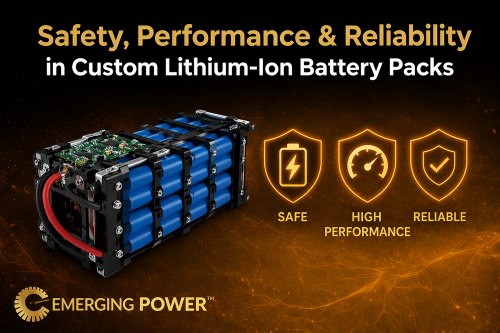
This is why custom lithium-ion battery packs are engineered with a strong focus on safety, performance optimization, and long-term reliability. Unlike standard batteries, these solutions are designed to meet precise operational requirements while minimizing risks and maximizing efficiency.
Why Safety, Performance & Reliability Matter
In real-world applications, battery systems often operate under extreme conditions—high loads, temperature variations, and continuous usage cycles. A poorly designed battery pack can lead to:
- Overheating or thermal runaway
- Reduced lifespan and performance degradation
- System downtime or failure
- Safety hazards including fire or explosion
Custom battery packs are built to mitigate these risks through advanced engineering and testing.
1. Safety in Custom Lithium-Ion Battery Packs
Safety is the foundation of any lithium-ion battery design.
Key Safety Components
Battery Management System (BMS)
The BMS acts as the brain of the battery pack. It continuously monitors:
- Voltage levels
- Current flow
- Temperature
- State of charge (SOC)
It prevents:
- Overcharging
- Over-discharging
- Short circuits
Thermal Management Systems
Temperature control is critical. Custom battery packs integrate:
- Heat sinks
- Cooling systems (passive or active)
- Thermal sensors
These components prevent overheating and ensure stable operation.
Protection Circuits
Additional safety layers include:
- Overcurrent protection
- Short-circuit protection
- Cell balancing mechanisms
Rigorous Testing & Compliance
Custom battery packs undergo:
- Environmental testing (temperature, humidity)
- Mechanical testing (shock, vibration)
- Electrical safety validation
They are designed to meet industry standards such as UL, IEC, and UN certifications.
2. Performance Optimization in Custom Battery Packs
Performance is about delivering consistent, efficient power under varying conditions.
Key Performance Factors
Cell Selection & Chemistry
Different lithium-ion chemistries impact performance:
- Lithium Cobalt Oxide (LCO): High energy density
- Lithium Manganese Oxide (LMO): Balanced safety and performance
- Lithium Iron Phosphate (LFP): High stability and long life
Choosing the right chemistry ensures optimal output for the application.
Energy Density & Power Output
Custom packs are designed to:
- Maximize energy storage in limited space
- Deliver high discharge rates for demanding systems
This is crucial for applications like industrial equipment and communication devices.
Efficient Charging Mechanisms
Lithium-ion batteries typically use:
- Constant Current / Constant Voltage (CC/CV) charging
This ensures:
- Faster charging
- Reduced stress on cells
- Extended battery life
Design Flexibility
Custom battery packs can be optimized for:
- Compact size constraints
- Weight reduction
- Unique form factors
This flexibility is especially valuable in modern electronic devices.
3. Reliability & Longevity
Reliability ensures that a battery performs consistently over time, even in demanding environments.
Key Reliability Factors
Cycle Life
Most lithium-ion battery packs offer:
- 300–500 charge cycles (or more depending on design)
Custom engineering can extend this lifespan through better materials and control systems.
Environmental Resistance
Custom battery packs are built to operate in:
- Extreme temperatures (-20°C to 60°C or wider ranges)
- Harsh industrial environments
Specialized cells can function even in -40°C to 70°C conditions.
Cell Balancing
Uneven charge distribution can reduce battery life. Custom packs include:
- Active or passive balancing systems
- Uniform energy distribution across cells
Robust Mechanical Design
Durability is ensured through:
- Strong enclosures
- Vibration-resistant construction
- Shock protection
Real-World Applications Where It Matters Most
Medical Devices
- Requires absolute reliability and safety
- No tolerance for failure
Communication Systems
- Continuous uptime is essential
- Stable power delivery required
Industrial Equipment
- High load handling
- Harsh environment resistance
Military & Defense
- Extreme durability and performance
- Mission-critical reliability
Best Practices for Choosing a Custom Battery Pack
To ensure optimal safety, performance, and reliability:
- Work with experienced battery design engineers
- Define clear power and environmental requirements
- Choose the right lithium-ion chemistry
- Ensure compliance with safety standards
- Prioritize testing and validation
Future Trends in Custom Lithium-Ion Battery Design
Emerging innovations are improving all three pillars:
- Advanced battery chemistries with higher energy density
- Smart BMS with AI-based monitoring
- Safer, more sustainable battery materials
- Faster and more efficient charging technologies
These advancements will further enhance reliability and safety across industries.
Conclusion
Safety, performance, and reliability are not optional—they are critical pillars in the design of custom lithium-ion battery packs. By combining advanced engineering, intelligent systems, and rigorous testing, custom battery solutions deliver dependable power for even the most demanding applications.
Whether powering life-saving medical devices or high-performance industrial systems, investing in a custom-engineered battery pack ensures efficiency, longevity, and peace of mind.
Call-to-Action (CTA)
Looking for a safe, high-performance custom lithium-ion battery pack tailored to your exact requirements?
Partner with experienced battery design specialists to develop a solution that meets your power, safety, and reliability standards.
Request a custom battery consultation today and take the first step toward a smarter, safer energy solution.