Why Lithium-Ion Battery Packs Overheat in Industrial Equipment

Industrial equipment is becoming smarter, faster, and more power-intensive. From automated manufacturing systems and robotics to UAVs, IoT sensors, and medical devices, lithium-ion battery packs are now the backbone of modern industrial operations.

But there is one growing concern that manufacturers, OEMs, and engineering teams cannot ignore:


Battery overheating.

In 2025, lithium-ion battery incidents continue to rise globally. A recent business safety study found that 54% of businesses experienced lithium-ion battery-related incidents, including overheating, smoking, or fire events. (aviva.com)

For industrial applications, overheating is more than a maintenance issue. It can lead to:

  • Equipment shutdowns
  • Reduced battery lifespan
  • Thermal runaway
  • Compliance failures
  • Safety hazards
  • Expensive downtime

This is why OEM manufacturers increasingly rely on custom-engineered battery solutions from companies like Emerging Power to improve thermal stability, safety, and long-term performance.


Why Lithium-Ion Battery Packs Overheat

Lithium-ion batteries naturally generate heat during charging and discharging. However, industrial environments create extreme operating conditions that accelerate temperature buildup.


The Most Common Causes of Battery Overheating


1. High Discharge Loads

Industrial equipment often demands continuous high-current output. Heavy machinery, robotics, UAV systems, and industrial sensors place intense stress on battery cells.

When the discharge rate exceeds the battery pack’s thermal handling capability, internal temperatures rise rapidly.


2. Poor Thermal Management

Many off-the-shelf battery packs lack advanced cooling systems or airflow optimization.

Without proper heat dissipation:

  • Internal hotspots form
  • Cell imbalance increases
  • Performance degrades faster

Research published in 2025 found that optimized thermal management systems significantly reduced maximum battery temperatures and improved temperature uniformity. (arXiv)


Industrial Environments Make the Problem Worse

Industrial applications expose batteries to conditions far beyond consumer electronics.

Industrial Condition Impact on Battery
High ambient temperatures Faster thermal buildup
Continuous operation Increased heat generation
Dust and contaminants Reduced cooling efficiency
Vibration and shock Internal cell damage
Fast charging cycles Thermal stress
Enclosed equipment spaces Limited airflow

This is especially critical in:

  • Manufacturing automation
  • Medical devices
  • Military equipment
  • Drones and UAVs
  • Asset tracking systems
  • IoT devices

Emerging Power’s industrial battery solutions are specifically engineered to address these demanding environments with advanced battery management systems, custom enclosure design, and thermal safety integration.


What Is Thermal Runaway?

Thermal runaway occurs when heat generation inside a lithium-ion battery exceeds its ability to dissipate heat.

Once this chain reaction begins:

  1. Internal temperatures rise uncontrollably
  2. Electrolytes begin decomposing
  3. Flammable gases form
  4. Cells may ignite or explode

Recent fire safety reports show lithium-ion battery fires are becoming one of the fastest-growing industrial safety risks globally. (The Guardian)


Warning Signs Your Battery Pack Is Overheating

Industrial operators should monitor for:

  • Excessive surface heat
  • Swelling battery packs
  • Burning odors
  • Sudden capacity drops
  • Slow charging performance
  • Unexpected shutdowns
  • Voltage irregularities

Ignoring these signs can lead to catastrophic equipment failure.


How Custom Battery Engineering Prevents Overheating

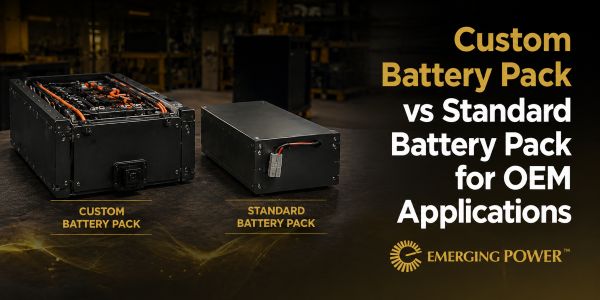
One of the biggest mistakes OEM manufacturers make is using standard battery packs for complex industrial applications.

Industrial systems require custom battery engineering based on:

  • Load profiles
  • Operating temperature
  • Duty cycles
  • Environmental exposure
  • Safety requirements

This is where Emerging Power differentiates itself.

With over 120 years of combined engineering experience, the company develops custom battery pack solutions for:

  • Medical applications
  • Military systems
  • IoT devices
  • Smart meters
  • UAVs
  • Industrial OEM equipment (emergingpower)

Key Solutions That Reduce Battery Overheating

Advanced Battery Management Systems (BMS)

A smart BMS monitors:

  • Temperature
  • Voltage
  • Current flow
  • Cell balancing

This prevents unsafe thermal conditions before they escalate.

Thermal Management Design

Modern battery packs now integrate:

  • Air cooling systems
  • Heat sinks
  • Thermal interface materials
  • Phase change materials (PCM)

Studies published in 2025 show PCM-based cooling systems can significantly reduce battery temperatures under heavy operating loads. (arXiv)

High-Quality Cell Selection

Cheap or low-quality lithium-ion cells are more prone to:

  • Internal short circuits
  • Heat buildup
  • Premature degradation

Emerging Power uses high-quality cells from trusted global manufacturers for safer long-term operation. (emergingpower)

Why OEMs Are Moving Toward Custom Battery Packs in 2026

Industrial systems are becoming more compact and energy-dense.

That means:

  • Higher power demand
  • Less airflow
  • More thermal risk

As a result, OEMs are shifting toward:

  • Custom lithium battery packs
  • Intelligent BMS integration
  • Ruggedized battery enclosures
  • Application-specific thermal design

The goal is not just longer runtime.

It is operational reliability and safety.

Battery Overheating Prevention Checklist

Best Practices for Industrial Equipment

Do:

  • Use certified battery packs
  • Monitor operating temperatures
  • Implement thermal management systems
  • Use smart charging protocols
  • Perform regular battery inspections
  • Choose application-specific battery designs

Avoid:

  • Overcharging
  • Poor ventilation
  • Low-quality chargers
  • Generic battery replacements
  • Excessive fast charging
  • Ignoring swelling or heat buildup

FAQs

Why do lithium-ion batteries overheat in industrial equipment?

Industrial systems create high electrical loads, elevated temperatures, and continuous operation cycles that generate excess heat inside battery cells.

What causes thermal runaway in lithium-ion batteries?

Thermal runaway typically occurs due to overheating, internal short circuits, overcharging, or poor thermal management.

Are custom battery packs safer than standard battery packs?

Yes. Custom battery packs are engineered specifically for the equipment’s power demands, environmental conditions, and safety requirements.

How does a Battery Management System help?

A BMS monitors voltage, temperature, and current to prevent unsafe operating conditions and improve battery lifespan.

Which industries are most affected by battery overheating?

Industries using high-performance portable equipment such as manufacturing, medical, defense, IoT, robotics, and UAV systems face the highest overheating risks.

Final Thoughts

Battery overheating is no longer just a technical issue. It is a major operational and safety concern for industrial OEMs in 2025 and beyond.

As industrial systems become more power-dense, manufacturers need battery solutions engineered for:

  • safety
  • thermal stability
  • durability
  • regulatory compliance
  • long-term performance

Emerging Power provides custom lithium-ion battery pack solutions designed specifically for demanding industrial applications, helping OEMs reduce thermal risk while improving reliability and performance.

Looking for a Custom Industrial Battery Solution?

Explore Emerging Power’s custom battery design services to build safer, more reliable battery systems for your industrial equipment.

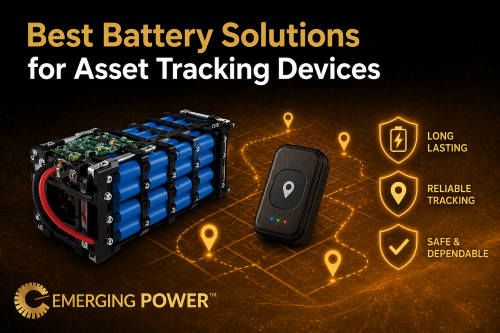
Best Battery Solutions for Asset Tracking Devices

Why Battery Selection Matters More Than Ever

Asset tracking devices are becoming smarter, smaller, and more connected, but none of that matters if the battery cannot support real-world performance. In modern tracking systems, battery selection directly affects uptime, reporting frequency, maintenance schedules, total cost of ownership, and even device size.

For OEMs and product developers, the best battery solution is not simply the battery with the highest capacity. It is the power system that matches the device’s communication method, reporting behavior, operating environment, physical constraints, and expected service life. That is especially important in asset tracking, where products may be deployed across logistics, fleet operations, industrial sites, warehouses, and outdoor environments.

No Single Battery Fits Every Asset Tracker

Not all asset tracking devices have the same power profile. A BLE tag used for indoor tools has very different battery requirements than a GPS-enabled outdoor tracker or a cellular-connected asset monitor sending frequent location updates.

Battery performance depends on a few critical variables:

  • how often the device transmits data,
  • how much power each transmission consumes,
  • whether GPS is used continuously or occasionally,
  • how large the battery can physically be,
  • and how often the device can realistically be serviced.

That is why the best battery solution for asset tracking devices depends on the use case, not just the specification sheet.

1. Primary Lithium Battery Packs for Long-Life, Low-Maintenance Deployments

For remote or difficult-to-access assets, primary lithium battery packs are often one of the best solutions. These batteries are especially effective when the asset tracker is expected to stay in the field for years without regular charging or service.

Primary battery packs are ideal for devices that:

  • transmit at low to moderate intervals,
  • operate on low-power wide-area networks,
  • need long shelf life,
  • and are installed in places where battery replacement is infrequent but still more practical than recharging.

This type of battery solution is often a strong fit for container tracking, equipment monitoring, supply chain visibility, and low-touch industrial tracking applications. When the goal is ultra-long runtime with minimal maintenance, primary lithium packs are often the preferred choice.

2. Rechargeable Lithium-Ion Battery Packs for GPS and Cellular Asset Tracking

When an asset tracking device sends frequent updates, uses GPS often, or depends on higher-energy communication methods such as LTE-M or NB-IoT, rechargeable lithium-ion battery packs are usually the better option.

These battery packs make sense when:

  • the device has a higher power draw,
  • regular location updates are required,
  • the asset is reused often,
  • or the product can be recharged during its operating cycle.

Rechargeable lithium-ion battery packs are well suited for fleet devices, mobile equipment, service assets, and high-value goods that need more frequent visibility. In these use cases, relying on a disposable battery may create unnecessary maintenance cost or require a physically larger battery pack than the design can support.

A properly engineered rechargeable solution can help balance runtime, recharge cycles, device size, and performance reliability.

3. Compact Battery Solutions for BLE Tags and Indoor Asset Tracking

For indoor asset tracking applications, compact battery solutions are often the best fit. BLE-based trackers are typically used for tools, carts, medical devices, returnable transport items, and inventory inside controlled environments.

These devices usually do not need the same wide-area communication capabilities as GPS or cellular trackers, so their power demands are lower. That makes smaller battery formats more practical.

Compact battery solutions are best when the design priorities include:

  • small size,
  • low weight,
  • low power consumption,
  • and long runtime within a short-range environment.

If the tracker operates inside a warehouse, facility, or campus with nearby gateways or mobile devices, a compact low-power battery design can deliver efficient performance without increasing the size or weight of the product.

4. Custom Battery Packs for Rugged and Specialized Tracking Applications

Off-the-shelf batteries are not always enough for asset tracking devices used in demanding environments. Some products need to survive extreme temperatures, vibration, impact, moisture, or irregular transmission loads. Others must fit into highly specific enclosures or integrate with custom electronics.

In these situations, custom battery packs are often the best solution.

A custom battery pack can be designed around:

  • the required form factor,
  • peak and average current draw,
  • battery chemistry,
  • connector and wiring requirements,
  • charging behavior,
  • BMS integration,
  • PCB design,
  • testing and regulatory requirements.

For rugged outdoor GPS trackers, industrial monitoring systems, or specialized communications devices, custom battery design often delivers better long-term performance than trying to adapt a standard battery to a non-standard application.

5. Hybrid Power Strategies for High-Value Mobile Assets

In some tracking applications, the best solution is not simply a bigger battery. A better answer may be a more optimized power strategy.

For high-value mobile assets, hybrid power planning can include:

  • rechargeable battery packs,
  • smart sleep and wake behavior,
  • efficient GPS scheduling,
  • lower-power communication logic,
  • and careful management of transmission frequency.

In other words, the battery solution should be designed as part of the whole system, not as an isolated component. A device that wakes too often, transmits unnecessarily, or runs GPS longer than needed will drain even a large battery faster than expected.

For OEMs, improving battery life often comes from better electrical and firmware design as much as from choosing the right battery chemistry.

How to Choose the Right Battery for an Asset Tracking Device

Start With Reporting Frequency

The more often the tracker transmits, the more energy it consumes. A device that sends one update per day has a very different battery profile than one sending updates every few minutes. Understanding the required reporting interval is the first step in choosing the right battery solution.

Match the Battery to the Communication Technology

The network matters. BLE, LoRaWAN, LTE-M, and NB-IoT all have different power demands. Cellular-based tracking generally requires more energy than short-range or lower-power wireless technologies, so battery size and recharge strategy should be selected accordingly.

Design for the Real Operating Environment

Lab performance does not always match field performance. Outdoor trackers must deal with temperature swings, weather exposure, vibration, and physical stress. Indoor devices may have tighter size constraints but longer usable life. The battery should be selected based on where the device will actually operate, not just on nominal battery specs.

Think Beyond Battery Capacity

Battery capacity is important, but it is not the whole story. The best battery solution for asset tracking devices may also depend on:

  • safety requirements,
  • enclosure limitations,
  • charging method,
  • compliance needs,
  • product lifecycle expectations,
  • and the integration of BMS, PCB, and programming.

For many OEM products, custom battery design leads to better outcomes than choosing a generic battery pack.

What OEMs Should Prioritize in 2026

As asset tracking continues to expand across logistics, connected infrastructure, industrial equipment, and fleet visibility, battery strategy is becoming a major product differentiator.

OEMs should prioritize:

  • longer field life,
  • lower maintenance needs,
  • reliable performance in real conditions,
  • compact mechanical design,
  • safe and tested battery systems,
  • and power solutions that scale with actual deployment needs.

The products that succeed will be the ones that match battery design to the real application instead of relying on a one-size-fits-all approach.

Final Thoughts

The best battery solutions for asset tracking devices depend on how the tracker communicates, how often it reports, where it operates, and how easy it is to service in the field.

For low-maintenance, long-life deployments, primary lithium battery packs are often the best option. For GPS and cellular asset trackers that demand more frequent updates, rechargeable lithium-ion battery packs are usually the stronger choice. For indoor tags and compact devices, small-form-factor low-power battery solutions make the most sense. And for rugged or highly specialized applications, custom battery pack design is often the only way to achieve the right balance of performance, safety, reliability, and size.

The right battery solution is not just about powering the device. It is about enabling the entire tracking system to perform reliably, efficiently, and cost-effectively over time.

If you are developing an asset tracking product and need a battery solution built around real-world requirements, Emerging Power can help. From custom battery pack design to rechargeable and primary battery solutions for GPS, IoT, and communications devices, the team supports OEMs through concept, design, testing, and production.

Contact Emerging Power to discuss the best battery solution for your next asset tracking device.

FAQs

What is the best battery for asset tracking devices?

The best battery depends on the application. Primary lithium batteries are often best for long-life, low-maintenance deployments, while rechargeable lithium-ion packs are usually better for GPS or cellular trackers with frequent updates.

Are rechargeable batteries good for GPS asset trackers?

Yes. Rechargeable lithium-ion battery packs are often a strong choice for GPS asset trackers that need frequent location updates or higher power communications.

How long should an asset tracking battery last?

That depends on reporting frequency, communication technology, battery size, environmental conditions, and device design. Some tracking devices are built for months of runtime, while others are designed for several years in the field.

What affects battery life in outdoor GPS trackers?

Battery life is affected by transmission frequency, GPS usage, temperature extremes, battery quality, and physical outdoor conditions.

Should OEMs use custom battery packs for asset tracking devices?

In many cases, yes. Custom battery packs help ensure the power solution matches the device’s size, electrical load, safety needs, and operating environment.