


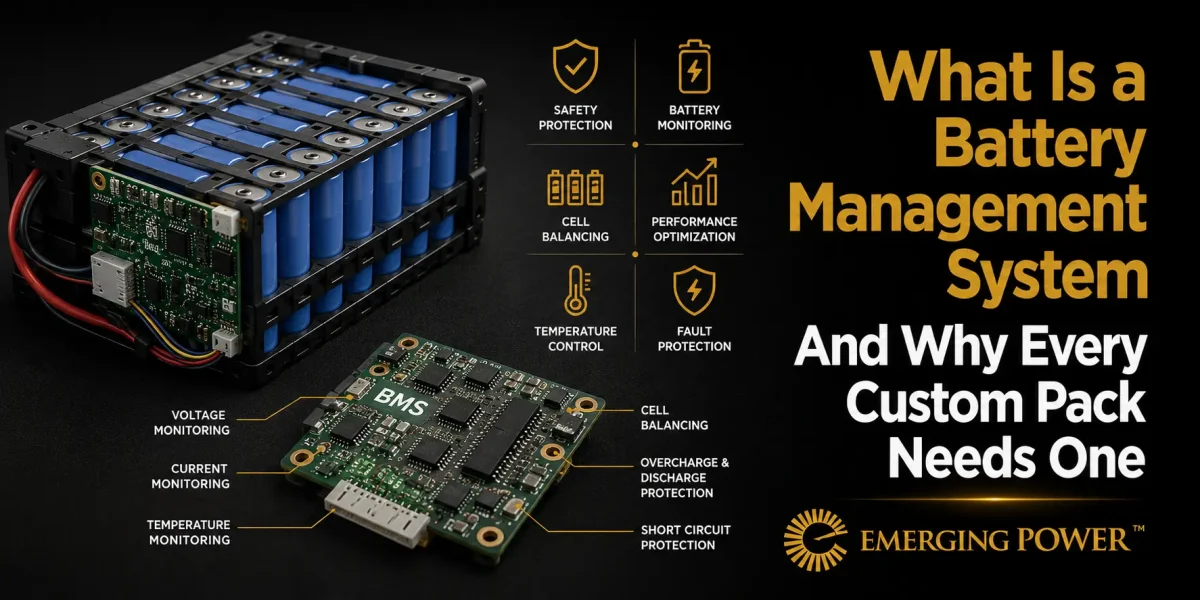
What Is a Battery Management System (BMS) and Why Every Custom Pack Needs One
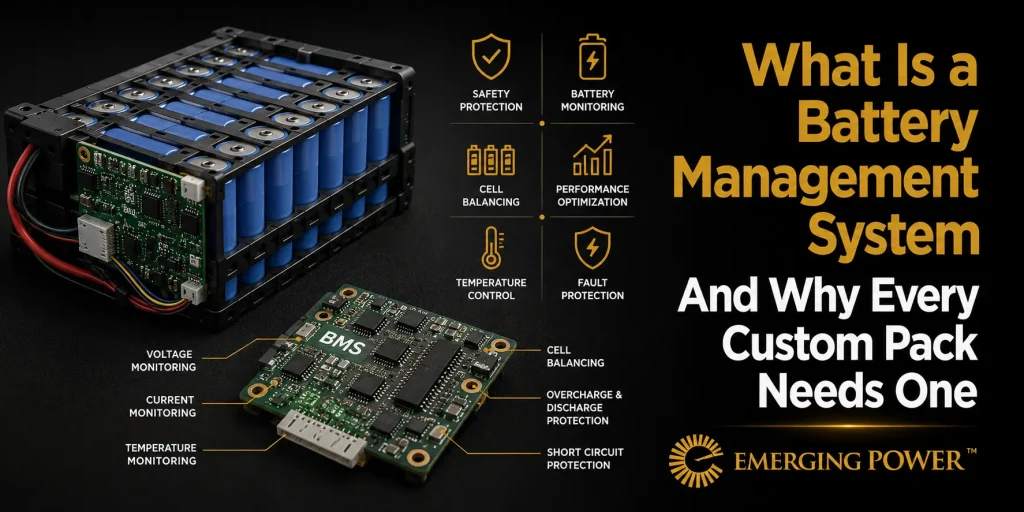
Every lithium battery pack has a hidden layer of electronics working behind the scenes to keep it safe:
The battery management system.
Whether it is powering a medical device, a drone, or an industrial sensor, a pack without a proper BMS is running blind. Most OEM teams discover this the hard way when a pack overheats, drains unevenly, or fails certification testing. As battery-powered products become more demanding in 2025 and 2026, understanding what a BMS actually does has become essential for engineers, product managers, and procurement teams. The answer lies in:
Smart monitoring, protection, and cell balancing.
What a Battery Management System Actually Does
A BMS is the electronic brain of a battery pack. It sits between the cells and the rest of the device, constantly tracking conditions such as:
- Voltage per cell
- Pack temperature
- Charge and discharge current
- State of charge
- Cycle history
This data lets the BMS make real-time decisions to keep the pack safe and performing as designed. Without this layer of intelligence, a battery pack has no way of knowing when it is being pushed past safe limits.
Why Raw Lithium Cells Cannot Be Used Alone
Lithium cells are powerful, but they are also unforgiving. Without active protection, cells can:
- Overcharge past safe voltage limits
- Discharge too deeply and lose capacity
- Overheat under high current draw
- Drift out of balance with neighboring cells
- Experience internal short circuits under stress
Any one of these conditions can shorten pack life or create a safety hazard. This is why a BMS is not optional for serious product designs, it is a core requirement. Manufacturers that skip this step often see it show up later as warranty claims, field failures, or safety recalls.
The Core Functions of a Battery Management System
Voltage Monitoring and Cell Balancing
In a multi-cell pack, no two cells are perfectly identical. Small manufacturing differences cause cells to charge and discharge at slightly different rates. Over time, this imbalance reduces total pack capacity and usable runtime. A BMS corrects this by:
- Monitoring each cell individually
- Redirecting energy to weaker cells
- Keeping the whole pack balanced across hundreds of cycles
Balancing can be done passively, by bleeding off excess energy from stronger cells as heat, or actively, by shifting energy between cells for higher efficiency. The right approach depends on the application, the pack size, and how much runtime matters.
Overcharge and Overdischarge Protection
Charging a lithium cell beyond its rated voltage, or draining it too low, can permanently damage the cell and create a fire risk. A BMS cuts off charging or discharging the moment safe limits are reached, protecting both the pack and the end user. This function alone is one of the biggest reasons regulators and certification bodies require a functioning BMS in lithium products headed for commercial or industrial use.
Thermal Monitoring
Heat is one of the fastest ways to degrade a lithium cell. A BMS tracks temperature across the pack and can throttle current or shut the pack down entirely if conditions become unsafe. In demanding environments, such as outdoor industrial equipment or military hardware, thermal monitoring becomes even more critical because ambient temperature swings add another layer of stress on top of normal charge and discharge cycles.
Current Regulation
High current draw, whether from a motor starting up or a sudden load spike, can stress a pack beyond its design limits. A BMS regulates current flow to prevent damage during these events, protecting sensitive components downstream and reducing the chance of a thermal event.
Communication and Data Reporting
Many modern BMS designs also report data back to the host device or a cloud platform, giving OEMs visibility into:
| Data Point | Why It Matters |
| State of charge | Accurate runtime estimates |
| Cycle count | Predicting end of life |
| Temperature history | Warranty and field diagnostics |
| Fault codes | Faster troubleshooting |
| Charge and discharge rate | Identifying abnormal usage patterns |
This kind of visibility is becoming increasingly important as OEMs move toward predictive maintenance models, where a device can flag a failing battery before it becomes a field issue.
Passive vs. Active Cell Balancing
Not all BMS designs balance cells the same way, and the choice affects both cost and performance.
Passive Balancing
Passive balancing bleeds excess charge from stronger cells as heat through a resistor. It is:
- Lower cost
- Simpler to design and manufacture
- Well suited to smaller packs with modest balancing needs
Active Balancing
Active balancing moves energy from stronger cells to weaker ones instead of wasting it as heat. It is:
- More efficient, especially in larger packs
- Better for applications where every percentage of runtime matters
- More complex and typically more expensive to implement
Choosing between the two depends on pack size, budget, and how critical runtime and cycle life are to the application.
Why Custom Applications Need a Custom BMS
Off-the-shelf battery packs often come with a generic BMS that is not tuned to the actual load profile of your device. A drone, a medical infusion pump, and an industrial sensor all draw power very differently. A custom BMS is engineered around:
- The specific charge and discharge profile of the application
- Required certifications such as UN38.3
- Enclosure size and thermal constraints
- Communication protocols the host system already uses
- Redundancy and fail-safe requirements for mission-critical use cases
This is where working with a custom battery pack manufacturer makes a measurable difference in performance and safety. A generic BMS might technically work, but it rarely performs at the level a purpose-built product actually needs.
Common Mistakes OEMs Make With BMS Design
Even experienced product teams run into avoidable issues when BMS design is treated as an afterthought. Some of the most common mistakes include:
- Choosing a BMS after the enclosure design is already finalized, leaving no room for proper thermal management
- Assuming a generic BMS will work with a custom cell configuration
- Underestimating the current draw of the actual application
- Failing to plan for communication between the BMS and the host device
- Skipping BMS-specific testing during the certification process
Avoiding these mistakes early saves significant time and cost later in the product development cycle.
How a BMS Affects Certification
Certification bodies evaluating a battery pack for transportation or safety compliance look closely at how the BMS behaves under stress. A well-designed BMS supports:
- Safer results during UN38.3 transportation testing
- Fewer failures during thermal and short-circuit testing
- Smoother approval processes for regulated industries like medical and defense
Building BMS design and certification planning into the same phase of a project, rather than treating them separately, tends to produce faster, more predictable outcomes.
Industries That Depend on a Reliable BMS
Medical Devices
Patient safety depends on predictable, protected power delivery in every use case. A malfunction is not just an inconvenience; it can directly affect patient outcomes.
Drones and UAVs
Flight controllers rely on stable voltage and accurate state of charge to avoid mid-flight power loss, especially during long-range or beyond-visual-line-of-sight missions.
Industrial and IoT Sensors
Long deployment cycles in the field require a BMS that protects cell health over years of use, often with little to no direct maintenance.
Military and Defense
Mission-critical equipment cannot afford unpredictable power behavior, especially in remote or hostile environments where a failure cannot simply be fixed on the spot.
BMS vs. a Simple Protection Circuit
Some low-cost devices use a basic protection circuit module instead of a full BMS. It is worth understanding the difference before assuming either one will work for your application:
- A protection circuit module typically handles only overcharge, overdischarge, and short circuit protection for a single cell or a small group of cells
- A full BMS handles multi-cell balancing, temperature monitoring, current regulation, and often communicates data back to the host device
- A protection circuit module is passive and reactive, while a BMS is active and continuously managing pack behavior
- Multi-cell packs with series or parallel configurations almost always require a full BMS, not a basic protection circuit
Choosing the wrong level of protection is one of the most common mistakes OEMs make early in a project, and it usually surfaces later during certification testing or field failures.
Common BMS Design Mistakes to Avoid
Even experienced engineering teams run into avoidable problems when a BMS is not planned correctly from the start. Some of the most frequent mistakes include:
- Selecting a BMS after the enclosure design is already locked, leaving no room for proper thermal management
- Underestimating peak current requirements, which causes the BMS to trip during normal operation
- Choosing a BMS without the communication protocol the host device actually needs
- Failing to validate balancing performance across the full range of expected cell aging
- Treating BMS firmware as an afterthought instead of testing it under real load conditions
Avoiding these issues early saves significant time and cost later in the development cycle.
How to Choose the Right BMS for Your Application
Not every BMS is built the same way, and matching the design to the application is critical. When evaluating options, consider:
- The number of cells in series and parallel, since balancing complexity increases with cell count
- Maximum continuous and peak current draw during real-world use
- Required communication protocol, such as I2C, UART, or CAN bus
- Operating temperature range, especially for outdoor, medical, or defense applications
- Whether the BMS needs to support fast charging or specific charge profiles
- Space constraints within the final enclosure
The Cost of Skipping a Proper BMS
Some OEMs try to cut costs by using a minimal protection circuit instead of a properly engineered BMS. In practice, this often leads to higher costs down the road, including:
- Warranty claims from premature battery failure
- Failed certification testing that delays product launch
- Field safety incidents that damage brand reputation
- Shorter product lifespan, leading to more frequent replacements
A well-designed BMS is a small part of the total product cost but has an outsized impact on safety, reliability, and customer satisfaction.
FAQs
What does a BMS actually protect against?
A BMS protects against overcharging, overdischarging, overheating, and current spikes that could otherwise damage the pack or create a safety risk.
Do all lithium battery packs need a BMS?
Yes. Any multi-cell lithium pack needs some level of monitoring and protection to operate safely and reliably.
Can a BMS extend battery life?
Yes. Cell balancing and protection features reduce stress on individual cells, which helps the pack retain capacity over more charge cycles.
Is a generic BMS good enough for custom products?
Not always. Generic BMS designs are not tuned to the specific load profile of your device, which can limit performance and safety margins.
What is the difference between passive and active balancing?
Passive balancing bleeds excess energy as heat, while active balancing redistributes energy between cells for higher efficiency, usually at a higher design cost.
Who designs a custom BMS for OEM products?
Custom battery engineering companies design the BMS alongside the cell configuration, enclosure, and certification plan as one integrated system.
What is the difference between active and passive cell balancing?
Passive balancing dissipates excess energy from stronger cells as heat, while active balancing transfers energy between cells directly. Active balancing is more efficient but typically costs more to implement.
How does a BMS affect certification testing?
A properly designed BMS is often required to pass safety certifications such as UN38.3, since it demonstrates that the pack can protect itself against fault conditions during transport and use.
Can a BMS be upgraded after a pack is already in production?
In most cases, BMS changes require redesigning part of the pack, so it is far more efficient to finalize BMS requirements before production begins rather than after.
How early should BMS design start in a product development cycle?
BMS design should begin during the initial requirements phase, alongside cell selection, so that thermal, communication, and certification needs are considered from the start.
Final Thoughts
A battery management system is not an add-on; it is the foundation of a safe, reliable custom battery pack. As devices demand more power in tighter enclosures, a properly engineered BMS is what separates a pack that performs for years from one that fails in the field. Emerging Power designs custom battery packs with fully integrated BMS solutions built around the exact needs of medical, industrial, defense, and UAV applications.