


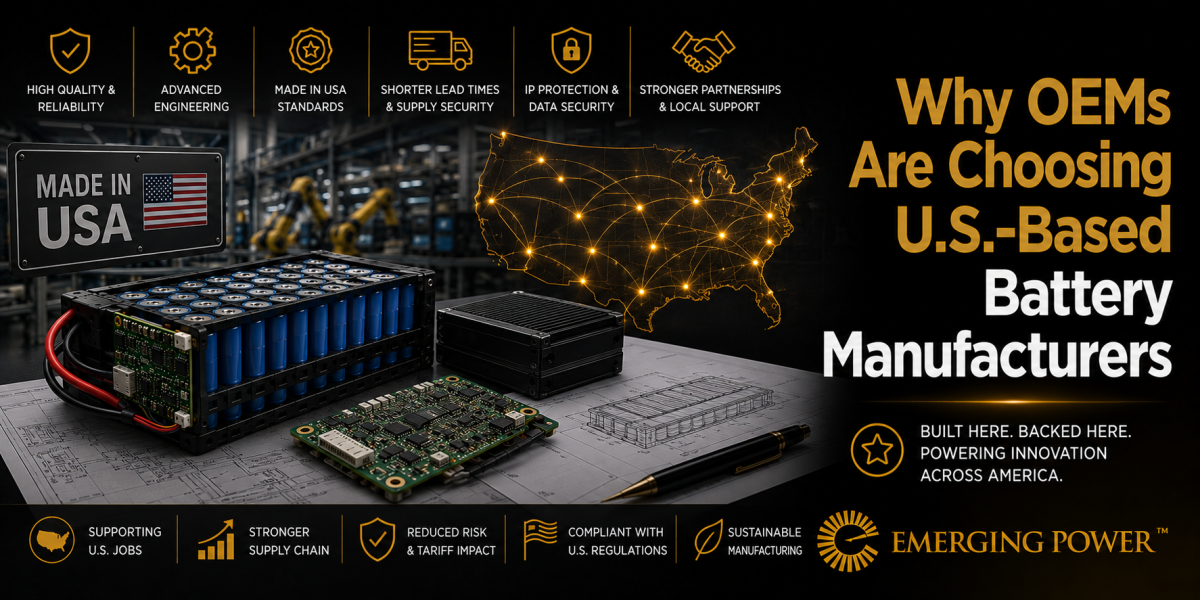
Why OEMs Are Choosing U.S.-Based Battery Manufacturers
For OEMs developing battery-powered products, selecting a battery manufacturer is no longer simply a matter of finding the lowest unit price.
Engineering support, supply chain resilience, quality control, traceability, communication, lead times, regulatory requirements, and the ability to move efficiently from prototype to production can all influence the success of a battery program.
That is one reason more OEM teams are evaluating U.S.-based battery manufacturers as part of their sourcing strategy.
NIST has identified supply chain resilience as an important issue for U.S. manufacturers and notes that bringing manufacturing closer to home can improve responsiveness and reduce exposure to international disruptions. At the same time, the U.S. Department of Energy continues to support expansion of domestic battery manufacturing and critical-material supply chains.
For OEMs, however, choosing a domestic battery manufacturer is not simply about where a battery is assembled.
The more important question is:
Can the manufacturer provide the engineering, quality, manufacturing, traceability, and long-term support required for the product?
Here are the factors driving OEM interest in U.S.-based battery manufacturing.
Why Are OEMs Moving Toward U.S.-Based Battery Manufacturers?
OEMs may choose U.S.-based battery manufacturers to gain closer engineering collaboration, greater supply chain visibility, easier communication, stronger quality oversight, and more responsive production support.
This can be particularly important when developing custom battery packs for medical equipment, industrial systems, communications equipment, UAVs, military applications, instrumentation, and other products with specialized requirements.
The battery is often deeply integrated into the finished product. Voltage, capacity, discharge requirements, physical dimensions, BMS functionality, connectors, charging, temperature range, testing, and certification requirements may all need to be considered together.
Working more closely with the manufacturer can therefore become an engineering advantage rather than simply a sourcing preference.
1. Supply Chain Resilience Has Become a Bigger Priority
For years, manufacturers optimized global supply chains primarily around cost and scale.
Recent disruptions have made resilience, supplier visibility, logistics, and continuity increasingly important considerations.
NIST’s Manufacturing Extension Partnership notes that reshoring is being driven in part by an increased emphasis on supply chain resiliency. Bringing manufacturing closer to the end customer can reduce certain risks and improve responsiveness.
For an OEM, this does not mean every component must originate in the United States. The global battery industry remains highly interconnected, and battery cells, electronics, raw materials, and other components can originate from multiple countries.
Instead, OEMs should evaluate where critical engineering, assembly, testing, quality control, and supplier management occur.
A U.S.-based battery manufacturing partner may help an OEM create a supply chain with greater visibility and more direct communication when disruptions occur.
External resource: NIST Manufacturing Extension Partnership — Supply Chain and Reshoring Guidance.
2. Faster Engineering Communication
Custom battery development is rarely a simple purchase-order transaction.
Engineers may need to discuss:
- Voltage and capacity
- Continuous and peak current
- Runtime requirements
- Cell chemistry
- Battery Management System (BMS)
- PCB design
- Charging
- Mechanical dimensions
- Connectors
- Communications
- Operating temperature
- Environmental conditions
- Regulatory requirements
- Prototype testing
When the OEM’s engineering team and battery manufacturer’s engineering team can communicate directly, questions can often be addressed earlier in the design process.
This becomes particularly valuable during prototype development and design revisions.
Emerging Power’s custom battery design services include support for battery architecture, BMS and PCB requirements, enclosures, testing, regulatory considerations, and custom programming.
The objective is not simply faster communication.
It is faster technical decision-making with fewer misunderstandings between design and manufacturing teams.
3. Better Control During Prototype-to-Production Development
A custom battery should not move directly from an initial specification into full production.
Most OEM programs move through several stages:
Requirements → Preliminary Design → Engineering → Prototype / First Article → Testing → Approval → Production
Each stage can reveal issues that require changes.
For example, prototype testing might identify:
- Unexpected thermal behavior
- Mechanical fit issues
- Connector problems
- BMS communication changes
- Runtime differences
- Charging issues
- Environmental limitations
Working with a manufacturer that provides engineering and production support can help maintain continuity as the project progresses.
Emerging Power’s project management process follows a structured development workflow that includes initial technical review, preliminary design, design and development, first articles, customer testing, and production approval.
This type of process is especially valuable when the battery is a critical subsystem rather than a replaceable commodity component.
4. Quality and Traceability Matter More for Critical Applications
Battery quality is important for every product, but the consequences of failure vary considerably by application.
A battery used in a medical device, military system, industrial instrument, communications platform, or UAV may operate under demanding conditions and require tighter controls than a basic consumer application.
Supply chain traceability is also becoming increasingly important.
In 2026, the National Institute of Standards and Technology published its Supply Chain Traceability Principles: A Manufacturing Meta-Framework, highlighting the importance of product provenance and verifiable traceability across increasingly complex manufacturing supply chains.
For OEM procurement and quality teams, useful questions include:
- Where are the battery cells sourced?
- Are components traceable?
- How are incoming materials controlled?
- What production tests are performed?
- How are design revisions documented?
- What quality systems does the manufacturer maintain?
- How are nonconforming components handled?
- What happens if a specified cell becomes unavailable?
The lowest battery price means little if quality or traceability problems create field failures, redesigns, recalls, or production interruptions.
5. Domestic Engineering Can Simplify Custom Battery Development
Many OEM products cannot use a standard battery pack.
The product may require a specific combination of:
Voltage + Capacity + Size + Weight + Current + Temperature + Communication + Safety
This can require a fully custom solution.
A capable custom lithium-ion battery pack manufacturer can support more than cell assembly.
Depending on the application, development may include:
- Cell selection
- Electrical architecture
- BMS design
- PCB development
- Mechanical engineering
- Custom enclosures
- Connectors and wiring
- Fuel-gauge functionality
- Charging systems
- Automated testing
- Prototype development
- Regulatory support
Having engineering and manufacturing teams working together can also help identify manufacturability issues before a design reaches high-volume production.
6. OEMs Want Greater Supply Chain Visibility
Supply chain visibility has become increasingly important for manufacturers managing long product lifecycles.
A product may remain in production for years, while individual battery cells and electronic components can change, become constrained, or reach end-of-life.
OEM teams therefore need to think beyond the first production order.
They should ask:
What happens if a critical battery component becomes unavailable two years from now?
A strong battery manufacturing partner should help manage component sourcing and communicate changes that could affect the approved battery design.
This is especially important because switching cells is not always a simple substitution. Different cells can have different electrical, thermal, mechanical, and certification characteristics.
The battery manufacturer therefore becomes part of the OEM’s broader supply chain risk-management strategy.
7. Regulatory and Testing Support Can Begin Earlier
Lithium battery compliance should be considered during development rather than after the battery design has been finalized.
Changing a cell, pack configuration, enclosure, or other significant component late in the process can create additional testing and validation requirements.
OEM teams should identify relevant transportation, safety, industry, and end-market requirements early.
For example, lithium cells and batteries offered for transport are subject to the testing provisions of UN 38.3.
A manufacturer experienced with battery testing and regulatory requirements can help OEM teams identify these considerations during development rather than discovering them near product launch.
Emerging Power’s custom battery pack design checklist provides a structured overview of cell selection, BMS design, mechanical engineering, testing, and certification considerations.
8. U.S. Battery Manufacturing Is Receiving Strategic Attention
Domestic battery manufacturing has also become a broader U.S. supply-chain priority.
In August 2026, the U.S. Department of Energy announced $500 million for seven selected projects intended to expand U.S. critical-mineral processing, battery manufacturing, and recycling capacity.
For OEMs, government investment does not automatically make a domestic supplier the right supplier.
However, it demonstrates the strategic importance being placed on developing greater domestic battery and critical-material capabilities.
OEM sourcing teams should still evaluate each manufacturer based on engineering capability, quality systems, production capacity, supply chain, certifications, testing capabilities, and application experience.
External resource: U.S. Department of Energy — Critical Mineral and Battery Supply Chain Manufacturing Initiatives.
9. Domestic Does Not Mean the Entire Supply Chain Is Domestic
This distinction is important.
A U.S.-based battery manufacturer is not necessarily the same as a battery manufactured entirely from U.S.-origin materials and components.
The lithium-ion battery supply chain is global.
Cells, electronic components, raw materials, connectors, and other components may originate internationally even when battery engineering, pack assembly, testing, or manufacturing takes place in the United States.
OEM buyers should therefore avoid relying on a “U.S.-based” label alone.
Instead, ask the manufacturer to explain:
- Where engineering occurs
- Where packs are assembled
- Where cells are sourced
- What alternative cell sources are available
- Where testing occurs
- How components are traced
- What manufacturing locations may be used
- How supply disruptions are managed
That creates a much more useful sourcing comparison.
10. When Does a U.S.-Based Battery Manufacturer Make the Most Sense?
Domestic battery manufacturing can be particularly valuable when a project requires substantial engineering interaction or has demanding quality, documentation, or production requirements.
Examples include:
Medical Equipment
Medical OEMs may need strict documentation, repeatable production, controlled components, and long-term product support.
Military and Defense Systems
Defense applications may involve specialized environmental, documentation, traceability, manufacturing, or regulatory requirements.
Industrial Equipment
Industrial batteries may need to withstand temperature extremes, vibration, high current, long duty cycles, or unusual mechanical environments.
UAV and Drone Systems
UAV battery packs often require careful optimization of weight, energy density, discharge performance, thermal behavior, and mechanical packaging.
Communications and Instrumentation
These applications may require custom form factors, intelligent BMS functionality, specialized connectors, or long product lifecycles.
In each case, the value of the manufacturer extends beyond assembling cells.
The manufacturer becomes part of the product-development team.
How Should OEMs Evaluate a U.S.-Based Battery Manufacturer?
Before selecting a domestic battery supplier, evaluate its capabilities rather than choosing based on location alone.
Ask:
- Does the manufacturer provide in-house engineering support?
- Can it develop both electrical and mechanical battery systems?
- Does it have BMS and PCB design capabilities?
- Which battery chemistries does it support?
- Where does it source cells and critical components?
- What quality certifications does it maintain?
- Can it support prototype, pilot, and production quantities?
- What testing capabilities are available?
- Can it assist with regulatory requirements?
- How does it manage component obsolescence and supply interruptions?
- Where will your specific battery pack actually be manufactured?
- Can it support the product throughout its expected lifecycle?
For additional guidance, see Emerging Power’s article on how to choose the right custom battery pack manufacturer.
Why OEMs Work With Emerging Power
Emerging Power provides custom and standard battery solutions for OEM applications.
The company’s primary R&D, development, and manufacturing operations are based in New Jersey, while its broader manufacturing capabilities include facilities in the U.S., Mexico, and Asia.
Its capabilities include:
- Custom battery pack design
- Lithium-ion and other battery chemistries
- BMS and PCB development
- Mechanical and enclosure design
- Prototype development
- Automated testing
- Regulatory and certification support
- Manufacturing and assembly
- Supply chain support
Emerging Power also reports ISO 9001:2015 and AS9100:2016 certification and works with OEM applications across medical, military, communications, instrumentation, industrial, and other markets.
OEM teams can review Emerging Power’s battery manufacturing and engineering capabilities to determine which services align with their project requirements.
Frequently Asked Questions
Why are OEMs choosing U.S.-based battery manufacturers?
OEMs may choose U.S.-based battery manufacturers for closer engineering collaboration, improved communication, greater supply chain visibility, quality oversight, prototype support, and more responsive manufacturing. The importance of each factor depends on the product and its requirements.
Are U.S.-manufactured battery packs more expensive?
Not necessarily in terms of total program cost. Unit pricing may differ between domestic and overseas suppliers, but OEMs should also evaluate engineering costs, freight, inventory, lead times, quality, testing, redesign risk, supply interruptions, and lifecycle support.
Does U.S.-based manufacturing mean all battery components are made in America?
No. A battery pack may be engineered, assembled, or tested in the United States while using cells or other components sourced internationally. OEMs should ask manufacturers for specific information about component sourcing and manufacturing locations.
What should OEMs look for in a domestic battery manufacturer?
OEMs should evaluate engineering capabilities, cell sourcing, BMS expertise, mechanical design, quality systems, testing, certification support, traceability, manufacturing capacity, supply chain management, and long-term product support.
Can a U.S. battery manufacturer design custom lithium-ion battery packs?
Yes. Custom battery manufacturers can design packs around application-specific voltage, capacity, current, size, weight, temperature, BMS, charging, connector, communication, and environmental requirements.
Is domestic battery manufacturing better for supply chain resilience?
Domestic manufacturing can reduce some logistics and communication risks and may improve responsiveness, but location alone does not guarantee supply chain resilience. OEMs should also evaluate cell sourcing, component availability, alternative suppliers, inventory strategy, production capacity, and risk-management processes.
The Bottom Line
OEMs are reconsidering how battery sourcing affects the complete product lifecycle.
Price remains important, but it is only one part of the decision.
Engineering collaboration, quality, traceability, supply chain visibility, testing, communication, and long-term manufacturing support can be equally important when a battery is a critical part of the finished product.
For products requiring custom battery engineering, a U.S.-based battery manufacturer can provide closer collaboration from initial requirements through prototype development and production.
The key is not simply choosing a domestic supplier.
It is choosing a battery partner with the technical, quality, manufacturing, and supply chain capabilities required for the application.
Looking for a U.S.-Based Custom Battery Manufacturer?
Emerging Power supports OEM battery projects from technical review and custom battery design through prototypes, testing, and production.
Request a Custom Battery Pack Quote to discuss your voltage, capacity, form factor, BMS, operating environment, testing, and production requirements.