IoT Battery Chemistry: How to Choose the Right Battery

Compare lithium primary, lithium-ion, LiFePO4, Li-polymer, and NiMH for IoT devices. Learn how load profile, wireless bursts, temperature, and service life affect battery choice.

Powering IoT Devices: Choosing the Right Battery Chemistry
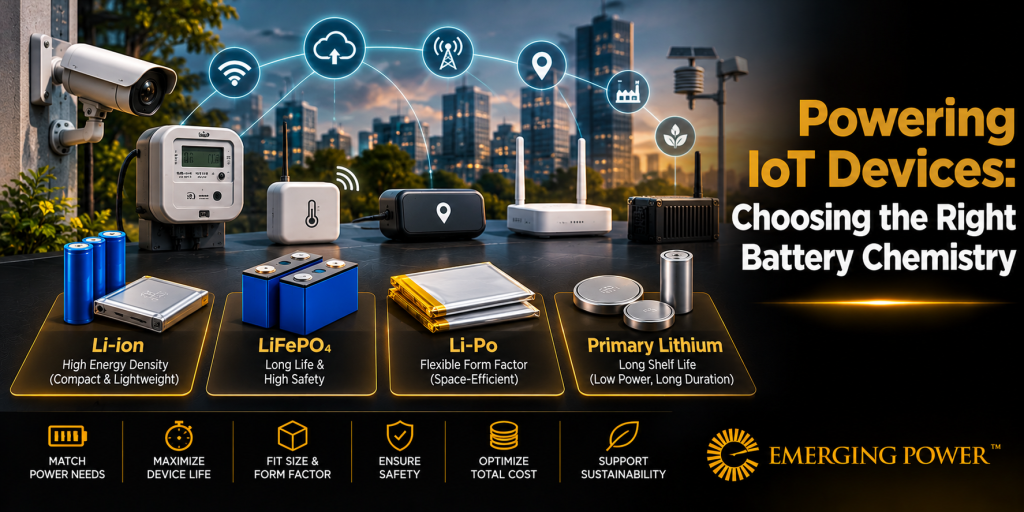
IoT battery chemistry

The best battery chemistry for an IoT device depends on how the device actually uses power. A sensor that sleeps for hours and transmits for a few seconds has a very different battery requirement from a rechargeable gateway, handheld reader, or always-connected edge device.

For IoT engineering, chemistry selection should start with the load profile, deployment environment, maintenance plan, wireless protocol, expected service life, and physical constraints. Only then should teams compare lithium primary, lithium-ion, LiFePO4, lithium-polymer, NiMH, or other options.

What Should You Consider When Choosing an IoT Battery?

  • Average current during normal operation.
  • Peak current during radio transmission, startup, sensing, or actuation.
  • Sleep current and wake-up frequency.
  • Required service life between battery replacements or charges.
  • Operating and storage temperature.
  • Available volume and weight.
  • Whether the device is rechargeable or maintenance-free.
  • Self-discharge and long-term storage behavior.
  • Required voltage profile throughout discharge.
  • Safety, transportation, regulatory, and field-service requirements.

Why the Load Profile Matters More Than Capacity Alone

An IoT device can have a very low average current but still require short high-current pulses from a cellular, Wi-Fi, LoRa, satellite, or other radio. If the selected cell cannot support those pulses without excessive voltage drop, the device may reset or lose communication even though the battery still has substantial stored energy.

That is why an accurate current-versus-time profile is more useful than a single ‘average current’ figure during battery selection.

Common Battery Chemistries for IoT Devices

Chemistry

Typical Strength

Common IoT Fit

Lithium primary

Long storage/service life; high energy; non-rechargeable

Remote sensors, meters, trackers, low-maintenance nodes

Lithium-ion

Rechargeable; strong energy density

Gateways, portable connected devices, frequently used equipment

Lithium-polymer

Rechargeable; flexible form factors

Compact or shape-constrained connected products

LiFePO4

Rechargeable; cycle life and thermal-stability advantages

Industrial IoT, repeated cycling, larger embedded systems

NiMH

Rechargeable; established chemistry

Selected legacy or specialized designs

When Lithium Primary Is a Strong IoT Choice

Primary lithium can be attractive when an IoT device must operate for long periods without recharging. Remote environmental sensors, utility devices, asset-monitoring nodes, alarms, and equipment installed in hard-to-access locations are common examples.

Our custom lithium primary battery pack page explains that primary lithium chemistries can provide high specific energy and maintain useful voltage over long periods, although internal impedance and pulse requirements must be evaluated carefully.

For pulse-heavy wireless devices, engineers may need a cell specifically suited for high-rate pulses, additional capacitance, or a hybrid energy architecture. The correct solution depends on pulse magnitude, duration, frequency, temperature, and minimum system voltage.

When Rechargeable Lithium-Ion Makes More Sense

Rechargeable lithium-ion is often a better fit when the IoT device is serviced regularly, has access to charging power, communicates frequently, or requires a higher sustained energy throughput over its lifecycle.

  • Portable connected instruments.
  • Rechargeable gateways.
  • Smart handheld equipment.
  • Connected medical or industrial devices.
  • Devices with displays, processors, cameras, or frequent wireless communication.

Rechargeable designs also require a charging strategy and protection functions. Depending on the pack, that can include overcharge, over-discharge, current protection, temperature monitoring, state-of-charge measurement, and host communication.

Where LiFePO4 Fits in Industrial IoT

LiFePO4 can be a strong candidate for industrial IoT equipment that values cycle life, repeated charging, power capability, and thermal-stability characteristics more than maximum energy density.

We develop custom LiFePO4 packs for OEM applications where the complete electrical and mechanical design supports LFP’s trade-offs.

Temperature Can Change the Answer

Outdoor and industrial IoT devices can operate in conditions far outside a laboratory. Low temperature can reduce available power and increase voltage drop, while elevated temperature can accelerate degradation in many rechargeable chemistries.

Specify realistic operating, charging, storage, and transportation temperatures before cell selection. A battery that works well at room temperature may not satisfy a remote sensor installed outdoors year-round.

How to Estimate IoT Battery Life

A basic battery-life estimate starts with usable battery capacity divided by average current, but real deployments are more complex. Engineers should account for sleep current, transmit pulses, conversion losses, self-discharge, temperature, battery aging, minimum operating voltage, and safety margin.

For long-life IoT nodes, field life should be validated through representative load testing rather than relying only on nominal capacity printed on a cell datasheet.

Designing the Battery Pack Around the IoT Device

Our IoT battery pack solutions are developed around the end product and include inspection during incoming receiving, manufacturing, and completion.

A custom IoT battery pack can also integrate the connector, wire harness, enclosure, protection circuit, fuel gauge, BMS, labeling, and test requirements needed for production.

For broader engineering support, see our custom battery design services.

Frequently Asked Questions

What battery is best for an IoT sensor?

There is no single best battery for every IoT sensor. Long-life remote sensors often favor lithium primary chemistries, while rechargeable connected devices may favor lithium-ion, Li-polymer, or LiFePO4. The correct choice depends on current profile, temperature, service interval, size, voltage, and safety requirements.

Why do wireless transmissions affect battery selection?

Wireless radios can create short current peaks that are much higher than a device’s average current. The battery must support those pulses without excessive voltage drop.

Are rechargeable batteries always better for IoT?

No. Rechargeable batteries make sense when charging is practical, and lifecycle energy demand justifies it. For remote devices expected to run for years without maintenance, a primary battery may be more appropriate.

What reduces IoT battery life?

High transmit frequency, poor sleep-current control, cold temperatures, excessive self-discharge, high pulse loads, conversion losses, and an undersized battery can all reduce field life.

Choose Chemistry From the Duty Cycle, Not the Label

The right IoT battery supports the device’s real load profile for the required field life and environment. We help OEM teams compare chemistry, cell format, pack architecture, protection, testing, and production requirements before they lock the design.

Discuss your IoT power requirements with us through our contact page.
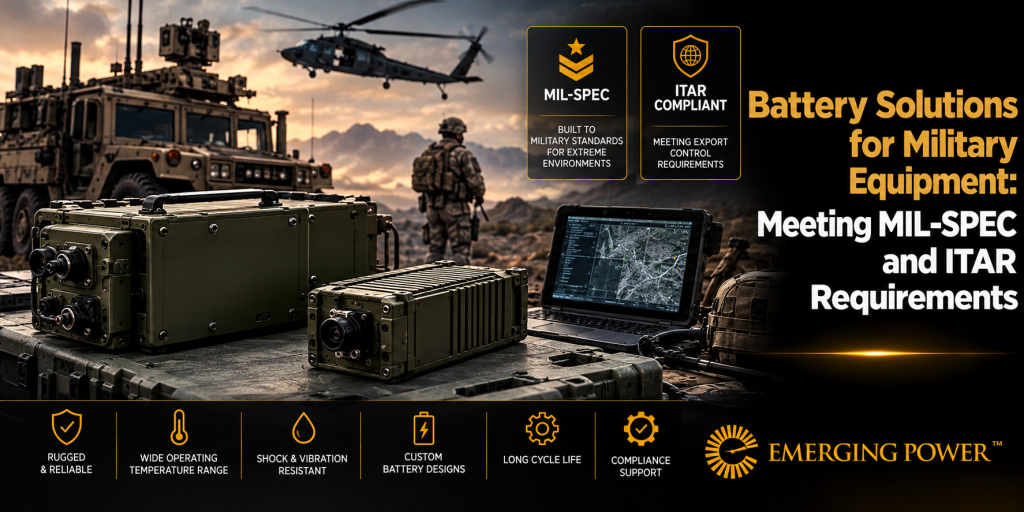
Military Battery Solutions: MIL-SPEC & ITAR Requirements

Military battery solutions are not defined by one universal ‘MIL-SPEC battery’ requirement. The correct battery design depends on the platform, procurement specification

Battery Solutions for Military Equipment: Meeting MIL-SPEC and ITAR Requirements

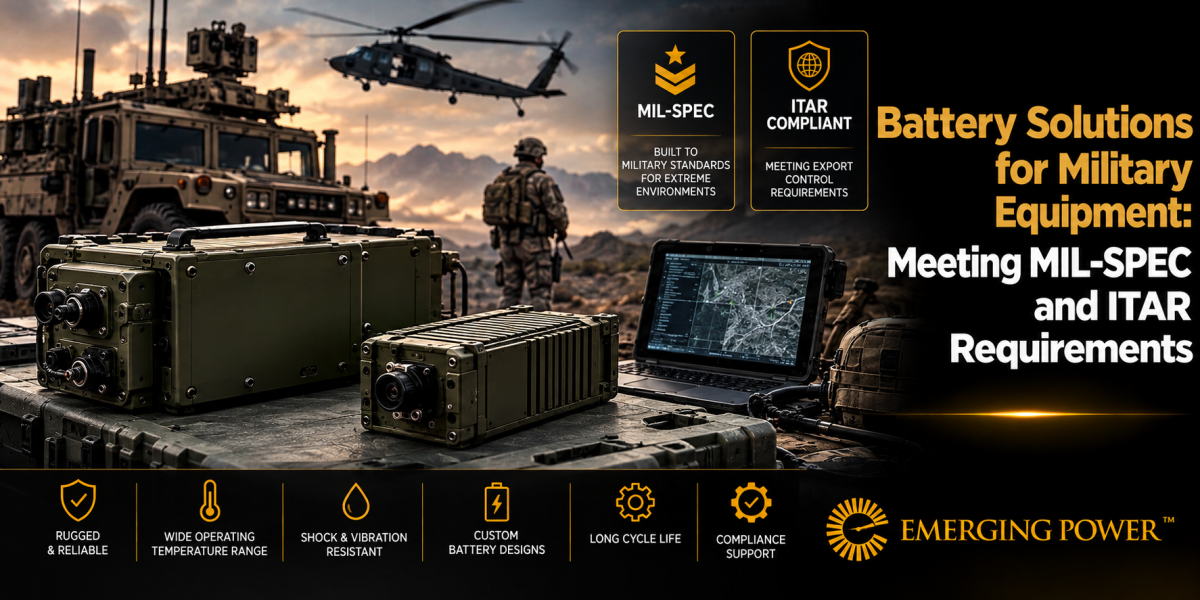
Military battery solutions designed for MIL-SPEC and ITAR-controlled equipment

Military battery solutions are not defined by one universal ‘MIL-SPEC battery’ requirement. The correct battery design depends on the platform, procurement specification, environmental profile, electrical load, battery chemistry, interface, logistics plan, and whether defense technical data or articles are controlled under U.S. export regulations.

For OEMs and defense contractors, the safest approach is to identify the exact contractual and technical requirements first, then design, document, test, and manufacture the battery pack against those requirements.

What Does MIL-SPEC Mean for a Battery Pack?

MIL-SPEC is a broad term used for U.S. military specifications, standards, handbooks, and related procurement requirements. A battery project may be governed by a battery-specific performance specification, an interface standard, environmental test requirements, drawing notes, program-specific requirements, or a combination of these.

The Defense Logistics Agency’s ASSIST database lists active battery documents such as MIL-PRF-32383 for sealed rechargeable batteries used in portable military communications electronics.

Another active document, MIL-STD-3078, addresses interoperability for replaceable batteries used in Army equipment.

The key point: do not select a test plan simply because a standard is commonly associated with military equipment. The procuring activity, contract, drawing, statement of work, and system requirements determine what actually applies.

What Is ITAR and When Does It Matter?

The International Traffic in Arms Regulations, or ITAR, are administered by the U.S. Department of State’s Directorate of Defense Trade Controls. ITAR controls specified defense articles, defense services, technical data, exports, temporary imports, and related activities associated with items on the United States Munitions List.

The Department of State explains the framework on its official ITAR and Export Controls portal.

Not every product sold to a military customer is automatically ITAR-controlled. Classification and program requirements matter. OEMs should work with their export-control and legal teams to determine jurisdiction, classification, authorization, data handling, and supplier obligations.

Emerging Power is ITAR registered and supports military and defense battery programs that require controlled handling of applicable technical data.

Core Design Requirements for Military Battery Packs

Requirement

Why It Matters

Temperature

Field equipment may face severe heat, cold, storage, or rapid temperature changes.

Shock and vibration

Vehicles, airborne systems, carried equipment, and transport can expose packs to mechanical stress.

Ingress/environment

Humidity, water, dust, salt, or other environmental exposure may influence enclosure and sealing.

Power profile

Radios, optics, UAVs, displays, and computing systems can have very different peak and continuous loads.

Weight and size

Soldier-carried and airborne equipment are highly sensitive to mass and volume.

Storage/service life

Defense logistics may require long storage periods and predictable readiness.

Traceability

Controlled programs often require robust documentation and component traceability.

Interoperability

Some programs require defined interfaces, form factors, connectors, or replaceability.


Military Battery Chemistry Selection

Military equipment may use rechargeable lithium-ion, LiFePO4, lithium-polymer, lithium primary, NiMH, or other chemistries depending on mission requirements. Chemistry selection should consider energy density, power, operating temperature, storage life, charging logistics, safety, weight, and availability.

Our military battery solutions support applications including communications equipment, rugged computers, training systems, night vision equipment, UAVs, and other defense electronics.

For long-life non-rechargeable applications, our custom lithium primary battery packs can be evaluated where the load profile and program requirements favor primary lithium.

Testing Is Program-Specific

Military battery qualification can include electrical, mechanical, environmental, safety, and transportation testing. Exact tests and acceptance limits should be derived from the applicable contract and technical baseline.

  • Incoming component inspection and supplier controls.
  • In-process inspection during assembly.
  • Electrical functional testing and end-of-line automated testing.
  • Mechanical verification for new designs.
  • Temperature, shock, vibration, humidity, immersion, or other environmental tests when specified.
  • Transportation testing for applicable lithium battery designs.
  • Documented first-article or qualification testing when required by the program.

A strong quality plan also defines test equipment, pass/fail limits, calibration, traceability, nonconformance handling, and records retention.

ITAR Registration Is Not the Same as Product Certification

This distinction is important for procurement teams. ITAR registration relates to defense trade activities and regulatory obligations. It is not a product safety certification and does not mean every battery automatically meets every military specification.

Likewise, passing one military or transportation test does not establish compliance with all requirements for a defense platform. Compliance should be mapped requirement by requirement.

A Practical Military Battery Development Workflow

  1. Confirm program jurisdiction, data-handling requirements, and supplier access controls.
  2. Identify every applicable drawing, specification, interface standard, environmental requirement, and test method.
  3. Define voltage, energy, current, runtime, storage, temperature, dimensions, weight, and charging requirements.
  4. Select cells and chemistry based on the mission profile rather than commercial availability alone.
  5. Design the electrical protection, BMS, mechanical enclosure, connector, harness, and labeling.
  6. Build prototypes or first articles and verify fit, function, ruggedness, and integration.
  7. Execute qualification and acceptance testing to the program-defined requirements.
  8. Freeze the controlled bill of materials and production process.
  9. Maintain traceability, inspection records, revision control, and change management through production.

Frequently Asked Questions

What is a MIL-SPEC battery?

The term usually refers to a battery designed, manufactured, or qualified to specified U.S. military requirements. There is no single MIL-SPEC that applies to every battery. The correct requirements depend on the equipment and procurement program.

Does a military battery manufacturer need to be ITAR registered?

It depends on the activities performed and whether the company manufactures or exports defense articles or furnishes defense services subject to ITAR. The State Department administers ITAR, and organizations should obtain appropriate export-control guidance for their specific activities.

Does ITAR registration mean a battery is MIL-SPEC compliant?

No. ITAR registration and MIL-SPEC conformance address different issues. A battery must be evaluated against the technical requirements applicable to the program.

What tests are common for military batteries?

Depending on the program, testing may address electrical performance, temperature, shock, vibration, humidity, ingress, storage, charging, safety, and transportation. The applicable specification should define the actual tests and limits.

Design Military Power Around the Mission

A defense battery is only successful if the complete system performs against its mission and contractual requirements. We support OEMs from requirements review and cell selection through custom battery design, testing, documentation, and production.

Learn more about our custom battery design capabilities or contact us to review a military battery requirement.

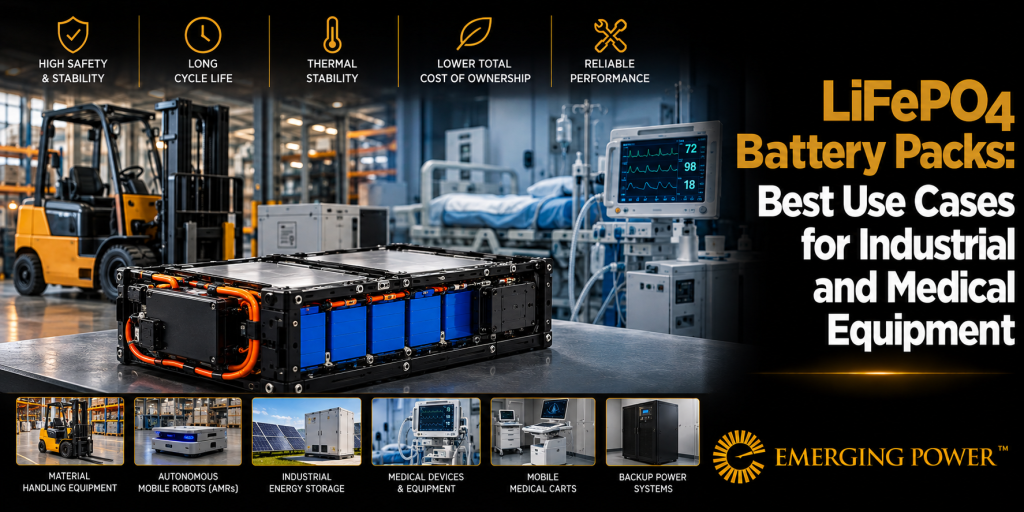
LiFePO4 Battery Packs: Best Use Cases for Industrial and Medical Equipment

LiFePO4 battery packs, also called lithium iron phosphate or LFP battery packs, are often a strong choice when an OEM needs long cycle life

LiFePO4 Battery Packs for Industrial & Medical Equipment

LiFePO4 battery packs for industrial and medical equipment

LiFePO4 battery packs, also called lithium iron phosphate or LFP battery packs, are often a strong choice when an OEM needs long cycle life, stable power delivery, and a chemistry that prioritizes thermal stability over maximum energy density. For industrial and medical equipment, that balance can be more important than simply fitting the greatest possible watt-hours into the smallest space.

What Is a LiFePO4 Battery Pack?

A LiFePO4 battery pack is a rechargeable lithium-ion battery system that uses lithium iron phosphate as the cathode material. Compared with several other lithium-ion chemistries, LFP generally trades some energy density for strong cycle-life potential, good power capability, and favorable thermal-stability characteristics.

The U.S. Department of Energy describes LFP as one of the major lithium-ion cathode classes and notes differences among lithium-ion chemistries in energy, lifecycle, and safety characteristics. See the DOE lithium-ion technology assessment.

At Emerging Power, we design and manufacture custom LiFePO4 battery packs around the electrical, mechanical, environmental, and regulatory needs of the end product.

Why OEMs Consider LiFePO4 for Demanding Equipment

  • Long cycle-life potential for equipment that is charged and discharged frequently.
  • Strong power capability for loads that require dependable current delivery.
  • Thermal-stability characteristics that can be attractive in safety-focused designs.
  • Relatively flat discharge behavior that can support predictable equipment operation.
  • Availability in configurations suitable for custom pack design, monitoring, protection, and enclosure integration.

These characteristics do not make LFP automatically correct for every product. The finished pack still has to be evaluated for voltage, runtime, peak load, charging, operating temperature, dimensions, weight, safety controls, certification, and lifecycle.

Best Industrial Use Cases for LiFePO4 Battery Packs

1. Portable Industrial Instrumentation

Test instruments, inspection systems, portable analyzers, and field-service equipment often need repeatable daily cycling and dependable output. Where the design can accommodate LFP’s lower energy density relative to some other lithium-ion chemistries, its lifecycle and power characteristics can make it attractive.

2. Robotics and Automated Equipment

Robotics, automated guided equipment, mobile industrial platforms, and control systems can create variable loads with repeated charge-discharge cycles. A properly engineered LFP pack can be designed around the required current, duty cycle, communications, and protection needs.

3. Backup and Standby Power

Industrial controllers, communication hardware, and critical monitoring equipment may require rechargeable backup power. The decision should be based on expected standby duration, recharge strategy, required service life, and environmental conditions rather than chemistry name alone.

4. Equipment Exposed to Frequent Cycling

When a battery is expected to cycle repeatedly over the product’s operating life, cycle-life economics can matter more than the lowest initial battery cost. This is one situation in which LFP is often worth evaluating early.

Best Medical Use Cases for LiFePO4 Battery Packs

Medical battery selection requires a system-level view. The appropriate chemistry depends on whether equipment is portable, mobile, stationary, patient-connected, frequently cycled, used as backup power, or expected to operate under defined fault conditions.

Our medical battery pack capabilities include custom design, traceability, serialization, and automated testing for OEM medical applications.

  • Portable analyzers and diagnostic instruments where long service life and predictable output are priorities.
  • Medical carts and mobile clinical equipment that undergo frequent daily charging.
  • Monitoring equipment that needs rechargeable backup power.
  • Healthcare devices where the pack can accommodate LFP’s size and energy-density trade-offs.
  • Medical systems that require custom electronics, protection, traceability, or end-of-line testing.

For portable rechargeable lithium systems used in medical devices, the FDA currently recognizes IEC 62133-2 as a consensus standard. Applicable standards still depend on the finished medical device and its intended use.

LiFePO4 vs. Other Lithium-Ion Chemistries

Design Factor

LiFePO4 / LFP

Higher-energy Li-ion chemistries

Energy density

Typically lower

Often higher

Cycle-life potential

Often a key strength

Varies by chemistry and use

Power capability

Can be strong

Varies widely

Thermal stability

Often a key reason to evaluate LFP

Chemistry dependent

Best fit

Long-life, power, safety-conscious designs

Space- and weight-constrained high-energy designs

The right comparison is not ‘Which chemistry is best?’ It is ‘Which chemistry best matches the product’s load profile, runtime target, environment, dimensions, safety requirements, and lifecycle?’

What Engineers Should Specify Before Choosing LFP

  1. Nominal and maximum pack voltage.
  2. Required usable energy and target runtime.
  3. Peak and continuous current.
  4. Charge time and charging method.
  5. Expected cycle life and calendar life.
  6. Operating and storage temperature range.
  7. Available pack dimensions and weight limit.
  8. Required BMS, fuel-gauge, communications, and protection functions.
  9. Mechanical shock, vibration, ingress, and enclosure requirements.
  10. Applicable medical, industrial, safety, and transportation standards.

Do LiFePO4 Packs Still Need a BMS?

Yes, many rechargeable LFP systems require battery management and protection functions. Depending on the pack, these may include overcharge protection, over-discharge protection, overcurrent protection, temperature monitoring, cell balancing, state-of-charge estimation, and communication with the host device.

Our custom battery design process can integrate BMS electronics, charging support, enclosures, automated testing, and regulatory support as required.

Frequently Asked Questions

Are LiFePO4 batteries good for medical equipment?

They can be. LiFePO4 is worth evaluating when cycle life, power capability, thermal stability, and repeated charging are important. The final choice must still be based on the medical device’s specific electrical, mechanical, safety, and regulatory requirements.

Are LiFePO4 batteries safer than lithium-ion batteries?

LiFePO4 is itself a lithium-ion chemistry. It offers better thermal stability than several other cathode chemistries, but pack safety still depends on cell quality, electrical protection, charging, mechanical design, manufacturing controls, and the finished application.

What is the main disadvantage of LiFePO4?

A common trade-off is lower energy density than some other lithium-ion chemistries. That can matter when the product has strict size or weight limits.

Can LiFePO4 batteries be used in industrial equipment?

Yes. Common applications include instrumentation, automation, robotics, backup power, communications, and other equipment that requires frequent cycling or dependable power.

Build the Battery Around the Equipment

For industrial and medical OEMs, choosing LiFePO4 should be a requirements-driven engineering decision. We review the load profile, runtime, temperature, physical constraints, protection needs, lifecycle targets, testing, and compliance requirements before recommending a chemistry and pack architecture.

If you are evaluating LFP for a new or existing product, request a quote and share your electrical and mechanical requirements with our team.

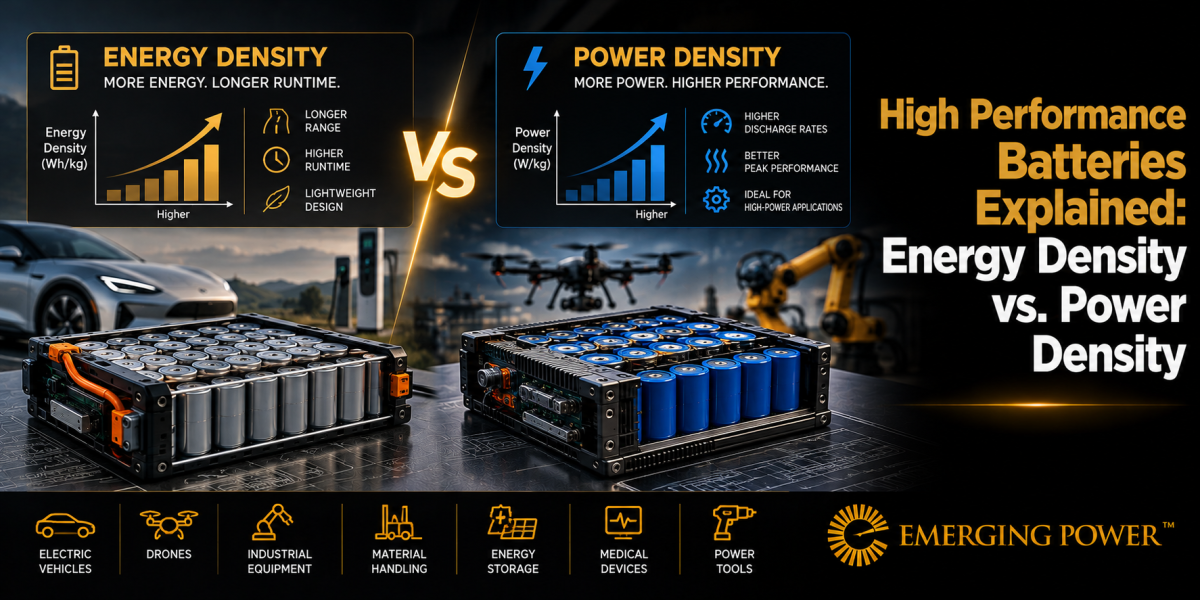
High-Performance Batteries: Energy Density vs. Power Density

Learn how energy density and power density affect high performance batteries, runtime, output, size, thermal demands, and custom battery pack design.

High-Performance Batteries Explained: Energy Density vs. Power Density

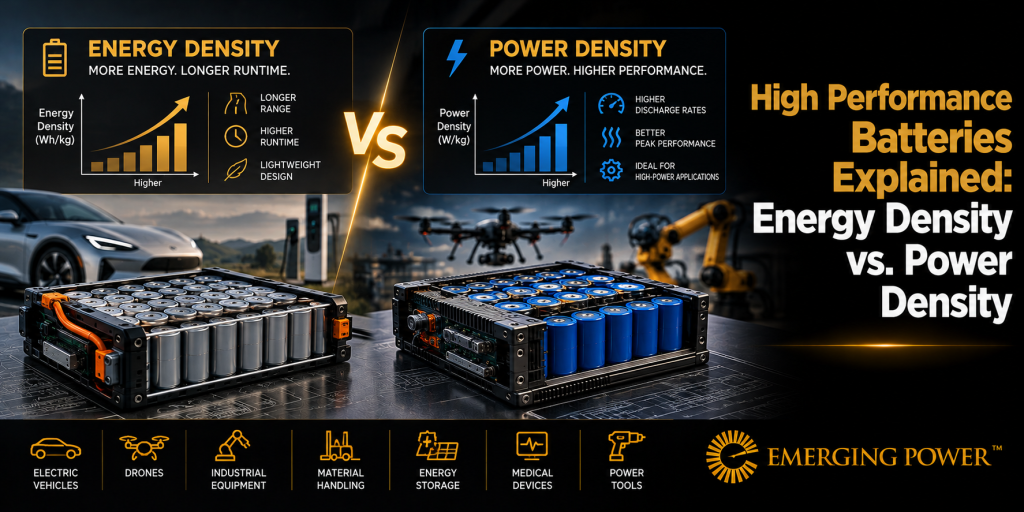
High-performance batteries showing energy density vs power density

When engineers evaluate high performance batteries, capacity is only one part of the equation.

Two batteries can have similar physical dimensions or stored energy but perform very differently once they are integrated into an application. One may be optimized to operate for a long time between charges, while another may be designed to deliver a large amount of power within seconds.

This difference often comes down to two important battery performance metrics: energy density and power density.

Understanding the difference between them can help OEMs make better decisions about cell chemistry, battery size, discharge requirements, thermal management, and overall battery pack design.

What Is a High-Performance Battery?

A high performance battery is not simply a battery with the highest capacity or highest energy density.

Performance depends on what the application actually requires.

For one device, high performance may mean maximizing operating time while minimizing battery weight. For another, it may mean supplying a high current during startup or supporting repeated power pulses. Other applications may prioritize cycle life, temperature performance, reliability, packaging flexibility, or a combination of these requirements.

That is why battery selection should begin with the application rather than a single specification.

Through our custom battery design services, we evaluate electrical, mechanical, safety, and application requirements before developing a battery pack around the needs of the product.

What Is Battery Energy Density?

Energy density describes how much energy a battery can store relative to its mass or volume.

It is commonly expressed in two ways:

  • Gravimetric energy density or specific energy: watt-hours per kilogram (Wh/kg)
  • Volumetric energy density: watt-hours per liter (Wh/L)

Natural Resources Canada defines energy density as the amount of energy stored relative to battery mass or volume. It also notes that energy density generally decreases as the measurement moves from active materials to cells, modules, and complete packs because components such as enclosures and thermal-management systems add weight and volume without adding stored energy.

For product engineers, this distinction matters.

A cell-level energy-density figure should not automatically be treated as the energy density of the finished battery pack.

Why Does High Energy Density Matter?

Higher energy density can help an OEM achieve objectives such as:

  • Longer runtime without substantially increasing battery weight
  • More stored energy within a limited physical space
  • Smaller or lighter portable products
  • Greater design flexibility where battery volume is constrained

The U.S. Department of Energy explains that increasing volumetric energy density can allow an electric vehicle, for example, to travel farther without increasing battery-pack size or potentially achieve the same range with a smaller pack.

The same basic design principle applies beyond vehicles. Medical equipment, instrumentation, communications systems, tracking devices, portable electronics, and other battery-powered products can all face limitations on available weight or space.

We develop custom lithium-ion battery packs for applications where size, weight, voltage, current requirements, safety, and reliability need to be considered together.

What Is Battery Power Density?

If energy density describes how much energy is available, power density describes how rapidly that energy can be delivered.

Power density may be expressed as:

  • Watts per kilogram (W/kg)
  • Watts per liter (W/L)

Natural Resources Canada describes power density as a battery’s rate capability, or the flow of energy into or out of the battery during charging and discharging relative to mass or volume.

Power requirements also need context. Factors such as discharge rate, temperature, state of charge, pulse duration, and whether the specification refers to continuous or pulse power can affect battery performance.

Why Does High Power Density Matter?

Some applications have relatively stable electrical loads. Others may suddenly require much more current.

High power capability becomes particularly important when equipment must support:

  • High-current startup
  • Motors or actuators
  • Short power bursts
  • Rapid acceleration
  • High-load communications
  • Pulsed equipment
  • Other demanding electrical loads

In these cases, simply choosing a battery with high capacity does not guarantee that it can safely provide the required current.

Energy Density vs. Power Density: What Is the Difference?

A simple way to understand the distinction is:

Energy density tells you how much energy the battery can carry. Power density tells you how quickly the battery can deliver it.

Metric

Energy Density

Power Density

Main question

How much energy can the battery store?

How quickly can the battery deliver energy?

Common units

Wh/kg or Wh/L

W/kg or W/L

Major design consideration

Runtime, size and weight

Current output and load demand

Important for

Long-duration operation

High-load or pulse operation

Higher value generally supports

More energy in less mass or volume

Greater power delivery relative to mass or volume

Both measurements are important, but neither should be evaluated independently from the application.

High Energy Battery vs. High Power Battery

Consider two hypothetical products.

Product A is a portable monitoring device expected to operate for long periods between charges. Its current demand is relatively modest.

Its design may prioritize:

high energy density → more stored energy → longer potential runtime

Now consider Product B, which contains a motor that creates a substantial temporary load during startup.

Its battery may need to prioritize:

high power capability → greater current delivery → better support for peak loads

Selecting a high-energy cell without verifying its discharge capability could result in poor performance in Product B. Likewise, optimizing Product A exclusively for high power could sacrifice energy capacity that would have been more valuable for its actual duty cycle.

This is why battery engineering is fundamentally an optimization problem rather than a search for the battery with the largest specification number.

Can a Battery Have Both High Energy and High Power Density?

Battery technology can provide combinations of strong energy and power performance, but engineering trade-offs remain.

Cell chemistry, electrode design, internal resistance, physical construction, thermal conditions, discharge rate, battery management, and other factors can influence how a battery performs.

Within lithium-ion chemistry, different formulations can favor different performance characteristics. Lithium cobalt oxide can provide high energy density, while lithium iron phosphate is often selected where discharge capability, cycle life, and thermal stability are important.

This makes chemistry selection an application-specific engineering decision rather than a universal ranking of one chemistry as “best.”

For a deeper technical discussion of this trade-off, see our guide to energy density vs. power density in battery pack design.

Why Cell-Level Specifications Are Not Enough

A common battery-selection mistake is comparing cells solely through datasheet specifications.

An OEM ultimately uses a battery system, not an isolated cell.

The completed pack may also include:

  • Battery management system
  • Protection electronics
  • Wiring and interconnects
  • Connectors
  • Mechanical enclosure
  • Insulation
  • Thermal-management components
  • Fuel-gauge electronics
  • Charging controls

These components affect the final pack’s mass, volume, electrical performance, safety, and reliability.

That is one reason we evaluate pack-level performance separately from cell-level performance when developing a custom solution.

How Battery Management Affects High Performance Applications

High performance batteries also need appropriate control and protection.

A battery management system may monitor or manage factors such as cell voltage, current, temperature, charging, discharge limits, state of charge, and cell balancing depending on the battery design.

This becomes particularly important as electrical and thermal demands increase.

Our smart battery design capabilities include protection circuits, fuel gauges, charger-control PCBAs, and battery management systems.

The objective is not simply to select a high-performance cell. We look at the entire battery pack as an integrated system.

Temperature Matters Too

Battery performance figures should not be evaluated without considering operating conditions.

Temperature can affect electrochemical reaction rates and battery performance. A battery that meets a power requirement under controlled laboratory conditions may behave differently when used in an application exposed to very low or high temperatures.

OEM requirements should therefore identify the expected operating environment early in the development process.

This can influence cell selection, enclosure design, thermal management, BMS parameters, testing, and potentially the physical size of the finished battery.

How Should OEMs Choose Between Energy and Power?

Instead of beginning with “What battery has the highest energy density?”, engineering teams should define what the finished product needs the battery to do.

Important questions include:

  1. How much energy does the product consume during a typical operating cycle?
  2. What runtime is required?
  3. What is the average electrical load?
  4. What is the maximum continuous load?
  5. Are there short-duration peak loads?
  6. How much space is available for the battery?
  7. What is the maximum acceptable battery weight?
  8. What temperatures will the product encounter?
  9. What charging time is acceptable?
  10. What cycle-life expectations does the product have?
  11. What safety or regulatory requirements apply?
  12. Does the application require a custom BMS, enclosure, connector, or communication system?

Once these requirements are defined, engineers can evaluate energy density and power density in the context of the entire system.

Our broader battery engineering and manufacturing capabilities support multiple battery chemistries and applications, including lithium-ion, lithium-polymer, lithium iron phosphate, lithium primary, and nickel-metal hydride solutions.

Energy Density and Power Density Are Only Part of Battery Performance

A high performance battery should not be evaluated using one metric.

Energy density and power density need to be considered alongside:

  • Safety
  • Cycle life
  • Calendar life
  • Operating temperature
  • Charging characteristics
  • Internal resistance
  • Mechanical requirements
  • Battery management
  • Reliability
  • Manufacturing consistency
  • Regulatory requirements
  • Cost and supply availability

A battery with exceptional energy density but inadequate discharge capability may be wrong for a high-load device.

A battery with exceptional power capability but insufficient energy storage may require an unnecessarily large pack to achieve the required runtime.

The appropriate battery is the one that achieves the right balance for the actual product.

Frequently Asked Questions

What is energy density in a battery?

Battery energy density describes how much energy a battery stores relative to its mass or volume. Gravimetric energy density is typically expressed in Wh/kg, while volumetric energy density is typically expressed in Wh/L.

What is power density in a battery?

Power density describes how rapidly a battery can deliver energy relative to its mass or volume. It is commonly expressed in W/kg or W/L.

Is higher energy density always better?

No. Higher energy density can be valuable when runtime, weight, or available space is important, but battery selection also needs to account for power requirements, temperature, safety, cycle life, charging, physical design, and other application requirements.

What is the difference between energy density and battery capacity?

Battery capacity describes the amount of electrical charge a battery can provide and is commonly stated in ampere-hours (Ah). Energy considers both capacity and voltage and is expressed in watt-hours (Wh). Energy density relates that stored energy to the battery’s mass or volume.

Does higher power density mean longer battery life?

Not necessarily. Power density describes how quickly energy can be delivered, while energy density is more closely associated with how much energy can be stored for a given mass or volume. Runtime depends on the battery’s usable energy and the application’s load profile.

Which battery chemistry is best for high performance applications?

There is no single best chemistry for every high-performance application. The appropriate chemistry depends on required energy, power, cycle life, operating temperature, size, weight, safety requirements, charging characteristics, cost, and other design constraints.

Build the Battery Around the Application

For OEM product development, the question should not be whether energy density or power density is more important in general.

The better question is:

What combination of energy, power, size, weight, safety, runtime, and lifecycle does this specific product require?

Answering that question early can help engineering teams make better decisions about cell chemistry, pack architecture, electronics, thermal requirements, mechanical design, and testing.

At Emerging Power, we work with OEMs to develop custom battery solutions around specific electrical and mechanical requirements, from initial technical review and battery design through prototyping, testing, and manufacturing.

Request a quote to discuss your application’s energy, power, size, operating environment, and performance requirements.