


As lithium-ion batteries continue powering everything from industrial equipment and medical devices to UAVs and IoT systems, battery transportation safety has become a major global concern.
For OEM manufacturers, one certification is especially critical:
UN38.3 certification.
Without UN38.3 compliance, lithium batteries cannot legally ship through most international air, sea, rail, or ground transportation channels.
In 2025 and 2026, stricter lithium battery shipping regulations and rising battery fire incidents are pushing manufacturers to prioritize certified battery systems earlier in product development.
This guide explains:
- What UN38.3 certification means
- Why it matters for OEMs
- Required testing procedures
- Common compliance challenges
- How custom battery manufacturers help simplify the process
What Is UN38.3 Certification?
UN38.3 refers to Section 38.3 of the United Nations Manual of Tests and Criteria for lithium batteries.
The regulation was created to ensure lithium-ion and lithium metal batteries can safely withstand transportation conditions without:
- Leaking
- Rupturing
- Catching fire
- Exploding
UN38.3 applies to:
- Lithium-ion battery packs
- Lithium metal batteries
- Rechargeable batteries
- Battery-powered products
- Standalone battery shipments
Without passing UN38.3 testing, batteries may be rejected by:
- Airlines
- Freight carriers
- Customs authorities
- International distributors
Why UN38.3 Matters for OEM Manufacturers
OEMs developing battery-powered products often underestimate how important transportation certification is during product design.
A battery pack may perform perfectly in operation but still fail transportation safety testing.
This can delay:
- Product launches
- International shipments
- Supply chain operations
- Customer deliveries
In some cases, non-compliant battery shipments may face:
- Regulatory penalties
- Shipment confiscation
- Product recalls
- Safety liability issues
According to global transport safety agencies, lithium battery incidents during transportation continue to increase due to improper packaging, damaged cells, and non-certified systems.
What Does UN38.3 Testing Include?
UN38.3 certification requires batteries to pass a series of environmental, mechanical, and electrical safety tests.
These tests simulate real-world transportation conditions.
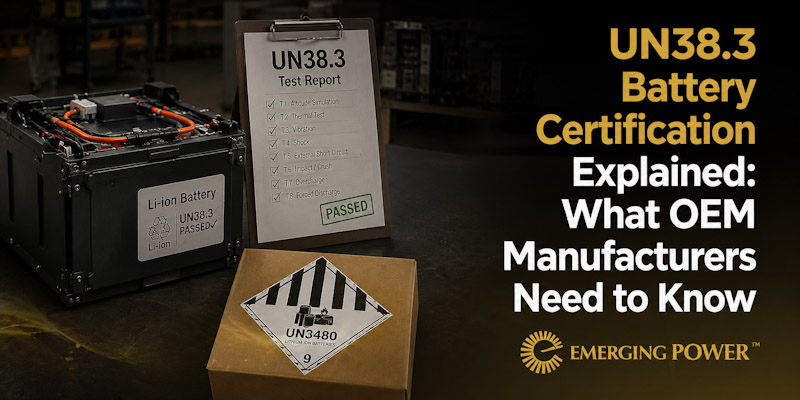
UN38.3 Test Sequence
| Test | Purpose |
| T1 Altitude Simulation | Simulates air transport pressure conditions |
| T2 Thermal Test | Evaluates resistance to temperature extremes |
| T3 Vibration Test | Simulates transport vibration exposure |
| T4 Shock Test | Tests resistance to sudden impacts |
| T5 External Short Circuit | Checks short-circuit safety |
| T6 Impact / Crush Test | Evaluates mechanical abuse resistance |
| T7 Overcharge Test | Assesses overcharging protection |
| T8 Forced Discharge Test | Tests forced discharge safety |
Battery packs must pass all required tests without:
- Fire
- Explosion
- Leakage
- Dangerous disassembly
Which Products Require UN38.3 Certification?
UN38.3 applies to many OEM applications, including:
Industrial Equipment
- Robotics
- Automated systems
- Portable industrial tools
Medical Devices
- Portable monitoring systems
- Diagnostic equipment
- Mobile healthcare electronics
UAV and Drone Systems
- Commercial drones
- Defense UAVs
- Surveying equipment
IoT and Smart Devices
- Smart meters
- Asset tracking devices
- Remote monitoring systems
Consumer Electronics
- Portable electronics
- Battery-powered appliances
- Smart devices
If the product contains lithium batteries and requires transportation, UN38.3 is typically mandatory.
Common Reasons Batteries Fail UN38.3 Testing
Many OEM battery systems fail certification because transportation safety is not considered during early-stage design.
Poor Cell Quality
Low-grade cells increase the risk of:
- Swelling
- Leakage
- Thermal instability
Weak Battery Management Systems (BMS)
Inadequate BMS protection can fail:
- Overcharge tests
- Short-circuit tests
- Thermal safety checks
Improper Pack Design
Issues with spacing, insulation, or enclosure integrity may lead to mechanical failures during vibration and shock testing.
Thermal Management Problems
Overheating remains one of the leading causes of lithium battery safety concerns.
Why OEMs Choose Custom Battery Manufacturers
OEM manufacturers increasingly partner with experienced custom battery engineering companies to simplify compliance.
Companies like Emerging Power help OEMs design battery packs specifically for:
- Transportation safety
- Regulatory compliance
- Thermal protection
- Mechanical durability
- Long-term reliability
This reduces certification risks while improving product readiness for global distribution.
How Custom Battery Design Improves Compliance
Integrated Battery Management Systems
Advanced BMS technology helps batteries safely manage:
- Voltage
- Current
- Temperature
- Charging cycles
This improves test performance during:
- Overcharge testing
- Forced discharge testing
- Short-circuit simulations
Thermal Protection Engineering
Modern battery packs use:
- Thermal barriers
- Heat-resistant materials
- Smart cooling strategies
These reduce overheating risks during transportation stress conditions.
Ruggedized Mechanical Design
Custom battery enclosures improve:
- Shock resistance
- Vibration durability
- Structural integrity
Especially important for:
- Industrial equipment
- UAV systems
- Military applications
Growing Demand for Certified Battery Systems in 2026
Global lithium battery demand continues rising rapidly due to:
- Industrial automation
- Electric mobility
- Smart infrastructure
- Connected devices
- Portable medical technology
At the same time, transportation regulations are becoming stricter worldwide.
OEMs now prioritize:
- Early compliance planning
- Certified battery suppliers
- Safer battery architectures
- Transportation-ready battery systems
Companies that delay compliance planning often face expensive redesigns later in production.
Best Practices for OEM Manufacturers
To Improve UN38.3 Compliance Success:
Do:
- Use certified high-quality battery cells
- Integrate advanced BMS systems
- Design for thermal safety
- Work with experienced battery engineers
- Test prototypes early
- Maintain complete compliance documentation
Avoid:
- Using generic battery assemblies
- Ignoring transportation regulations
- Delaying compliance testing
- Overlooking thermal management
- Using uncertified suppliers
FAQs
What is UN38.3 certification?
UN38.3 is a United Nations transportation safety standard required for shipping lithium batteries internationally.
Is UN38.3 mandatory?
Yes. Most lithium batteries and battery-powered devices must pass UN38.3 testing before transportation by air, sea, rail, or road.
How long does UN38.3 testing take?
Testing timelines vary depending on battery complexity, design readiness, and testing laboratory schedules. Most projects take several weeks.
Does every battery pack need separate certification?
Yes. Changes to battery design, cell chemistry, or configuration may require additional testing and certification.
Can custom battery packs achieve UN38.3 certification?
Absolutely. In fact, custom battery engineering often improves compliance success through optimized safety and thermal management design.
Final Thoughts
UN38.3 certification is no longer just a regulatory requirement. It is a critical part of product safety, logistics readiness, and global OEM operations.
As lithium battery applications expand across industrial, medical, UAV, and IoT sectors, manufacturers must prioritize:
- Transportation safety
- Thermal stability
- Compliance engineering
- Reliable battery architecture
Working with experienced custom battery manufacturers can significantly reduce certification risks while accelerating product readiness.
Emerging Power helps OEM manufacturers develop high-performance custom battery solutions designed to meet demanding safety, transportation, and operational standards.
Need Help Designing a UN38.3-Compliant Battery Pack?
Explore Emerging Power’s custom battery engineering solutions to build safer, certified, and transportation-ready battery systems for your OEM applications.