Custom vs Off-the-Shelf Battery Chargers Manufacturers: Choosing the Right Charger Manufacturer

Custom vs Off-the-Shelf Battery Chargers Manufacturers: Choosing the Right Charger Manufacturer

Every custom battery pack eventually raises the same overlooked question:

What is actually going to charge it?

Whether it is a medical device, an industrial sensor, or a UAV, the charger is just as important to product safety and performance as the battery pack itself. Many OEM teams treat charger selection as an afterthought, only to run into compatibility or safety issues later. As battery systems become more specialized in 2025 and 2026, choosing the right Custom vs Off-the-Shelf Battery Chargers Manufacturers has become a critical part of product design.

The decision usually comes down to:

Standardized convenience versus purpose-built performance.

What Off-the-Shelf Chargers Offer

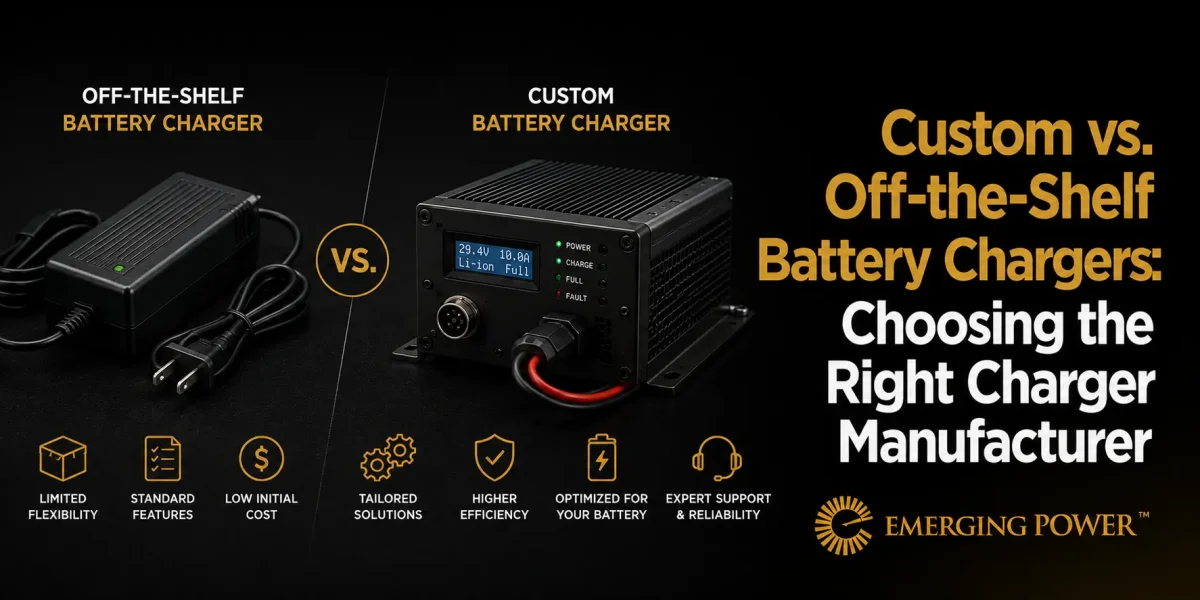
Off-the-shelf chargers are pre-designed, mass-produced products built to charge common battery configurations. Their advantages include:

  • Lower upfront cost
  • Immediate availability
  • Simple integration for standard battery types
  • Established safety certifications for common use cases

Where Off-the-Shelf Chargers Fall Short

Generic chargers are built for general use, not for the specific behavior of a custom battery pack. Common limitations include:

  • Charging profiles that do not match custom cell chemistry
  • Limited or no communication with a custom BMS
  • Incorrect voltage or current settings for non-standard packs
  • Reduced pack lifespan from improper charging cycles
  • Enclosure or connector mismatches

What Custom Battery Charger Manufacturers Offer

A custom charger is engineered around the exact specifications of the battery pack it is paired with. This includes:

  • Charging profiles tuned to the pack’s chemistry and BMS
  • Matched voltage, current, and thermal limits
  • Communication protocols that align with the host device
  • Certification support for the target market
  • Mechanical design that fits the product’s form factor

Comparing Custom and Off-the-Shelf Chargers

Factor

Off-the-Shelf Charger

Custom Charger

Upfront cost

Lower

Higher, but optimized long term

Compatibility with custom packs

Limited

Fully matched

BMS communication

Rarely supported

Built in as part of the design

Charging efficiency

Generic, not chemistry-specific

Tuned to the exact battery profile

Long-term pack health

Can reduce lifespan if mismatched

Supports maximum cycle life

Certification alignment

May require additional testing

Designed with certification in mind

Why Charging Behavior Affects Battery Life

A mismatched charger can overcharge cells, apply incorrect current, or ignore thermal limits the BMS is designed to enforce. Over time, this leads to:

  • Reduced total capacity
  • Faster degradation
  • Increased safety risk
  • Shorter product lifespan

Working with the right battery charger manufacturers helps ensure the charging system protects the investment made in the battery pack itself.

When Off-the-Shelf Makes Sense

Off-the-shelf chargers are a reasonable choice when:

  • The battery pack uses a standard, widely supported configuration
  • Time to market outweighs long-term optimization
  • The application does not require tight thermal or safety tolerances

The Hidden Cost of a Mismatched Charger

A charger that is not properly matched to a battery pack can create costs that are not obvious at the time of purchase. Over the life of a product, these hidden costs can include:

  • Increased warranty claims from packs that fail earlier than expected
  • Field service calls related to inconsistent charging behavior
  • Customer complaints about longer than expected charging times
  • Additional engineering hours spent diagnosing issues that trace back to the charger, not the battery pack

Factoring these costs into the sourcing decision often shifts the balance toward a properly matched, purpose-built charger.

When Custom Is the Right Choice

A custom charger is usually the better investment when:

  • The battery pack has a unique chemistry, voltage, or BMS design
  • The product operates in demanding environments such as medical, defense, or industrial settings
  • Certification requirements are strict or market-specific
  • Long-term reliability and cycle life are priorities

Types of Charging Technologies to Consider

Charger selection is not just about custom versus off-the-shelf. The underlying charging technology also affects performance and safety. Common approaches include:

  • Constant current, constant voltage (CC/CV) charging, the most common method for lithium-ion and LiPo cells
  • Trickle charging, used for maintaining a full charge without stressing the cells during long idle periods
  • Fast charging, which requires tighter thermal and current control to avoid degrading the pack
  • Smart charging with BMS communication, which adjusts charging behavior in real time based on cell condition

The right technology depends on how the product is used, how often it is charged, and how critical uptime is to the end user.

Safety Risks of Mismatched Charging

Pairing the wrong charger with a battery pack is not just a performance issue, it is a safety issue. Risks associated with mismatched charging include:

  • Overheating during charge cycles, which can damage cells or trigger thermal events
  • Voltage spikes that exceed the pack’s rated limits
  • Reduced protection if the charger cannot communicate with the BMS
  • Inconsistent charge termination, leaving cells either undercharged or overstressed

These risks are especially significant in medical, defense, and industrial applications where product failure carries higher consequences.

How to Evaluate a Charger Manufacturer

When comparing battery charger manufacturers, OEM teams should look beyond price and ask:

  • Does the manufacturer design chargers in-house or resell generic hardware?
  • Can the charger be customized to match a specific BMS communication protocol?
  • What certifications does the charger carry for your target market?
  • Does the manufacturer test the charger and battery pack together as a system?
  • What support is available if charging issues arise after launch?

Integrating Charger Design Into the Product Development Timeline

Charger development should happen alongside battery pack design, not after it. Involving the charger manufacturer early allows teams to:

  • Confirm charging time expectations before the product design is finalized
  • Align connector and enclosure design between the pack and charger
  • Coordinate certification testing so both components are validated together
  • Avoid late-stage redesigns caused by incompatible charging specifications

How Charger Form Factor Affects Product Design

Charger selection is not purely an electrical decision. The physical design of the charger also affects how a product is used and supported in the field. Considerations include:

  • Whether the charger is a standalone external unit, an integrated dock, or built directly into the device
  • Connector type and durability, especially for products used in rugged or outdoor environments
  • Cable length and portability requirements for field service teams or end users
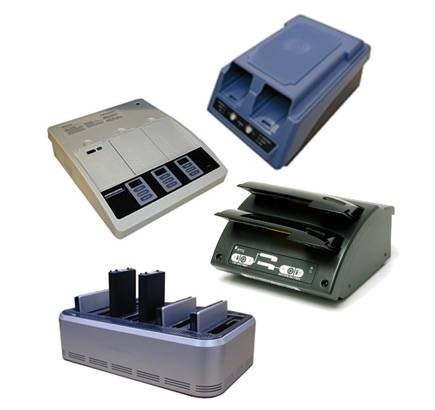
  • Whether multiple units need to be charged simultaneously, which may require a multi-bay charging station

A custom battery charger manufacturer can design the charger’s physical form to match these requirements, while off-the-shelf options typically offer only a limited range of standard shapes and connectors.

Environmental and Regulatory Considerations for Chargers

Just like battery packs, chargers are subject to their own set of environmental and regulatory requirements that vary by industry and region. These can include:

  • Ingress protection ratings for chargers used in outdoor, industrial, or medical washdown environments
  • Electromagnetic compatibility testing to prevent interference with other electronics
  • Regional plug and voltage standards for products sold in multiple countries
  • Safety certifications specific to the charger’s power class and end-use application

Off-the-shelf chargers are typically certified for general use cases, which may not cover the specific environmental conditions a custom product will face. A custom charger manufacturer can build these requirements into the design from the start rather than discovering a compliance gap during final testing.

How to Budget for Charger Development

OEMs often underestimate the engineering investment required for a properly matched charging system. A realistic budget should account for:

  • Initial design and prototyping of the charger circuitry and enclosure
  • Communication protocol development if the charger needs to interact with a custom BMS
  • Certification testing specific to the charger, separate from battery pack certification
  • Tooling costs if a custom enclosure or connector is required for production volume
  • Ongoing support for firmware updates or design revisions after launch

While these costs add to the upfront project budget, they are typically far lower than the cost of field failures, warranty claims, or a product recall caused by a mismatched charging system.

Working With a Single Partner for Both Pack and Charger

Many OEMs find it more efficient to source the battery pack and charger from the same partner rather than managing two separate vendor relationships. Benefits of this approach include:

  • A single point of accountability if a charging or performance issue arises
  • Coordinated testing that validates the pack and charger together as a system
  • Faster communication when design changes affect both components
  • Simplified documentation and certification management across the full power system

This integrated approach is one of the reasons many OEMs prefer working with a full-service custom battery pack manufacturer that also offers custom charging solutions, rather than sourcing each component independently.

Industries That Benefit From Custom Charging Systems

Medical Devices

Precise, validated charging behavior supports patient safety and regulatory approval.

Defense and Military

Rugged, mission-specific chargers must match demanding field conditions.

Industrial IoT

Long deployment cycles depend on charging systems that protect battery health over years of use.

Drones and UAVs

Fast turnaround charging must be tuned to the pack without compromising safety.

FAQs

Can I use an off-the-shelf charger with a custom battery pack?

It depends on the pack design. Mismatched charging profiles can reduce battery life or create safety risks, so compatibility should be confirmed with the pack manufacturer.

Are custom chargers more expensive than off-the-shelf options?

Custom chargers typically cost more upfront but can extend battery life and reduce long-term replacement costs.

Do custom chargers require their own certification?

Yes. Custom chargers are usually tested and certified alongside the battery pack to ensure safe operation.

Can a charger communicate directly with a BMS?

Custom chargers can be designed to communicate with a battery’s BMS for smarter, safer charging behavior.

How do I know if I need a custom charger?

If your battery pack uses a non-standard chemistry, voltage, or BMS design, a custom charger is usually the safer and more reliable choice.

Can a custom charger reduce total charging time?

Yes, when engineered correctly, a custom charger can safely optimize current delivery to reduce charging time without exceeding the pack’s thermal or voltage limits.

Do custom chargers need to be redesigned if the battery pack changes?

In most cases, yes. Since custom chargers are matched to a specific pack’s chemistry and BMS, significant pack changes usually require charger updates as well.

Should the charger and battery pack be tested together?

Yes. Testing the charger and pack as a complete system helps confirm safety and performance under real charging conditions rather than relying on separate component tests alone.

Final Thoughts

Choosing between Custom vs Off-the-Shelf Battery Chargers Manufacturers is not just about upfront cost. It affects battery lifespan, safety, and overall product reliability. For standard applications, an off-the-shelf charger may be sufficient, but custom-engineered products almost always benefit from a charging system built specifically around the battery pack it serves.

Need a Charger Built for Your Custom Battery Pack?

Explore Emerging Power’s charger solutions or view our custom battery design services to build a matched charging system for your product.

Upgrading Your Trailer Hitch Electrical Plug Adapter: When and Why It’s Necessary

When towing a trailer, the electrical plug adapter is a key component for connecting the vehicle to the trailer’s lights, brakes, and other electrical systems. Over time, as towing needs evolve or equipment ages, upgrading your trailer hitch electrical plug adapter can make a big difference. Knowing when and why it’s necessary to upgrade can help ensure safety, reliability, and better performance.

What is a Trailer Hitch Electrical Plug Adapter?

A trailer hitch electrical plug adapter is a device used to connect your vehicle’s electrical system to the trailer. It typically includes various pins and connectors that supply power to the trailer’s lighting, turn signals, brake lights, and electric brakes. The adapter makes it possible for the vehicle to communicate with the trailer’s electrical components, ensuring that everything functions smoothly while towing.

When Should You Upgrade Your Trailer Hitch Electrical Plug Adapter?

  1. When You Upgrade to a Larger or Heavier Trailer

If you are switching to a larger or heavier trailer, your current trailer hitch electrical plug adapter may not meet the new requirements. Larger trailers often have more complex electrical systems, such as additional lights or heavier brake systems. To ensure compatibility, you may need an adapter that supports more pins or higher power capacity. For example, trailers with electric brakes often require a 7-pin adapter, while smaller trailers might only need a 4-pin adapter.

  1. When You Experience Electrical Failures

If your trailer’s lights or brake systems are not functioning properly, this could indicate an issue with the electrical connection. Corrosion or wear over time can cause the plug to fail, leading to unreliable performance or even dangerous situations while towing. If this happens, upgrading the trailer hitch electrical plug adapter to a newer model with better materials or a more robust design can solve these problems. Newer adapters are also better sealed against weather conditions, preventing rust and moisture from affecting performance.

  1. When You Want More Features

Modern trailers come with advanced electrical systems, such as reverse lights, battery charging, or additional interior lighting. If your current adapter is not designed to support these extra features, it may be time for an upgrade. Newer trailer hitch electrical plug adapters offer more pins and advanced wiring options, allowing for better control over the trailer’s electrical functions. If you have a trailer that requires additional features, consider upgrading to a multi-functional adapter to meet all your needs.

  1. When Your Current Adapter Is Worn Out

Over time, constant use and exposure to the elements can cause the electrical plug adapter to wear down. Cracks, loose connections, or bent pins are all signs that the adapter may no longer be safe to use. At this point, upgrading to a newer, more durable model is important to avoid electrical malfunctions or potential hazards on the road.

Why Should You Upgrade Your Trailer Hitch Electrical Plug Adapter?

  1. Safety

Safety is one of the most important reasons to upgrade your trailer hitch electrical plug adapter. A worn or outdated adapter can cause electrical failures, such as malfunctioning brake lights or turn signals, which can lead to accidents. Upgrading ensures that your trailer’s lights and brakes work as intended, improving your safety and that of other drivers on the road.

  1. Better Compatibility with Modern Vehicles

As vehicles evolve, so do their electrical systems. Newer cars, trucks, and SUVs often require adapters with more pins and advanced wiring to support their sophisticated systems. Upgrading ensures that your trailer and vehicle are fully compatible, making it easier to tow your load while maintaining the proper electrical connection.

  1. Enhanced Durability

Older adapters may not be as weather-resistant or durable as newer models. Modern trailer hitch electrical plug adapters are built with better materials, such as corrosion-resistant coatings and improved seals. This helps prevent damage from rain, snow, or salt, extending the lifespan of your equipment.

Conclusion

Upgrading your trailer hitch electrical plug adapter is an important step to ensure safe, reliable towing. Whether you are upgrading to a larger trailer, experiencing electrical failures, or simply seeking better features, the right adapter can make a big difference. If you’re unsure about which adapter is right for your needs, Emerging Power, a well-known trailer hitch electrical plug adapter and custom battery manufacturer, provides expert guidance and high-quality solutions tailored to your specific requirements. Our custom solutions are designed to enhance the performance of your trailer and ensure that you always stay safe on the road.


Integrating ASIP Battery USB Adapters in IoT Devices

The Internet of Things (IoT) is growing rapidly. Millions of devices are now connected to the internet, and they all need reliable power sources. One of the most effective solutions is the ASIP battery USB adapter. This technology helps power these devices while keeping them efficient and user-friendly. Let’s explore how these adapters are integrated into IoT devices and their benefits.

Understanding ASIP Battery USB Adapters

ASIP battery USB adapters are specialized devices designed to convert power from a battery to a USB-compatible format. They allow IoT devices to run efficiently while using a custom lithium battery. This combination ensures that devices have a steady power supply. These adapters are essential for devices that need to operate continuously without interruption.

The use of a USB format also makes it easier to connect to various devices. Most people are familiar with USB connections. This familiarity helps users set up and manage their IoT devices more easily.

Benefits of ASIP Battery USB Adapters in IoT Devices

Integrating ASIP battery USB adapters into IoT devices offers several advantages. First, they improve the energy efficiency of these devices. By managing power output effectively, these adapters help extend battery life. This is crucial for IoT devices that operate in remote locations or where recharging is not possible.

Second, these adapters enable compact designs. IoT devices often have limited space. By using an ASIP battery USB adapter, manufacturers can save space and create smaller devices. This compactness is important in wearables and other portable devices that need to be lightweight.

Another key benefit is flexibility. Custom lithium battery manufacturers can design batteries that meet the specific power needs of each device. This means that IoT devices can be customized for various applications. For example, some devices may require higher energy for more complex tasks, while others may need less. The ASIP battery USB adapter makes this flexibility possible.

Customization and Integration Challenges

While integrating ASIP battery USB adapters into IoT devices has many benefits, there are challenges as well. One challenge is ensuring compatibility between the adapter and the device. Each device may have different power requirements, so it is important to match them carefully. Custom lithium battery manufacturers often work closely with engineers to develop the right solutions.

Another challenge is heat management. High-performance devices can generate heat, which may affect battery life. It is essential to design ASIP battery USB adapters that handle heat effectively. This may involve using better materials or incorporating cooling solutions.

Future of ASIP Battery USB Adapters in IoT

Looking ahead, the role of ASIP battery USB adapters in IoT devices will likely grow. With the increasing number of smart devices, demand for reliable and efficient power solutions will rise. Manufacturers will continue to innovate and improve adapter designs. This will include enhancements in energy management and compatibility.

Additionally, as the technology evolves, ASIP battery USB adapters may support faster charging and longer battery life. This will be especially important as devices become more advanced and require more power.

Enhance Your Device Performance with Emerging Power

Integrating ASIP battery USB adapters into IoT devices is a practical solution for powering the growing number of connected devices. These adapters improve efficiency, save space, and offer flexibility for customization. As the demand for IoT devices continues to rise, the importance of reliable power solutions will also increase.

For those seeking quality power solutions, consider Emerging Power that is considered one of the custom lithium battery manufacturers. We specialize in providing high-performance ASIP battery USB adapters and custom lithium batteries. Our products are designed to meet the unique needs of various applications. Trust Emerging Power to power your devices efficiently and effectively.


Advantages of Using Rechargeable Lithium Batteries in Soldier-Worn Equipment

In modern military operations, having reliable and portable power is crucial. A soldier typically carries several devices such as radios, night-vision goggles, and GPS units that all need consistent power. Rechargeable lithium batteries with chargers have become the go-to choice for powering these essential tools. They offer significant advantages over older battery types, enhancing the efficiency and mobility of soldiers on the battlefield.

Lightweight and Portable Power

One of the most significant advantages of military batteries using lithium technology is their lightweight design. Soldiers must carry all their gear on foot, often for long distances. Traditional batteries, such as nickel-cadmium or lead-acid, add unnecessary bulk and weight. In contrast, rechargeable lithium batteries provide a much higher energy density, meaning they store more energy without adding excessive weight.

This reduction in weight allows soldiers to carry more supplies or equipment without compromising their mobility. A lighter load means less fatigue and better operational efficiency, which can be a game-changer in demanding combat situations.

Longer Operating Times

Rechargeable lithium batteries offer longer operating times compared to older technologies. This extended battery life means soldiers can use their equipment for longer periods without needing to change batteries frequently. This is crucial for devices like communication radios or surveillance systems, where running out of power in the middle of an operation could compromise the mission.

With fewer battery changes required, soldiers can focus more on their tasks and less on managing their power supply. This also reduces the amount of spare batteries that need to be carried, further lightening their load.

Fast Recharging Capabilities

Another major benefit of rechargeable lithium batteries with chargers is their fast charging capability. In combat situations, downtime for charging equipment can be costly. Lithium batteries have the ability to recharge much faster than other battery types, such as nickel-based alternatives. This rapid recharging allows soldiers to get their gear back up and running quickly, minimizing downtime.

Additionally, portable and solar-powered chargers can be used to recharge batteries in the field. This means soldiers can rely on renewable power sources, allowing them to maintain a steady power supply even in remote areas with no access to traditional electricity.

Durability and High Performance in Extreme Conditions

Military operations often take place in harsh environments, ranging from hot deserts to freezing mountains. Military batteries made from lithium are designed to handle these extreme conditions. Unlike other battery types, lithium batteries maintain their performance even in extreme temperatures, ensuring that soldiers’ equipment functions reliably under all conditions.

Lithium batteries are also more durable and less prone to damage from vibrations or impacts. This makes them suitable for soldier-worn equipment that may be exposed to rough handling, ensuring that power remains steady even in the toughest environments.

Reduced Maintenance and Cost-Effectiveness

Rechargeable lithium batteries require far less maintenance than traditional battery types. They have a longer lifespan, with the ability to undergo hundreds or even thousands of charge cycles before needing replacement. This reduces the need for frequent battery replacements, saving time and money for military operations.

Although lithium batteries can have a higher upfront cost, their longevity and reliability make them more cost-effective in the long run. By reducing the number of batteries needed over time, military units can save money and reduce logistical complications related to supplying spare batteries.

In conclusion

Rechargeable lithium batteries have transformed the way soldiers power their equipment. They offer lightweight, durable, and efficient power solutions that are critical for modern military operations. With benefits like longer operating times, faster recharging, and high performance in extreme conditions, lithium batteries have become the top choice for military batteries.

Emerging Power specializes in providing cutting-edge rechargeable lithium batteries with chargers that meet the unique demands of military applications. Our products ensure that soldiers have reliable, high-performance power for their critical equipment, allowing them to focus on their mission without worrying about power shortages.

How Does Pulse Charging Technology Enhance the Performance and Lifespan of Non-Rechargeable Battery Chargers?

The pulse charging technology is revolutionizing the way we charge non-rechargeable batteries with adapters for battery chargers. In the realm of battery technology, where performance and lifespan are critical factors, understanding the benefits of pulse charging is essential.

Understanding Pulse Charging Technology

Pulse charging technology, also known as trickle charging or maintenance charging, involves delivering short pulses of charging current to the battery at regular intervals. Unlike continuous charging, which applies a steady current throughout the charging process, pulse charging alternates between charging and resting phases.

Enhanced Performance

One of the primary advantages of pulse charging technology is its ability to enhance the performance of non-rechargeable batteries. By delivering short bursts of energy, pulse chargers can break down crystalline formations that may form on the battery’s electrodes over time, a process known as sulfation. This helps prevent the buildup of sulfation, which can lead to reduced battery capacity and performance degradation.

Extended Lifespan

In addition to improving performance, pulse charging technology also extends the lifespan of non-rechargeable batteries. By minimizing the impact of sulfation and other forms of degradation, pulse chargers help maintain the battery’s capacity and efficiency over time. This can result in longer-lasting batteries that provide reliable power for a wide range of applications.

Optimized Charging Process

Another benefit of pulse charging technology is its ability to optimize the charging process for non-rechargeable batteries. Unlike traditional chargers that apply a constant voltage or current, pulse chargers adjust the charging parameters based on the battery’s condition and charging history. This ensures that the battery receives the optimal level of charging without overcharging or undercharging, maximizing efficiency and safety.

Applications in Various Industries

The versatility of pulse charging technology makes it suitable for a wide range of industries and applications. From consumer electronics and medical devices to industrial equipment and automotive systems, adapters for battery chargers equipped with pulse charging technology are indispensable tools for powering critical devices reliably and efficiently.

Energy Efficiency

Additionally, pulse charging technology enhances the energy efficiency of non-rechargeable battery chargers. By delivering precise pulses of energy, these chargers minimize wasted energy and heat generation during the charging process, resulting in more efficient charging and reduced energy consumption. This not only saves power but also helps reduce operating costs and environmental impact, making pulse chargers a sustainable choice for powering devices with non-rechargeable batteries.

Wrapping Up 

Pulse charging technology enhances the performance and lifespan of non-rechargeable battery chargers by breaking down sulfation, extending battery lifespan, and optimizing the charging process. As technology continues to advance, pulse chargers will play an increasingly important role in powering the devices that shape our daily lives.

How Does Smart Charging Capability Enhance the Safety and Convenience of Battery Adapter Chargers?

Smart charging capability is revolutionizing the way we power our devices with ASIP battery chargers. In an era where convenience and safety are paramount, understanding the role of smart charging technology is crucial.

What is Smart Charging Capability?

Smart charging capability refers to the ability of a battery adapter charger to intelligently communicate with the device being charged. Unlike traditional chargers that deliver a fixed amount of power, smart chargers adjust the charging voltage and current based on the device’s requirements, optimizing the charging process for efficiency and safety.

Enhanced Safety Features

One of the primary advantages of smart charging capability is enhanced safety. By dynamically adjusting the charging parameters, smart chargers can prevent overcharging, overheating, and overvoltage, reducing the risk of damage to the battery and the device itself. This helps prolong the lifespan of the battery and ensures safe charging under various conditions.

Improved Convenience and Efficiency

Smart charging capability also offers unparalleled convenience and efficiency. With the ability to recognize different devices and adjust the charging parameters accordingly, users can charge multiple devices simultaneously without worrying about compatibility issues or slow charging speeds. This versatility makes smart chargers ideal for both personal and professional use.

Optimized Charging Process

Another benefit of smart charging capability is the optimized charging process it enables. By analyzing the battery’s condition and charging history, smart chargers can tailor the charging profile to maximize the battery’s performance and longevity. This results in faster charging times, longer cycle life, and overall better battery health.

Applications in Various Industries

The versatility of smart charging capability makes it suitable for a wide range of industries and applications. From medical devices and industrial equipment to consumer electronics, ASIP battery chargers with smart charging capability are indispensable tools for powering critical devices reliably and safely.

Emerging Power delivers cutting-edge ASIP battery chargers with smart charging capability to meet the evolving needs of various industries. Our RRC-SMB-FPC charger, with its optimized charging process and plug-and-play simplicity, exemplifies our commitment to innovation and excellence in battery charging solutions.


Seamless Integration with Smart Devices

In addition to safety and convenience, smart charging capability allows for seamless integration with smart devices. With the rise of the Internet of Things (IoT) and connected technologies, ASIP battery chargers equipped with smart charging capability can communicate with smartphones, tablets, and other smart devices to provide real-time charging status updates, battery health monitoring, and remote control capabilities. This level of integration enhances user experience and empowers users to manage their charging needs more effectively, whether they are at home, in the office, or on the go.

Ending Notes

Smart charging capability enhances the safety and convenience of battery adapter charger by optimizing the charging process, preventing overcharging, and improving overall efficiency. As technology continues to advance, smart chargers will play an increasingly important role in powering the devices that shape our daily lives.

Harnessing Advanced Charging Technologies for Custom Mobile Chargers

Custom mobile chargers have evolved significantly, integrating advanced charging technologies to meet the demands of modern smartphone users. Within the domain of custom mobile chargers, advanced charging technologies such as fast charging and wireless charging serve as crucial elements, significantly augmenting user convenience and optimizing device efficiency.

Fast Charging: Empowering Rapid Power-up

Fast charging technology allows users to recharge their device batteries much faster than conventional methods. By delivering higher power levels, fast chargers streamline the charging process, drastically cutting down the time needed to fully charge the battery. This capability is especially advantageous for individuals leading busy lifestyles, heavily dependent on their mobile devices throughout the day.

Wireless Charging: Embracing Cable-free Convenience

Wireless charging eliminates the need for cumbersome charging cables, offering users a seamless and clutter-free charging experience. By leveraging electromagnetic induction or resonant inductive coupling, wireless chargers transfer power to compatible devices simply by placing them on a charging pad or stand. This technology not only simplifies the charging process but also eliminates wear and tear on charging ports, prolonging the lifespan of mobile devices.

Benefits of Advanced Charging Technologies in Custom Mobile Chargers

Custom mobile chargers equipped with advanced charging technologies offer several key benefits:

  1. Efficiency: Fast charging and wireless charging technologies maximize charging efficiency, allowing users to quickly power up their devices without compromising performance.
  2. Convenience: With fast charging, users can top up their device battery in a fraction of the time, reducing downtime and ensuring uninterrupted usage.
  3. Flexibility: Wireless charging provides flexibility in charging locations, allowing users to charge their devices hassle-free in various settings such as home, office, or public spaces.
  4. Versatility: Custom mobile chargers can accommodate a wide range of device types and brands, ensuring compatibility with popular smartphones and tablets.

Applications in Various Industries

The integration of advanced charging technologies in custom mobile chargers has broad applications across multiple industries:

  • Medical: Hospitals and healthcare facilities can deploy custom mobile chargers with fast charging capabilities to ensure that medical professionals have access to fully charged devices for patient care.
  • Industrial: Custom mobile chargers with wireless charging functionality can streamline operations in industrial settings, enabling workers to charge their devices conveniently without interrupting workflow.
  • Consumer: In the consumer market, custom mobile chargers cater to the diverse needs of smartphone users, offering fast and wireless charging solutions for on-the-go lifestyles.

Compatibility with Smart Battery Management Systems

Custom mobile chargers often integrate with smart battery management systems (BMS) to optimize charging efficiency and battery health. These systems monitor parameters such as voltage, current, and temperature to ensure safe and reliable charging, prolonging the lifespan of mobile device batteries. By leveraging smart BMS technology, custom mobile chargers can tailor the charging process to specific battery requirements, further enhancing performance and reliability.

Wrapping Up

Advanced charging technologies are integral components of custom mobile chargers offered by Emerging Power. These technologies empower users with efficient, convenient, and versatile charging solutions, revolutionizing the way we power our mobile devices in various industries and everyday life. As technology continues to advance, custom mobile chargers will play an ever more vital role in meeting the growing needs of smartphone users worldwide.