

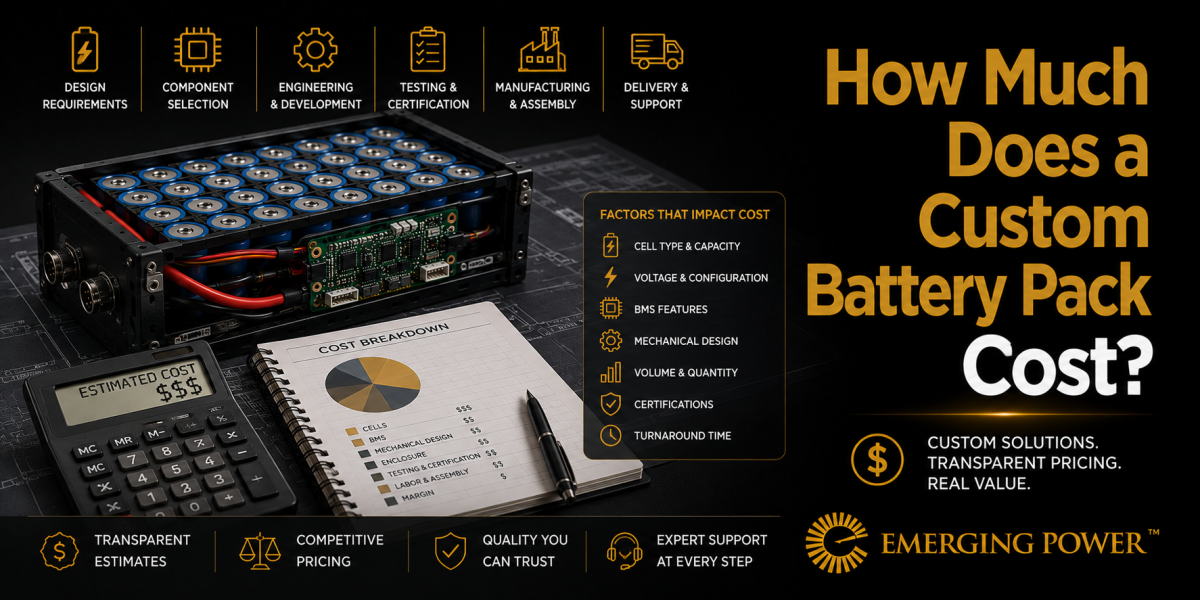
How Much Does a Custom Battery Pack Cost?
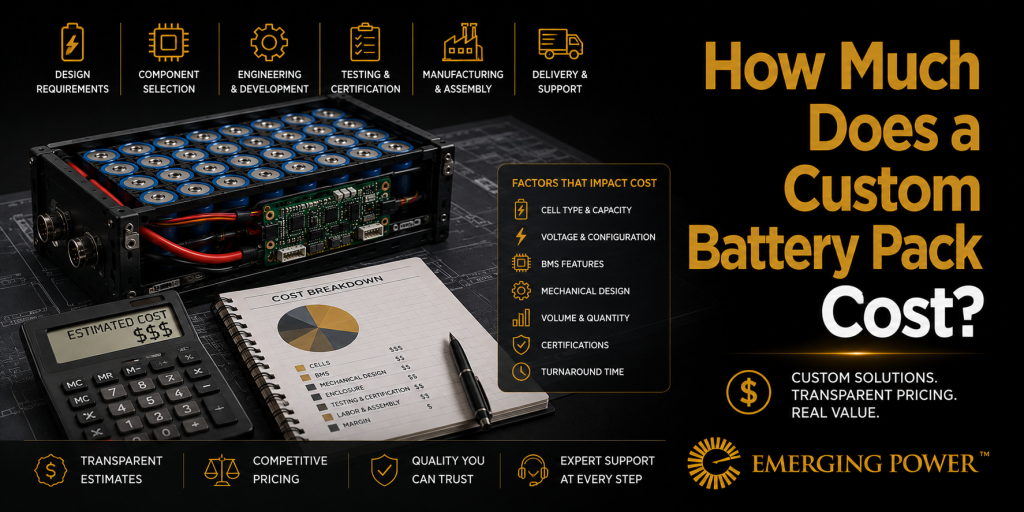
There is no single price for a custom battery pack. Custom battery pack cost depends on the cells, pack configuration, BMS and electronics, enclosure, engineering, tooling, prototypes, testing, certification requirements, and production volume. For OEM projects, it is important to separate one-time development expenses from recurring per-unit production costs.
A simple battery assembly using an established design may require relatively little customization. A battery for a medical device, industrial system, drone, communications product, or defense application may require custom electronics, mechanical engineering, software, testing, and regulatory work.
That is why asking, “How much does a custom battery cost?” without defining the application is a little like asking how much it costs to manufacture a product without having its specifications.
The better question is: What requirements are driving the cost of my battery pack?
How Is a Custom Battery Pack Price Calculated?
A custom battery quote typically combines one-time development costs, recurring unit costs, and applicable testing or certification expenses.
Development expenses can include engineering, BMS or PCB development, mechanical design, prototypes, tooling, and test development. Recurring production expenses typically include battery cells, electronics, enclosure components, connectors, assembly, production testing, and packaging.
Because each application changes these inputs, an accurate custom battery pack price normally requires a project-specific technical review.
Emerging Power’s battery design and production process includes technical review, preliminary design, engineering and development, first articles, customer testing, and production approval.
What Determines Custom Battery Pack Cost?
A custom battery pack is more than a group of cells. Its total cost reflects the electrical, mechanical, safety, performance, and production requirements of the finished system.
Here are the major cost drivers.
1. Cell Chemistry and Cell Selection
Cells are one of the most important recurring costs in a battery pack.
The appropriate chemistry depends on requirements such as energy density, discharge rate, operating temperature, expected cycle life, physical dimensions, and safety.
For applications requiring higher voltage, current, or energy density, Emerging Power develops custom lithium-ion battery packs around the requirements of the end product.
Higher-performance or specialized cells can affect both material costs and engineering requirements, so cell selection should be evaluated as part of the complete system rather than simply by comparing individual cell prices.
2. Battery Capacity, Voltage and Pack Configuration
A battery requiring more energy generally needs more cells or higher-capacity cells, but cost is not determined by capacity alone.
Voltage, peak current, continuous current, series/parallel configuration, runtime, charging requirements, and thermal behavior can all influence the design.
A compact high-discharge pack for a drone, for example, can present different engineering challenges from a battery designed for a lower-power industrial instrument.
Emerging Power’s custom battery pack design checklist explains why requirements such as voltage, capacity, load profile, temperature range, size, and expected product life should be defined early in the development process.
3. BMS and Electronics
For many rechargeable custom packs, the Battery Management System (BMS) is an important part of both safety and cost.
Depending on the application, electronics may need to manage:
- Overcharge and over-discharge protection
- Overcurrent protection
- Temperature monitoring
- Cell balancing
- State-of-charge information
- Communication with the host device
- Charging behavior
A basic protection circuit is very different from a sophisticated BMS with communications and custom programming.
Emerging Power’s custom battery design services can include BMS and PCB development, charging circuits, automated testing, and other engineering requirements based on the application.
4. Mechanical Design and Enclosure
The battery must physically fit and operate safely inside the end product.
A project may therefore require a custom enclosure, connectors, wiring, mounting features, insulation, seals, or mechanical protection.
Environmental requirements can increase complexity further. A battery used in a rugged industrial product or UAV may face vibration, temperature, shock, weight, or space constraints that a standard commercial battery does not.
For applications where size, weight, discharge performance, and environmental conditions are particularly important, reviewing the requirements for custom drone and UAV battery packs provides a useful example of how application requirements influence battery design.
Mechanical decisions should therefore be made alongside electrical design rather than after the battery architecture has already been finalized.
5. Engineering and NRE
One of the most misunderstood parts of custom battery pack pricing is non-recurring engineering, or NRE.
NRE covers development work required to create the battery rather than manufacture every production unit.
Depending on the project, this can include electrical engineering, mechanical design, PCB/BMS development, software, documentation, test development, and design revisions.
Emerging Power’s project management process separates considerations such as NRE, tooling, regulatory testing, and battery-pack production pricing during development.
For OEM buyers, these expenses should be evaluated separately from unit price.
6. Prototypes and First Articles
A custom battery generally should not move directly from a drawing into high-volume production.
Prototype and first-article builds allow the manufacturer and OEM to validate:
fit → electrical performance → thermal behavior → charging → communication → integration with the finished product
Emerging Power’s battery development process includes first-article battery packs for customer testing and approval before the project proceeds toward production.
Additional design iterations can increase development cost, but identifying an issue before mass production may prevent significantly more expensive rework later.
7. Testing and Certification
Testing can represent a meaningful portion of the initial project budget.
Requirements depend on the chemistry, application, destination markets, and transportation method.
For lithium cells and batteries, UN 38.3 is an important transportation-testing consideration. The UN Manual of Tests and Criteria contains the relevant lithium cell and battery testing provisions in subsection 38.3. UNECE
OEM teams evaluating lithium battery transportation requirements can consult the UNECE Manual of Tests and Criteria as a primary reference.
Depending on the application, other product-specific safety, transportation, or regulatory requirements may also apply.
Planning these requirements early is important because changing cells, configuration, or other major design elements later can lead to additional validation work.
8. Tooling
Custom mechanical components can require dedicated tooling.
Examples may include molded housings, fixtures, test equipment, and manufacturing aids.
Tooling is generally an upfront expense rather than something that should be interpreted entirely as part of the recurring battery unit cost.
This distinction becomes particularly important when comparing quotations from different battery manufacturers.
9. Production Volume
Volume can significantly affect battery pack manufacturing cost per unit.
Development, tooling, procurement, and manufacturing setup costs can be distributed across more units as production increases. Component purchasing and manufacturing processes may also become more efficient at higher volumes.
However, buyers should not evaluate a supplier solely on the lowest projected high-volume price.
Ask what pricing looks like across:
Prototype → Pilot → Initial Production → Forecast Production Volume
That provides a more realistic picture of total program economics.
One-Time Cost vs. Per-Unit Battery Cost
OEMs can make custom battery quotations easier to compare by separating costs into two categories.
One-Time / Development Costs | Recurring Production Costs |
Engineering / NRE | Battery cells |
BMS/PCB development | PCB/BMS components |
Mechanical design | Enclosure and connectors |
Tooling | Wiring and assembly |
Prototype development | Production testing |
Regulatory testing | Packaging |
Test-system development | Manufacturing labor |
A quote that appears expensive upfront may have lower production costs, while a low development quote may exclude tooling, certification, or engineering that will eventually be required.
Compare the total project scope, not simply the battery’s unit price.
How Can OEMs Control Custom Battery Pack Costs?
The most effective cost reductions often happen before production.
Start with clear electrical, mechanical, and environmental requirements. Avoid specifying performance the application does not actually need. Consider available cell formats before designing the final enclosure, and identify testing and certification requirements early.
Most importantly, treat the battery as part of the product architecture rather than a component added near the end of product development.
Following a structured custom battery pack design process can help OEM teams define critical requirements before engineering progresses too far.
Emerging Power’s development workflow begins with technical documentation and project requirements before moving into preliminary design, engineering, first articles, testing, and production.
That approach can help reduce unnecessary redesign later.
What Information Is Needed for an Accurate Battery Pack Quote?
If you are requesting custom battery pack pricing, prepare as much of the following information as possible:
- Required voltage and capacity
- Continuous and peak current
- Desired runtime
- Maximum dimensions and weight
- Rechargeable or primary battery
- Operating temperature range
- Charging requirements
- Connector requirements
- Communication requirements
- Environmental conditions
- Required certifications or testing
- Prototype quantity
- Expected annual production volume
You do not necessarily need to know the exact cell or BMS architecture. An experienced battery engineering team can help translate product requirements into a practical battery design.
Once these requirements are defined, OEM teams can request a custom battery pack quote based on the actual application rather than relying on a generic per-pack estimate.
Frequently Asked Questions
How much does a custom battery pack cost?
There is no universal price. Custom battery pack cost depends on cell chemistry and quantity, voltage and capacity, BMS complexity, enclosure design, engineering, tooling, prototypes, testing, certification requirements, and production volume. OEMs should request a project-specific quotation rather than rely on a generic price estimate.
Why are custom battery packs more expensive than standard batteries?
A custom battery may require electrical engineering, electronics, mechanical design, prototypes, specialized components, testing, and tooling that an existing standard battery does not require. These development requirements contribute to the total cost of the program.
Does a BMS increase battery pack cost?
Yes. A BMS adds electronics and potentially engineering and software requirements to the battery system. The cost impact depends on functions such as protection, cell balancing, temperature monitoring, communications, state-of-charge reporting, and custom programming.
Does ordering more battery packs reduce the unit cost?
Higher production volumes can sometimes reduce per-unit manufacturing costs because setup and other fixed expenses are distributed across more units, while component procurement and manufacturing may become more efficient. Actual pricing depends on the design, materials, forecast, and production requirements.
What information does a manufacturer need to quote a custom battery?
A battery manufacturer will typically need voltage, capacity, load profile, physical dimensions, operating environment, charging requirements, connectors, communications requirements, required testing or certifications, prototype quantity, and expected production volume.
The Bottom Line
Custom battery pack cost is determined by the complete system, not the cells alone.
Cell chemistry, BMS complexity, enclosure design, engineering, tooling, prototypes, testing, and production volume all contribute to total program cost.
For OEMs, the most useful quotation separates one-time development expenses from recurring production costs and clearly defines the engineering, testing, tooling, and manufacturing services included.
Emerging Power supports OEM battery projects through its custom battery design and development capabilities, from defining technical requirements through development and production.
Need Pricing for a Custom Battery Pack?
Request a custom battery pack quote to discuss voltage, capacity, form factor, operating environment, testing requirements, and anticipated production volume.