
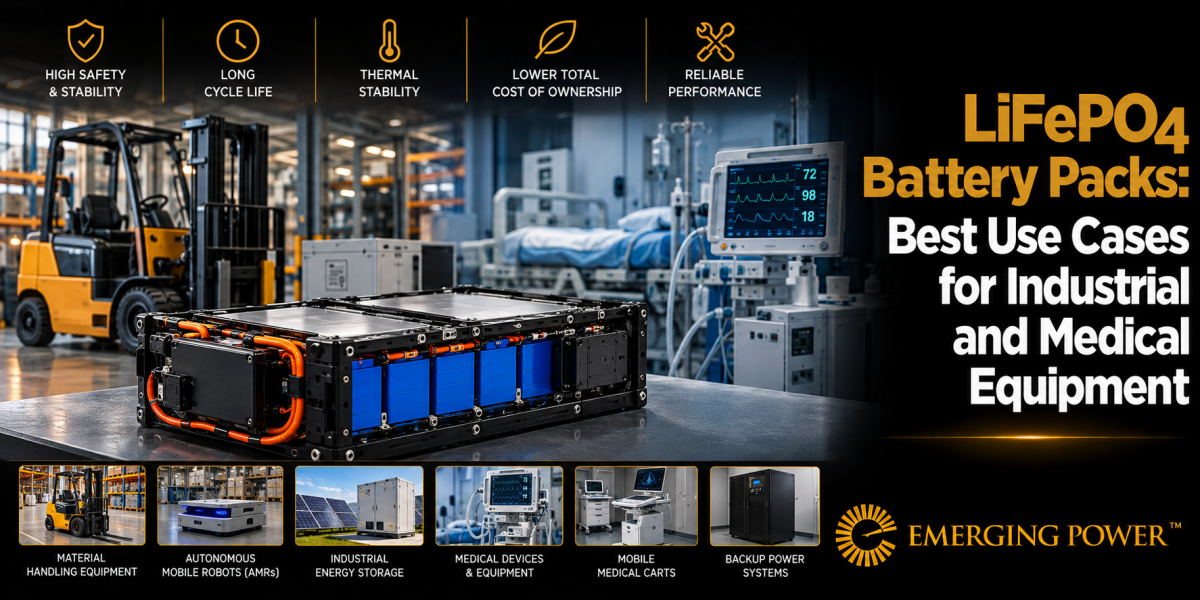
LiFePO4 Battery Packs: Best Use Cases for Industrial and Medical Equipment

LiFePO4 battery packs, also called lithium iron phosphate or LFP battery packs, are often a strong choice when an OEM needs long cycle life

LiFePO4 Battery Packs for Industrial & Medical Equipment
LiFePO4 battery packs for industrial and medical equipment

LiFePO4 battery packs, also called lithium iron phosphate or LFP battery packs, are often a strong choice when an OEM needs long cycle life, stable power delivery, and a chemistry that prioritizes thermal stability over maximum energy density. For industrial and medical equipment, that balance can be more important than simply fitting the greatest possible watt-hours into the smallest space.

What Is a LiFePO4 Battery Pack?

A LiFePO4 battery pack is a rechargeable lithium-ion battery system that uses lithium iron phosphate as the cathode material. Compared with several other lithium-ion chemistries, LFP generally trades some energy density for strong cycle-life potential, good power capability, and favorable thermal-stability characteristics.

The U.S. Department of Energy describes LFP as one of the major lithium-ion cathode classes and notes differences among lithium-ion chemistries in energy, lifecycle, and safety characteristics. See the DOE lithium-ion technology assessment.

At Emerging Power, we design and manufacture custom LiFePO4 battery packs around the electrical, mechanical, environmental, and regulatory needs of the end product.

Why OEMs Consider LiFePO4 for Demanding Equipment

  • Long cycle-life potential for equipment that is charged and discharged frequently.
  • Strong power capability for loads that require dependable current delivery.
  • Thermal-stability characteristics that can be attractive in safety-focused designs.
  • Relatively flat discharge behavior that can support predictable equipment operation.
  • Availability in configurations suitable for custom pack design, monitoring, protection, and enclosure integration.

These characteristics do not make LFP automatically correct for every product. The finished pack still has to be evaluated for voltage, runtime, peak load, charging, operating temperature, dimensions, weight, safety controls, certification, and lifecycle.

Best Industrial Use Cases for LiFePO4 Battery Packs

1. Portable Industrial Instrumentation

Test instruments, inspection systems, portable analyzers, and field-service equipment often need repeatable daily cycling and dependable output. Where the design can accommodate LFP’s lower energy density relative to some other lithium-ion chemistries, its lifecycle and power characteristics can make it attractive.

2. Robotics and Automated Equipment

Robotics, automated guided equipment, mobile industrial platforms, and control systems can create variable loads with repeated charge-discharge cycles. A properly engineered LFP pack can be designed around the required current, duty cycle, communications, and protection needs.

3. Backup and Standby Power

Industrial controllers, communication hardware, and critical monitoring equipment may require rechargeable backup power. The decision should be based on expected standby duration, recharge strategy, required service life, and environmental conditions rather than chemistry name alone.

4. Equipment Exposed to Frequent Cycling

When a battery is expected to cycle repeatedly over the product’s operating life, cycle-life economics can matter more than the lowest initial battery cost. This is one situation in which LFP is often worth evaluating early.

Best Medical Use Cases for LiFePO4 Battery Packs

Medical battery selection requires a system-level view. The appropriate chemistry depends on whether equipment is portable, mobile, stationary, patient-connected, frequently cycled, used as backup power, or expected to operate under defined fault conditions.

Our medical battery pack capabilities include custom design, traceability, serialization, and automated testing for OEM medical applications.

  • Portable analyzers and diagnostic instruments where long service life and predictable output are priorities.
  • Medical carts and mobile clinical equipment that undergo frequent daily charging.
  • Monitoring equipment that needs rechargeable backup power.
  • Healthcare devices where the pack can accommodate LFP’s size and energy-density trade-offs.
  • Medical systems that require custom electronics, protection, traceability, or end-of-line testing.

For portable rechargeable lithium systems used in medical devices, the FDA currently recognizes IEC 62133-2 as a consensus standard. Applicable standards still depend on the finished medical device and its intended use.

LiFePO4 vs. Other Lithium-Ion Chemistries

Design Factor

LiFePO4 / LFP

Higher-energy Li-ion chemistries

Energy density

Typically lower

Often higher

Cycle-life potential

Often a key strength

Varies by chemistry and use

Power capability

Can be strong

Varies widely

Thermal stability

Often a key reason to evaluate LFP

Chemistry dependent

Best fit

Long-life, power, safety-conscious designs

Space- and weight-constrained high-energy designs

The right comparison is not ‘Which chemistry is best?’ It is ‘Which chemistry best matches the product’s load profile, runtime target, environment, dimensions, safety requirements, and lifecycle?’

What Engineers Should Specify Before Choosing LFP

  1. Nominal and maximum pack voltage.
  2. Required usable energy and target runtime.
  3. Peak and continuous current.
  4. Charge time and charging method.
  5. Expected cycle life and calendar life.
  6. Operating and storage temperature range.
  7. Available pack dimensions and weight limit.
  8. Required BMS, fuel-gauge, communications, and protection functions.
  9. Mechanical shock, vibration, ingress, and enclosure requirements.
  10. Applicable medical, industrial, safety, and transportation standards.

Do LiFePO4 Packs Still Need a BMS?

Yes, many rechargeable LFP systems require battery management and protection functions. Depending on the pack, these may include overcharge protection, over-discharge protection, overcurrent protection, temperature monitoring, cell balancing, state-of-charge estimation, and communication with the host device.

Our custom battery design process can integrate BMS electronics, charging support, enclosures, automated testing, and regulatory support as required.

Frequently Asked Questions

Are LiFePO4 batteries good for medical equipment?

They can be. LiFePO4 is worth evaluating when cycle life, power capability, thermal stability, and repeated charging are important. The final choice must still be based on the medical device’s specific electrical, mechanical, safety, and regulatory requirements.

Are LiFePO4 batteries safer than lithium-ion batteries?

LiFePO4 is itself a lithium-ion chemistry. It offers better thermal stability than several other cathode chemistries, but pack safety still depends on cell quality, electrical protection, charging, mechanical design, manufacturing controls, and the finished application.

What is the main disadvantage of LiFePO4?

A common trade-off is lower energy density than some other lithium-ion chemistries. That can matter when the product has strict size or weight limits.

Can LiFePO4 batteries be used in industrial equipment?

Yes. Common applications include instrumentation, automation, robotics, backup power, communications, and other equipment that requires frequent cycling or dependable power.

Build the Battery Around the Equipment

For industrial and medical OEMs, choosing LiFePO4 should be a requirements-driven engineering decision. We review the load profile, runtime, temperature, physical constraints, protection needs, lifecycle targets, testing, and compliance requirements before recommending a chemistry and pack architecture.

If you are evaluating LFP for a new or existing product, request a quote and share your electrical and mechanical requirements with our team.
High-Performance Batteries: Energy Density vs. Power Density

Learn how energy density and power density affect high performance batteries, runtime, output, size, thermal demands, and custom battery pack design.

High-Performance Batteries Explained: Energy Density vs. Power Density

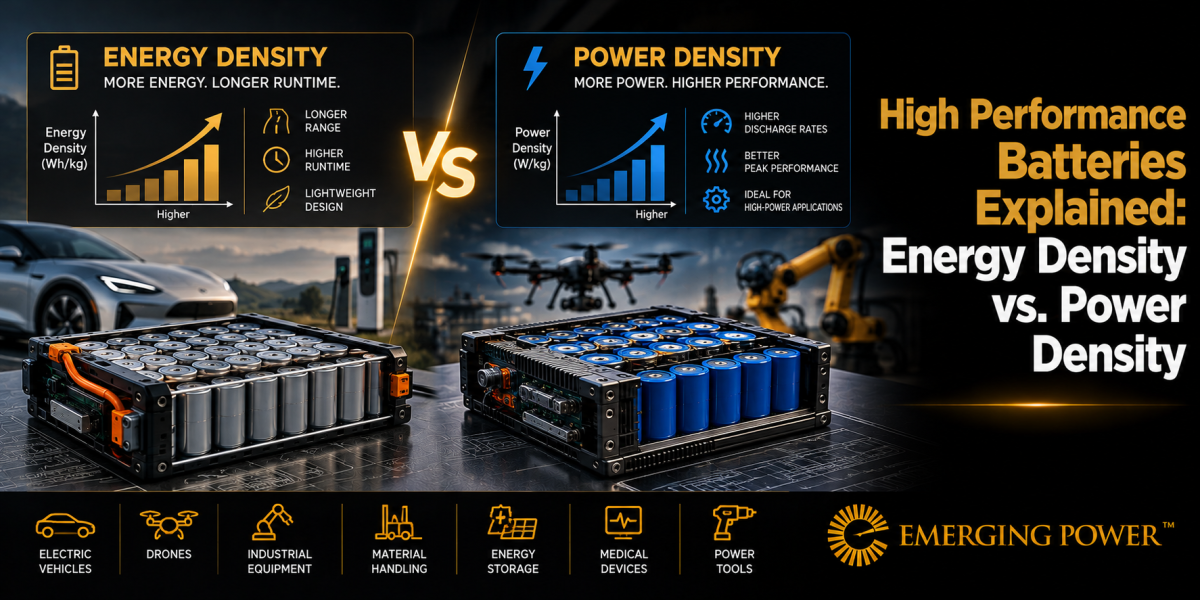
High-performance batteries showing energy density vs power density

When engineers evaluate high performance batteries, capacity is only one part of the equation.

Two batteries can have similar physical dimensions or stored energy but perform very differently once they are integrated into an application. One may be optimized to operate for a long time between charges, while another may be designed to deliver a large amount of power within seconds.

This difference often comes down to two important battery performance metrics: energy density and power density.

Understanding the difference between them can help OEMs make better decisions about cell chemistry, battery size, discharge requirements, thermal management, and overall battery pack design.

What Is a High-Performance Battery?

A high performance battery is not simply a battery with the highest capacity or highest energy density.

Performance depends on what the application actually requires.

For one device, high performance may mean maximizing operating time while minimizing battery weight. For another, it may mean supplying a high current during startup or supporting repeated power pulses. Other applications may prioritize cycle life, temperature performance, reliability, packaging flexibility, or a combination of these requirements.

That is why battery selection should begin with the application rather than a single specification.

Through our custom battery design services, we evaluate electrical, mechanical, safety, and application requirements before developing a battery pack around the needs of the product.

What Is Battery Energy Density?

Energy density describes how much energy a battery can store relative to its mass or volume.

It is commonly expressed in two ways:

  • Gravimetric energy density or specific energy: watt-hours per kilogram (Wh/kg)
  • Volumetric energy density: watt-hours per liter (Wh/L)

Natural Resources Canada defines energy density as the amount of energy stored relative to battery mass or volume. It also notes that energy density generally decreases as the measurement moves from active materials to cells, modules, and complete packs because components such as enclosures and thermal-management systems add weight and volume without adding stored energy.

For product engineers, this distinction matters.

A cell-level energy-density figure should not automatically be treated as the energy density of the finished battery pack.

Why Does High Energy Density Matter?

Higher energy density can help an OEM achieve objectives such as:

  • Longer runtime without substantially increasing battery weight
  • More stored energy within a limited physical space
  • Smaller or lighter portable products
  • Greater design flexibility where battery volume is constrained

The U.S. Department of Energy explains that increasing volumetric energy density can allow an electric vehicle, for example, to travel farther without increasing battery-pack size or potentially achieve the same range with a smaller pack.

The same basic design principle applies beyond vehicles. Medical equipment, instrumentation, communications systems, tracking devices, portable electronics, and other battery-powered products can all face limitations on available weight or space.

We develop custom lithium-ion battery packs for applications where size, weight, voltage, current requirements, safety, and reliability need to be considered together.

What Is Battery Power Density?

If energy density describes how much energy is available, power density describes how rapidly that energy can be delivered.

Power density may be expressed as:

  • Watts per kilogram (W/kg)
  • Watts per liter (W/L)

Natural Resources Canada describes power density as a battery’s rate capability, or the flow of energy into or out of the battery during charging and discharging relative to mass or volume.

Power requirements also need context. Factors such as discharge rate, temperature, state of charge, pulse duration, and whether the specification refers to continuous or pulse power can affect battery performance.

Why Does High Power Density Matter?

Some applications have relatively stable electrical loads. Others may suddenly require much more current.

High power capability becomes particularly important when equipment must support:

  • High-current startup
  • Motors or actuators
  • Short power bursts
  • Rapid acceleration
  • High-load communications
  • Pulsed equipment
  • Other demanding electrical loads

In these cases, simply choosing a battery with high capacity does not guarantee that it can safely provide the required current.

Energy Density vs. Power Density: What Is the Difference?

A simple way to understand the distinction is:

Energy density tells you how much energy the battery can carry. Power density tells you how quickly the battery can deliver it.

Metric

Energy Density

Power Density

Main question

How much energy can the battery store?

How quickly can the battery deliver energy?

Common units

Wh/kg or Wh/L

W/kg or W/L

Major design consideration

Runtime, size and weight

Current output and load demand

Important for

Long-duration operation

High-load or pulse operation

Higher value generally supports

More energy in less mass or volume

Greater power delivery relative to mass or volume

Both measurements are important, but neither should be evaluated independently from the application.

High Energy Battery vs. High Power Battery

Consider two hypothetical products.

Product A is a portable monitoring device expected to operate for long periods between charges. Its current demand is relatively modest.

Its design may prioritize:

high energy density → more stored energy → longer potential runtime

Now consider Product B, which contains a motor that creates a substantial temporary load during startup.

Its battery may need to prioritize:

high power capability → greater current delivery → better support for peak loads

Selecting a high-energy cell without verifying its discharge capability could result in poor performance in Product B. Likewise, optimizing Product A exclusively for high power could sacrifice energy capacity that would have been more valuable for its actual duty cycle.

This is why battery engineering is fundamentally an optimization problem rather than a search for the battery with the largest specification number.

Can a Battery Have Both High Energy and High Power Density?

Battery technology can provide combinations of strong energy and power performance, but engineering trade-offs remain.

Cell chemistry, electrode design, internal resistance, physical construction, thermal conditions, discharge rate, battery management, and other factors can influence how a battery performs.

Within lithium-ion chemistry, different formulations can favor different performance characteristics. Lithium cobalt oxide can provide high energy density, while lithium iron phosphate is often selected where discharge capability, cycle life, and thermal stability are important.

This makes chemistry selection an application-specific engineering decision rather than a universal ranking of one chemistry as “best.”

For a deeper technical discussion of this trade-off, see our guide to energy density vs. power density in battery pack design.

Why Cell-Level Specifications Are Not Enough

A common battery-selection mistake is comparing cells solely through datasheet specifications.

An OEM ultimately uses a battery system, not an isolated cell.

The completed pack may also include:

  • Battery management system
  • Protection electronics
  • Wiring and interconnects
  • Connectors
  • Mechanical enclosure
  • Insulation
  • Thermal-management components
  • Fuel-gauge electronics
  • Charging controls

These components affect the final pack’s mass, volume, electrical performance, safety, and reliability.

That is one reason we evaluate pack-level performance separately from cell-level performance when developing a custom solution.

How Battery Management Affects High Performance Applications

High performance batteries also need appropriate control and protection.

A battery management system may monitor or manage factors such as cell voltage, current, temperature, charging, discharge limits, state of charge, and cell balancing depending on the battery design.

This becomes particularly important as electrical and thermal demands increase.

Our smart battery design capabilities include protection circuits, fuel gauges, charger-control PCBAs, and battery management systems.

The objective is not simply to select a high-performance cell. We look at the entire battery pack as an integrated system.

Temperature Matters Too

Battery performance figures should not be evaluated without considering operating conditions.

Temperature can affect electrochemical reaction rates and battery performance. A battery that meets a power requirement under controlled laboratory conditions may behave differently when used in an application exposed to very low or high temperatures.

OEM requirements should therefore identify the expected operating environment early in the development process.

This can influence cell selection, enclosure design, thermal management, BMS parameters, testing, and potentially the physical size of the finished battery.

How Should OEMs Choose Between Energy and Power?

Instead of beginning with “What battery has the highest energy density?”, engineering teams should define what the finished product needs the battery to do.

Important questions include:

  1. How much energy does the product consume during a typical operating cycle?
  2. What runtime is required?
  3. What is the average electrical load?
  4. What is the maximum continuous load?
  5. Are there short-duration peak loads?
  6. How much space is available for the battery?
  7. What is the maximum acceptable battery weight?
  8. What temperatures will the product encounter?
  9. What charging time is acceptable?
  10. What cycle-life expectations does the product have?
  11. What safety or regulatory requirements apply?
  12. Does the application require a custom BMS, enclosure, connector, or communication system?

Once these requirements are defined, engineers can evaluate energy density and power density in the context of the entire system.

Our broader battery engineering and manufacturing capabilities support multiple battery chemistries and applications, including lithium-ion, lithium-polymer, lithium iron phosphate, lithium primary, and nickel-metal hydride solutions.

Energy Density and Power Density Are Only Part of Battery Performance

A high performance battery should not be evaluated using one metric.

Energy density and power density need to be considered alongside:

  • Safety
  • Cycle life
  • Calendar life
  • Operating temperature
  • Charging characteristics
  • Internal resistance
  • Mechanical requirements
  • Battery management
  • Reliability
  • Manufacturing consistency
  • Regulatory requirements
  • Cost and supply availability

A battery with exceptional energy density but inadequate discharge capability may be wrong for a high-load device.

A battery with exceptional power capability but insufficient energy storage may require an unnecessarily large pack to achieve the required runtime.

The appropriate battery is the one that achieves the right balance for the actual product.

Frequently Asked Questions

What is energy density in a battery?

Battery energy density describes how much energy a battery stores relative to its mass or volume. Gravimetric energy density is typically expressed in Wh/kg, while volumetric energy density is typically expressed in Wh/L.

What is power density in a battery?

Power density describes how rapidly a battery can deliver energy relative to its mass or volume. It is commonly expressed in W/kg or W/L.

Is higher energy density always better?

No. Higher energy density can be valuable when runtime, weight, or available space is important, but battery selection also needs to account for power requirements, temperature, safety, cycle life, charging, physical design, and other application requirements.

What is the difference between energy density and battery capacity?

Battery capacity describes the amount of electrical charge a battery can provide and is commonly stated in ampere-hours (Ah). Energy considers both capacity and voltage and is expressed in watt-hours (Wh). Energy density relates that stored energy to the battery’s mass or volume.

Does higher power density mean longer battery life?

Not necessarily. Power density describes how quickly energy can be delivered, while energy density is more closely associated with how much energy can be stored for a given mass or volume. Runtime depends on the battery’s usable energy and the application’s load profile.

Which battery chemistry is best for high performance applications?

There is no single best chemistry for every high-performance application. The appropriate chemistry depends on required energy, power, cycle life, operating temperature, size, weight, safety requirements, charging characteristics, cost, and other design constraints.

Build the Battery Around the Application

For OEM product development, the question should not be whether energy density or power density is more important in general.

The better question is:

What combination of energy, power, size, weight, safety, runtime, and lifecycle does this specific product require?

Answering that question early can help engineering teams make better decisions about cell chemistry, pack architecture, electronics, thermal requirements, mechanical design, and testing.

At Emerging Power, we work with OEMs to develop custom battery solutions around specific electrical and mechanical requirements, from initial technical review and battery design through prototyping, testing, and manufacturing.

Request a quote to discuss your application’s energy, power, size, operating environment, and performance requirements.